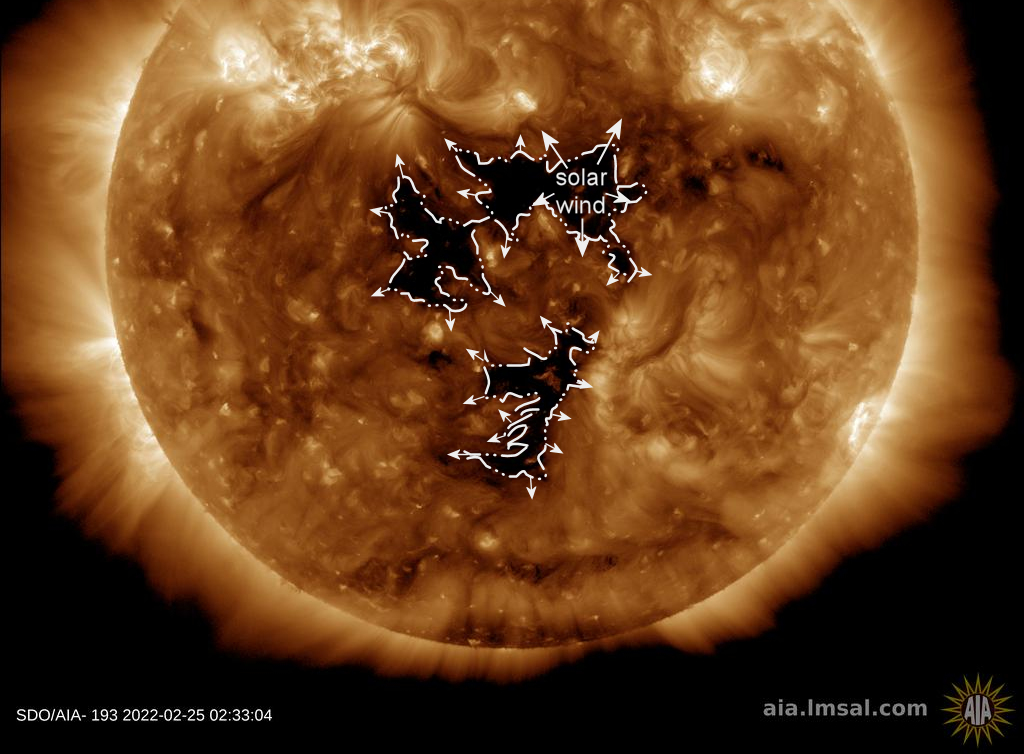
THE SOLAR WIND HAS ARRIVED: Earth is inside a stream of solar wind flowing from a loosely organized cluster of holes in the sun's atmosphere. Geomagnetic storms are not expected at this time. However, lesser geomagnetic unrest and bright auroras are possible inside the Arctic Circle.
Solar wind
speed: 490.1 km/sec
density: 7.0 protons/cm3
more data: ACE, DSCOVR
Updated: Today at 1422 UT
X-ray Solar Flares
6-hr max: C1 0939 UT Feb28
24-hr: C1 0939 UT Feb28
explanation | more data
Updated: Today at: 1435 UT
speed: 490.1 km/sec
density: 7.0 protons/cm3
more data: ACE, DSCOVR
Updated: Today at 1422 UT
X-ray Solar Flares
6-hr max: C1 0939 UT Feb28
24-hr: C1 0939 UT Feb28
explanation | more data
Updated: Today at: 1435 UT
Space Weather Today pinned «Solar wind speed: 490.1 km/sec density: 7.0 protons/cm3 more data: ACE, DSCOVR Updated: Today at 1422 UT X-ray Solar Flares 6-hr max: C1 0939 UT Feb28 24-hr: C1 0939 UT Feb28 explanation | more data Updated: Today at: 1435 UT»
SOLAR WIND STREAM APPROACHES EARTH: A stream of solar wind is approaching Earth. Estimated time of arrival: March 4th. The gaseous material is flowing from an equatorial hole in the sun's atmosphere, and it could spark minor geomagnetic storms when it arrives. #spaceweather #solar #wind
THE TERMINATION EVENT HAS ARRIVED: Something big just happened on the sun. Solar physicists Scott McIntosh (NCAR) and Bob Leamon (U. Maryland-Baltimore County) call it "The Termination Event."
"Old Solar Cycle 24 has finally died--it was terminated!" says McIntosh. "Now the new solar cycle, Solar Cycle 25, can really take off."
The "Termination Event" is a new idea in solar physics, outlined by McIntosh and Leamon in a December 2020 paper in the journal Solar Physics. Not everyone accepts it--yet. If Solar Cycle 25 unfolds as McIntosh and Leamon predict, the Termination Event will have to be taken seriously.
"Old Solar Cycle 24 has finally died--it was terminated!" says McIntosh. "Now the new solar cycle, Solar Cycle 25, can really take off."
The "Termination Event" is a new idea in solar physics, outlined by McIntosh and Leamon in a December 2020 paper in the journal Solar Physics. Not everyone accepts it--yet. If Solar Cycle 25 unfolds as McIntosh and Leamon predict, the Termination Event will have to be taken seriously.