Space Weather Today
1.42K subscribers
1.39K photos
10 videos
1.8K links
Download Telegram
Solar wind
speed: 384.2 km/sec
density: 5.6 protons/cm3
Updated: Today at 0916 UT

X-ray Solar Flares
6-hr max: B3 0555 UT Feb26
24-hr: C5 2140 UT Feb25
Updated: Today at: 0920 UT
Daily Sun: 26 Feb 22


These two sunspots have simple, stable magnetic fields that pose no threat for strong flares. Credit: SDO/HMI
Current Auroral Oval:

Planetary K-index
Now: Kp= 1 quiet
24-hr max: Kp= 2 quiet
explanation | more data

Interplanetary Mag. Field
Btotal: 3.6 nT
Bz: 3.0 nT north
more data: ACE, DSCOVR
Updated: Today at 0915 UT
Coronal Holes: 26 Feb 22


Solar wind flowing from this equatorial coronal hole could reach Earth on Feb. 28-March 1. Credit: SDO/AIA
SOLAR WIND, INCOMING: A stream of solar wind is approaching Earth. Estimated time of arrival: Feb. 28th. The gaseous material is flowing from an irregular hole in the sun's atmosphere, and could spark Arctic auroras when it reaches our planet.
Solar wind
speed: 462.5 km/sec
density: 12.2 protons/cm3
Updated: Today at 1105 UT

X-ray Solar Flares
6-hr max: C1 0626 UT Feb27
24-hr: C1 0626 UT Feb27
Updated: Today at: 1110 UT
๐Ÿ‘1
Daily Sun: 27 Feb 22

These two sunspots have simple, stable magnetic fields that pose no threat for strong flares. Credit: SDO/HMI
Current Auroral Oval:

Planetary K-index
Now: Kp= 4 unsettled
24-hr max: Kp= 4 unsettled
explanation | more data

Interplanetary Mag. Field
Btotal: 10.5 nT
Bz: 9.8 nT north
more data: ACE, DSCOVR
Updated: Today at 1105 UT
Coronal Holes: 27 Feb 22

Solar wind flowing from this equatorial coronal hole could reach Earth on Feb. 28-March 1. Credit: SDO/AIA
SOLAR WIND, INCOMING: A stream of solar wind is approaching Earth. Estimated time of arrival: Feb. 28-Mar. 1. The gaseous material is flowing from an irregular hole in the sun's atmosphere, and could spark Arctic auroras when it reaches our planet.
Thank you for 400 subscribers! ๐Ÿ™๐Ÿคฉ

https://t.me/SpaceWeatherToday
๐Ÿ‘6๐Ÿฅฐ2๐Ÿ‘1
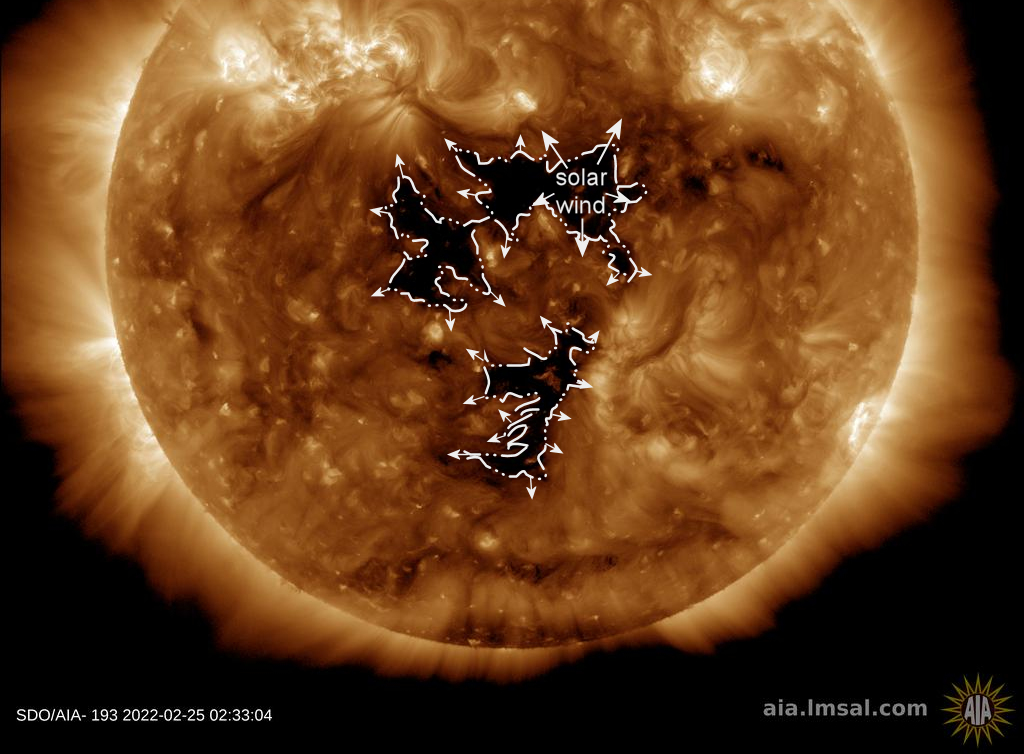
THE SOLAR WIND HAS ARRIVED: Earth is inside a stream of solar wind flowing from a loosely organized cluster of holes in the sun's atmosphere. Geomagnetic storms are not expected at this time. However, lesser geomagnetic unrest and bright auroras are possible inside the Arctic Circle.
Solar wind
speed: 490.1 km/sec
density: 7.0 protons/cm3
more data: ACE, DSCOVR
Updated: Today at 1422 UT

X-ray Solar Flares
6-hr max: C1 0939 UT Feb28
24-hr: C1 0939 UT Feb28
explanation | more data
Updated: Today at: 1435 UT
Space Weather Today pinned ยซSolar wind speed: 490.1 km/sec density: 7.0 protons/cm3 more data: ACE, DSCOVR Updated: Today at 1422 UT X-ray Solar Flares 6-hr max: C1 0939 UT Feb28 24-hr: C1 0939 UT Feb28 explanation | more data Updated: Today at: 1435 UTยป
Solar wind
speed: 537.2 km/sec
density: 8.1 protons/cm3
Updated: Today at 0736 UT

X-ray Solar Flares
6-hr max: B3 0608 UT Mar01
24-hr: C1 0939 UT Feb28
Updated: Today at: 0740 UT
Daily Sun: 01 Mar 22


All of these sunspots have simple, stable magnetic fields that pose no threat for strong flares. This situation could soon change, however, because AR2956, 57 and 58 are growing rapidly. Credit: SDO/HMI
Current Auroral Oval:

Planetary K-index
Now: Kp= 2 quiet
24-hr max: Kp= 2 quiet
explanation | more data

Interplanetary Mag. Field
Btotal: 5.4 nT
Bz: -2.9 nT south
more data: ACE, DSCOVR
Updated: Today at 0735 UT
Coronal Holes: 01 Mar 22


Solar wind flowing from this equatorial coronal hole could reach Earth on March 4th. Credit: SDO/AIA
SOLAR WIND STREAM APPROACHES EARTH: A stream of solar wind is approaching Earth. Estimated time of arrival: March 4th. The gaseous material is flowing from an equatorial hole in the sun's atmosphere, and it could spark minor geomagnetic storms when it arrives. #spaceweather #solar #wind