Space Weather Today
1.42K subscribers
1.39K photos
10 videos
1.8K links
Download Telegram
SUNSPOT NOT SO SCARY, AFTER ALL? Old sunspot AR2936 is back. It is now rotating into view over the sun's northeastern limb. Unless there is more of it hidden behind the edge of the sun, AR2936 is not as scary as we expected. Who would have guessed that a sunspot like this could produce a huge explosion like that? Perhaps the sun's rotation will reveal some additional menace later today. Stay tuned.
https://spaceweathergallery.com/full_image.php?image_name=Eduardo-Schaberger-Poupeau-New-Old-Sunspot-02-20-22_1645383447.jpg
👍2
Solar wind
speed: 469.6 km/sec
density: 6.8 protons/cm3
more data: ACE, DSCOVR
Updated: Today at 1040 UT

X-ray Solar Flares
6-hr max: B3 0817 UT Feb23
24-hr: B4 0244 UT Feb23
explanation | more data
Updated: Today at: 1045 UT
Daily Sun: 23 Feb 22
Expand: labels | no labels


These sunspots have simple, stable magnetic fields that pose no threat for strong flares. Credit: SDO/HMI
Current Auroral Oval:


Planetary K-index
Now: Kp= 2 quiet
24-hr max: Kp= 2 quiet
explanation | more data

Interplanetary Mag. Field
Btotal: 4.9 nT
Bz: -0.0 nT south
more data: ACE, DSCOVR
Updated: Today at 1040 UT
Coronal Holes: 23 Feb 22


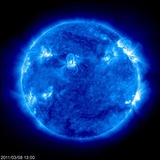
Solar wind flowing from this equatorial coronal hole could reach Earth on Feb. 28-March 1. Credit: SDO/AIA
ALMOST NO CHANCE OF FLARES: According to NOAA forecasters, the chance of a strong flare today is no more than 1%. Blame the simplicity of sunspots. All of the sunspots on the sun today have uncomplicated magnetic fields too stable to explode.
Solar wind
speed: 456.0 km/sec
density: 1.7 protons/cm3
more data: ACE, DSCOVR
Updated: Today at 1146 UT

X-ray Solar Flares
6-hr max: B1 0549 UT Feb24
24-hr: B9 0255 UT Feb24
explanation | more data
Updated: Today at: 1150 UT
Daily Sun: 24 Feb 22


These sunspots have simple, stable magnetic fields that pose no threat for strong flares. Credit: SDO/HMI
Current Auroral Oval:


Planetary K-index
Now: Kp= 2 quiet
24-hr max: Kp= 3 quiet
explanation | more data

Interplanetary Mag. Field
Btotal: 3.6 nT
Bz: 2.9 nT north
more data: ACE, DSCOVR
Updated: Today at 1145 UT
Coronal Holes: 24 Feb 22


Solar wind flowing from this equatorial coronal hole could reach Earth on Feb. 28-March 1. Credit: SDO/AIA
Solar wind
speed: 384.2 km/sec
density: 5.6 protons/cm3
Updated: Today at 0916 UT

X-ray Solar Flares
6-hr max: B3 0555 UT Feb26
24-hr: C5 2140 UT Feb25
Updated: Today at: 0920 UT