Space Weather Today pinned «Solar wind speed: 433.7 km/sec density: 11.8 protons/cm3 more data: ACE, DSCOVR Updated: Today at 2049 UT X-ray Solar Flares 6-hr max: C2 1550 UT Feb02 24-hr: C9 2236 UT Feb01 explanation | more data Updated: Today at: 2055 UT»
👀 CHANCE OF FLARES TODAY ☀️
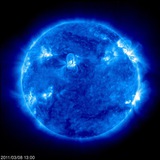
Sunspot AR2940 has a 'beta-gamma' magnetic field that harbors energy for strong M-class solar flares.
NOAA forecasters say there is a 25% chance of such an eruption during the next 24 hours.
The sunspot is almost directly facing Earth, so any flares will be geoeffective.
Sunspot AR2940 has a 'beta-gamma' magnetic field that harbors energy for strong M-class solar flares.
NOAA forecasters say there is a 25% chance of such an eruption during the next 24 hours.
The sunspot is almost directly facing Earth, so any flares will be geoeffective.
🤩2
Solar wind
speed: 458.2 km/sec
density: 5.0 protons/cm3
more data: ACE, DSCOVR
Updated: Today at 2030 UT
X-ray Solar Flares
6-hr max: C2 1700 UT Feb07
24-hr: C3 1239 UT Feb07
explanation | more data
Updated: Today at: 2035 UT
speed: 458.2 km/sec
density: 5.0 protons/cm3
more data: ACE, DSCOVR
Updated: Today at 2030 UT
X-ray Solar Flares
6-hr max: C2 1700 UT Feb07
24-hr: C3 1239 UT Feb07
explanation | more data
Updated: Today at: 2035 UT
GEOMAGNETIC STORM WATCH--UPDATE: A CME is going to hit Earth's magnetic field during the late hours of Feb. 9th, according to updated NOAA forecast models. The impact could spark G1-class geomagnetic storms. The CME was hurled in our direction yesterday by a long-duration solar flare (AR2939). The explosion peaked at category C3, which is considered to be weak. However, the flare made up for its low amplitude by lasting for more than 3 hours; it put more power into the CME than its feeble C3 rating might suggest.

🔥2