Space Weather Today
1.42K subscribers
1.39K photos
10 videos
1.8K links
Download Telegram
Solar wind
speed: 433.3 km/sec
density: 6.1 protons/cm3
more data: ACE, DSCOVR
Updated: Today at 1452 UT

X-ray Solar Flares
6-hr max: B2 1022 UT Jan22
24-hr: B6 0708 UT Jan22
explanation | more data
Updated: Today at: 1455 UT
Daily Sun: 21 Jan 22
Expand: labels | no labels


Departing sunspot AR2929 poses a continued threat for M-class solar flares. Credit: SDO/HMI
Current Auroral Oval:

Planetary K-index
Now: Kp= 2 quiet
24-hr max: Kp= 3 quiet
explanation | more data

Interplanetary Mag. Field
Btotal: 4.2 nT
Bz: -2.0 nT south
more data: ACE, DSCOVR
Updated: Today at 1450 UT
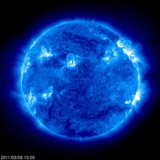
Coronal Holes: 21 Jan 22


Solar wind flowing from this coronal hole should reach Earth on Jan 25. Credit: SDO/AIA
Noctilucent Clouds The southern hemisphere season for noctilucent clouds has begun. NASA's AIM spacecraft detected the first electric-blue puffs over Antarctica on Dec. 14th.
(2018 CW2)
Upcoming Earth-asteroid encounters

https://ssd.jpl.nasa.gov/tools/sbdb_lookup.html#/?sstr=2018%20CW2

2022-Feb-18 2018 CW2
👍1
(2018 CW2)
Upcoming Earth-asteroid encounters

https://ssd.jpl.nasa.gov/tools/sbdb_lookup.html#/?sstr=2018%20CW2

2022-Feb-18 2018 CW2
GLANCING-BLOW CMEs: In recent days, the sun has produced multiple coronal mass ejections (CMEs). None of them is heading directly toward Earth; nevertheless, they might touch our planet.

Glancing blows are possible on Jan. 23rd, 24th, and 25th. The impacts, if they occur, are not expected to cause geomagnetic storms but could brighten auroras inside the Arctic Circle.
A SUNSET FROM TONGA? When the sun goes down tonight, take a look at the fading sky. If the twilight turns purple, you might have spotted a "Tonga sunset." Heiko Ulbricht photographed this example Jan. 21st in Großopitz, Germany.
Solar wind
speed: 312.1 km/sec
density: 11.1 protons/cm3
more data: ACE, DSCOVR
Updated: Today at 0734 UT

X-ray Solar Flares
6-hr max: C1 0237 UT Jan24
24-hr: C1 0237 UT Jan24
explanation | more data
Updated: Today at: 0810 UT
Daily Sun: 24 Jan 22


These two sunspots are stable and quiet. Credit: SDO/HMI
Current Auroral Oval:

Planetary K-index
Now: Kp= 0 quiet
24-hr max: Kp= 2 quiet
explanation | more data

Interplanetary Mag. Field
Btotal: 3.4 nT
Bz: 0.1 nT north
more data: ACE, DSCOVR
Updated: Today at 0734 UT
Coronal Holes: 24 Jan 22

Solar wind flowing from this coronal hole should reach Earth on Jan 25-26. Credit: SDO/AIA
FARSIDE SUNSPOTS: NASA's STEREO-A spacecraft is monitoring three ultraviolet hotspots on the farside of the sun. Because of their compact morphology, they are probably sunspots. The trio will rotate into view early this week, potentially bringing a sharp increase in sunspot number.
👍1
Solar wind
speed: 342.2 km/sec
density: 35.6 protons/cm3
more data: ACE, DSCOVR
Updated: Today at 0840 UT

X-ray Solar Flares
6-hr max: C2 0553 UT Jan25
24-hr: C2 0553 UT Jan25
explanation | more data
Updated: Today at: 0845 UT
Daily Sun: 25 Jan 22


A new sunspot is emerging at the circled location. Credit: SDO/HMI