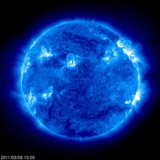
WEEKEND AURORA OUTLOOK: Updated modeling by NOAA forecasters suggests that only one CME will pass near Earth in the days ahead. A single glancing blow is expected on Jan. 22nd or 23rd when a CME from the Jan. 18th M1.5-class solar flare arrives. The impact could spark bright auroras inside the Arctic Circle.
(2018 CW2)
Upcoming Earth-asteroid encounters
https://ssd.jpl.nasa.gov/tools/sbdb_lookup.html#/?sstr=2018%20CW2
2022-Feb-18 2018 CW2
Upcoming Earth-asteroid encounters
https://ssd.jpl.nasa.gov/tools/sbdb_lookup.html#/?sstr=2018%20CW2
2022-Feb-18 2018 CW2
👍1
(2018 CW2)
Upcoming Earth-asteroid encounters
https://ssd.jpl.nasa.gov/tools/sbdb_lookup.html#/?sstr=2018%20CW2
2022-Feb-18 2018 CW2
Upcoming Earth-asteroid encounters
https://ssd.jpl.nasa.gov/tools/sbdb_lookup.html#/?sstr=2018%20CW2
2022-Feb-18 2018 CW2
GLANCING-BLOW CMEs: In recent days, the sun has produced multiple coronal mass ejections (CMEs). None of them is heading directly toward Earth; nevertheless, they might touch our planet.
Glancing blows are possible on Jan. 23rd, 24th, and 25th. The impacts, if they occur, are not expected to cause geomagnetic storms but could brighten auroras inside the Arctic Circle.
Glancing blows are possible on Jan. 23rd, 24th, and 25th. The impacts, if they occur, are not expected to cause geomagnetic storms but could brighten auroras inside the Arctic Circle.