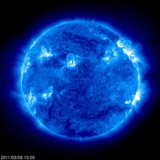
GEOMAGNETIC FORECAST: On Jan. 22nd, a coronal mass ejection (CME) will pass close to Earth and might deliver a glancing blow to our planet's magnetic field. Polar geomagnetic unrest is expected when the storm cloud arrives, bringing bright Arctic auroras.
BIG SOLAR FLARE: Sunspot AR2929 erupted again on Jan. 20th (0601 UT), producing a powerful M5.5-class solar flare. NASA's Solar Dynamics Observatory recorded the extreme ultraviolet flash.
During the flare, a pulse of X-rays ionized the top of Earth's atmosphere, causing a shortwave radio blackout around the Indian Ocean: blackout map. Aviators, mariners, and ham radio operators in the area may have noticed unusual propagation effects at frequencies below 30 MHz.
The explosion probably produced a CME. Confirmation awaits fresh data from SOHO coronagraphs. Stay tuned.
During the flare, a pulse of X-rays ionized the top of Earth's atmosphere, causing a shortwave radio blackout around the Indian Ocean: blackout map. Aviators, mariners, and ham radio operators in the area may have noticed unusual propagation effects at frequencies below 30 MHz.
The explosion probably produced a CME. Confirmation awaits fresh data from SOHO coronagraphs. Stay tuned.
WEEKEND AURORA OUTLOOK: Updated modeling by NOAA forecasters suggests that only one CME will pass near Earth in the days ahead. A single glancing blow is expected on Jan. 22nd or 23rd when a CME from the Jan. 18th M1.5-class solar flare arrives. The impact could spark bright auroras inside the Arctic Circle.
(2018 CW2)
Upcoming Earth-asteroid encounters
https://ssd.jpl.nasa.gov/tools/sbdb_lookup.html#/?sstr=2018%20CW2
2022-Feb-18 2018 CW2
Upcoming Earth-asteroid encounters
https://ssd.jpl.nasa.gov/tools/sbdb_lookup.html#/?sstr=2018%20CW2
2022-Feb-18 2018 CW2
👍1
(2018 CW2)
Upcoming Earth-asteroid encounters
https://ssd.jpl.nasa.gov/tools/sbdb_lookup.html#/?sstr=2018%20CW2
2022-Feb-18 2018 CW2
Upcoming Earth-asteroid encounters
https://ssd.jpl.nasa.gov/tools/sbdb_lookup.html#/?sstr=2018%20CW2
2022-Feb-18 2018 CW2
GLANCING-BLOW CMEs: In recent days, the sun has produced multiple coronal mass ejections (CMEs). None of them is heading directly toward Earth; nevertheless, they might touch our planet.
Glancing blows are possible on Jan. 23rd, 24th, and 25th. The impacts, if they occur, are not expected to cause geomagnetic storms but could brighten auroras inside the Arctic Circle.
Glancing blows are possible on Jan. 23rd, 24th, and 25th. The impacts, if they occur, are not expected to cause geomagnetic storms but could brighten auroras inside the Arctic Circle.