Space Weather Today
1.42K subscribers
1.39K photos
10 videos
1.8K links
Download Telegram
Solar wind
speed: 582.6 km/sec
density: 1.3 protons/cm3
Updated: Today at 1725 UT

X-ray Solar Flares
6-hr max: C2 1727 UT Jan18
24-hr: C2 1727 UT Jan18
Updated: Today at: 1730 UT
Solar wind
speed: 590.3 km/sec
density: 6.8 protons/cm3
Updated: Today at 1756 UT

X-ray Solar Flares
6-hr max: B5 1643 UT Jan19
24-hr: M1 1759 UT Jan18
Updated: Today at: 1800 UT
Daily Sun: 19 Jan 22

Sunspot AR2929 poses a threat for M-class solar flares. Credit: SDO/HMI
Planetary K-index
Now: Kp= 3 quiet
24-hr max: Kp= 6 storm
explanation | more data

Interplanetary Mag. Field
Btotal: 3.2 nT
Bz: -0.7 nT south
more data: ACE, DSCOVR
Updated: Today at 1755 UT
Coronal Holes: 19 Jan 22

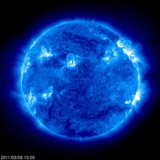
Earth is inside a stream of solar wind flowing from this southern coronal hole. Credit: SDO/AIA
CME UPDATE: Yesterday, Jan. 18th, an M1.5-class solar flare from sunspot AR2929 hurled a CME into space. NOAA forecasters have analyzed the storm cloud and determined that it probably has an Earth-directed component. A glancing blow is possible on Jan. 22-23, bringing minor geomagnetic storms and auroras to the Arctic Circle.
Solar wind
speed: 485.7 km/sec
density: 7.3 protons/cm3
Updated: Today at 0725 UT

X-ray Solar Flares
6-hr max: M5 0601 UT Jan20
24-hr: M5 0601 UT Jan20
Updated: Today at: 0820 UT
Daily Sun: 20 Jan 22

Sunspot AR2929 poses a continued threat for M-class solar flares. Credit: SDO/HMI
Planetary K-index
Now: Kp= 1 quiet
24-hr max: Kp= 3 quiet
explanation | more data

Interplanetary Mag. Field

Btotal: 5.4 nT
Bz: -0.0 nT south
more data: ACE, DSCOVR
Updated: Today at 0725 UT
Coronal Holes: 20 Jan 22

Solar wind flowing from this coronal hole should reach Earth on Jan 24-25. Credit: SDO/AIA
GEOMAGNETIC FORECAST: On Jan. 22nd, a coronal mass ejection (CME) will pass close to Earth and might deliver a glancing blow to our planet's magnetic field. Polar geomagnetic unrest is expected when the storm cloud arrives, bringing bright Arctic auroras.
BIG SOLAR FLARE: Sunspot AR2929 erupted again on Jan. 20th (0601 UT), producing a powerful M5.5-class solar flare. NASA's Solar Dynamics Observatory recorded the extreme ultraviolet flash.

During the flare, a pulse of X-rays ionized the top of Earth's atmosphere, causing a shortwave radio blackout around the Indian Ocean: blackout map. Aviators, mariners, and ham radio operators in the area may have noticed unusual propagation effects at frequencies below 30 MHz.

The explosion probably produced a CME. Confirmation awaits fresh data from SOHO coronagraphs. Stay tuned.
Solar wind
speed: 418.6 km/sec
density: 2.5 protons/cm3
more data: ACE, DSCOVR
Updated: Today at 1035 UT

X-ray Solar Flares
6-hr max: B5 0822 UT Jan21
24-hr: B9 0002 UT Jan21
explanation | more data
Updated: Today at: 1040 UT
Daily Sun: 21 Jan 22


Departing sunspot AR2929 poses a continued threat for M-class solar flares. Credit: SDO/HMI
Planetary K-index
Now: Kp= 1 quiet
24-hr max: Kp= 1 quiet
explanation | more data

Interplanetary Mag. Field
Btotal: 3.3 nT
Bz: 1.2 nT north
more data: ACE, DSCOVR
Updated: Today at 1036 UT
Coronal Holes: 21 Jan 22

Solar wind flowing from this coronal hole should reach Earth on Jan 25. Credit: SDO/AIA
WEEKEND AURORA OUTLOOK: Updated modeling by NOAA forecasters suggests that only one CME will pass near Earth in the days ahead. A single glancing blow is expected on Jan. 22nd or 23rd when a CME from the Jan. 18th M1.5-class solar flare arrives. The impact could spark bright auroras inside the Arctic Circle.
Solar wind
speed: 433.3 km/sec
density: 6.1 protons/cm3
more data: ACE, DSCOVR
Updated: Today at 1452 UT

X-ray Solar Flares
6-hr max: B2 1022 UT Jan22
24-hr: B6 0708 UT Jan22
explanation | more data
Updated: Today at: 1455 UT