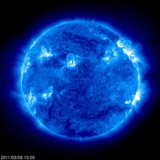
GLANCING-BLOW CME: As predicted, a CME brushed Earth's magnetic field during the late hours of Jan. 17th. The glancing blow sparked a minor G1-class geomagnetic storm. The CME was hurled into space on Jan. 14th by a C4-class solar flare (sunspot AR2925). Storm conditions are subsiding now and should continue to wane throughout Jan. 18th.
This media is not supported in your browser
VIEW IN TELEGRAM
VOLCANIC GRAVITY WAVES OVER HAWAII: The eruption of an undersea volcano near Tonga on Jan. 15th was even bigger than anyone thought. It nearly touched the edge of space. Hours after a mushroom cloud burst out of the Pacific Ocean, cameras at the Gemini Observatory on Mauna Kea recorded red waves rippling over Hawaii.
These are gravity waves, a type of atmospheric disturbance excited by intense thunderstorms and volcanic eruptions. Many gravity waves scud through the low atmosphere. The ripples caught by Gemini's Cloudcam, however, are in the mesosphere 85 km high--the realm of meteors, sprites, and noctilucent clouds.
Photographer Steve Cullen spotted the waves in online footage. "I had a hunch that Gemini Cloudcams might detect gravity waves produced by the eruption of Hunga Tonga-Hunga Ha'apai. So, I just took a look and there they were!"
These are gravity waves, a type of atmospheric disturbance excited by intense thunderstorms and volcanic eruptions. Many gravity waves scud through the low atmosphere. The ripples caught by Gemini's Cloudcam, however, are in the mesosphere 85 km high--the realm of meteors, sprites, and noctilucent clouds.
Photographer Steve Cullen spotted the waves in online footage. "I had a hunch that Gemini Cloudcams might detect gravity waves produced by the eruption of Hunga Tonga-Hunga Ha'apai. So, I just took a look and there they were!"
CME UPDATE: Yesterday, Jan. 18th, an M1.5-class solar flare from sunspot AR2929 hurled a CME into space. NOAA forecasters have analyzed the storm cloud and determined that it probably has an Earth-directed component. A glancing blow is possible on Jan. 22-23, bringing minor geomagnetic storms and auroras to the Arctic Circle.
GEOMAGNETIC FORECAST: On Jan. 22nd, a coronal mass ejection (CME) will pass close to Earth and might deliver a glancing blow to our planet's magnetic field. Polar geomagnetic unrest is expected when the storm cloud arrives, bringing bright Arctic auroras.
BIG SOLAR FLARE: Sunspot AR2929 erupted again on Jan. 20th (0601 UT), producing a powerful M5.5-class solar flare. NASA's Solar Dynamics Observatory recorded the extreme ultraviolet flash.
During the flare, a pulse of X-rays ionized the top of Earth's atmosphere, causing a shortwave radio blackout around the Indian Ocean: blackout map. Aviators, mariners, and ham radio operators in the area may have noticed unusual propagation effects at frequencies below 30 MHz.
The explosion probably produced a CME. Confirmation awaits fresh data from SOHO coronagraphs. Stay tuned.
During the flare, a pulse of X-rays ionized the top of Earth's atmosphere, causing a shortwave radio blackout around the Indian Ocean: blackout map. Aviators, mariners, and ham radio operators in the area may have noticed unusual propagation effects at frequencies below 30 MHz.
The explosion probably produced a CME. Confirmation awaits fresh data from SOHO coronagraphs. Stay tuned.