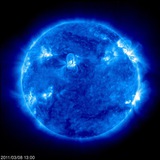
SUBSIDING GEOMAGNETIC STORM: A G1-class geomagnetic storm caused by the impact of a CIR on Jan. 8th (see above) is subsiding now. The storm is over. Arctic auroras remain possible as Earth enters a moderately fast stream of solar wind flowing behind the CIR.
FARSIDE SOLAR EXPLOSION: Something just exploded on the farside of the sun. Hidden from view, the blast hurled a magnificent CME over the northeastern edge of the solar disk. The bright light at the top of this SOHO coronagraph movie is Venus, which happened to be passing by the sun at the same time:
When the CME appeared, US Air Force antennas detected strong Type II and Type IV radio bursts. These are caused by shock waves inside the CME. Frequency drifts revealed the speed of the storm cloud, approximately 575 km/s or 1.3 million mph.
The source of this blast, probably an unstable sunspot, should turn toward Earth later this week.
When the CME appeared, US Air Force antennas detected strong Type II and Type IV radio bursts. These are caused by shock waves inside the CME. Frequency drifts revealed the speed of the storm cloud, approximately 575 km/s or 1.3 million mph.
The source of this blast, probably an unstable sunspot, should turn toward Earth later this week.
👍2
THE FORECAST CALLS FOR QUIET: Earth is in a void between solar wind streams. Quiet conditions are expected to prevail until the next stream arrives on Jan. 16th or 17th. This forecast could be upended by a solar flare. The sun is dotted with 3 numbered sunspot groups; unexpected explosions could occur at any time.
Solar wind
speed: 510.8 km/sec
density: 5.3 protons/cm3
more data: ACE, DSCOVR
Updated: Today at 1511 UT
X-ray Solar Flares
6-hr max: C2 1142 UT Jan13
24-hr: C2 1142 UT Jan13
explanation | more data
Updated: Today at: 1515 UT
speed: 510.8 km/sec
density: 5.3 protons/cm3
more data: ACE, DSCOVR
Updated: Today at 1511 UT
X-ray Solar Flares
6-hr max: C2 1142 UT Jan13
24-hr: C2 1142 UT Jan13
explanation | more data
Updated: Today at: 1515 UT
Space Weather Today pinned «Solar wind speed: 510.8 km/sec density: 5.3 protons/cm3 more data: ACE, DSCOVR Updated: Today at 1511 UT X-ray Solar Flares 6-hr max: C2 1142 UT Jan13 24-hr: C2 1142 UT Jan13 explanation | more data Updated: Today at: 1515 UT»