Space Weather Today
1.42K subscribers
1.39K photos
10 videos
1.8K links
Download Telegram
Planetary K-index
Now: Kp= 0 quiet
24-hr max: Kp= 2 quiet

Interplanetary Mag. Field
Btotal: 4.3 nT
Bz: 2.9 nT north
Updated: Today at 1335 UT
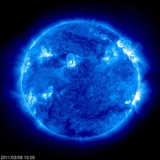
Coronal Holes: 06 Jan 22

Solar wind flowing from this southern coronal hole could graze Earth on Jan. 8-9. Credit: SDO/AIA
FAST-GROWING SUNSPOT: In the past few hours, new sunspot AR2924 has more than doubled in size. This movie from NASA's Solar Dynamics Observatory shows its rapid development. Solar flares may be in the offing if the growth continues apace.

https://www.spaceweather.com/images2022/06jan22/doubled.gif
Solar wind
speed: 309.2 km/sec
density: 3.5 protons/cm3
Updated: Today at 1341 UT

X-ray Solar Flares
6-hr max: C1 0813 UT Jan07
24-hr: C1 2246 UT Jan06
Updated: Today at: 1345 UT
Daily Sun: 07 Jan 22


Sunspot AR2924 has quadrupled in size during the past 48 hours and could soon pose a threat for Earth-directed solar flares. Credit: SDO/HMI
Planetary K-index
Now: Kp= 0 quiet
24-hr max: Kp= 1 quiet

Interplanetary Mag. Field
Btotal: 3.7 nT
Bz: 0.9 nT north
Updated: Today at 1340 UT
Coronal Holes: 07 Jan 22


Solar wind flowing from this southern coronal hole could graze Earth on Jan. 9th. Credit: SDO/AIA
FARSIDE SUNSPOTS: NASA's STEREO-A spacecraft is monitoring two ultraviolet hotspots just behind the sun's eastern limb.

These are potentially significant sunspot groups. The regions will rotate into view this weekend.
BIG SOUTHERN SUNSPOT: Two days ago, sunspot AR2924 was barely visible. Now it is a behemoth many times larger than Earth. Eduardo Schaberger Poupeau photographed the fast-growing active region today in Rafaela, Argentina.

So far, the sunspot has not produced any major flares. However, it is developing a mixed magnetic field in which "+" and "-" polarities are in close contact. The stage is set for explosive magnetic reconnection
โค3๐Ÿ‘1
Solar wind
speed: 308.5 km/sec
density: 20.3 protons/cm3
more data: ACE, DSCOVR
Updated: Today at 1550 UT

X-ray Solar Flares
6-hr max: B5 0959 UT Jan08
24-hr: C2 2210 UT Jan07
explanation | more data
Updated: Today at: 1555 UT
Space Weather Today pinned ยซSolar wind speed: 308.5 km/sec density: 20.3 protons/cm3 more data: ACE, DSCOVR Updated: Today at 1550 UT X-ray Solar Flares 6-hr max: B5 0959 UT Jan08 24-hr: C2 2210 UT Jan07 explanation | more data Updated: Today at: 1555 UTยป
Solar wind
speed: 367.3 km/sec
density: 48.5 protons/cm3
Updated: Today at 1855 UT

X-ray Solar Flares
6-hr max: B5 1401 UT Jan08
24-hr: C2 2210 UT Jan07
Updated: Today at: 1900 UT
Daily Sun: 08 Jan 22

Sunspot AR2924 has rapidly grown into one of the largest sunspots of young Solar Cycle 25. Any flares today will be Earth directed. Credit: SDO/HMI
Planetary K-index
Now: Kp= 2 quiet
24-hr max: Kp= 2 quiet

Interplanetary Mag. Field
Btotal: 15.0 nT
Bz: -8.9 nT south
Updated: Today at 1855 UT
Coronal Holes: 08 Jan 22

Solar wind flowing from this southern coronal hole could graze Earth on Jan. 9th. Credit: SDO/AIA
๐ŸŒŒARCTIC AURORA WATCH: Arctic auroras are likely on Jan. 9-10 when a minor stream of solar wind is expected to hit Earth. The gaseous material is flowing from a southern hole in the sun's atmosphere.
Solar wind
speed: 465.4 km/sec
density: 10.1 protons/cm3
Updated: Today at 1536 UT

X-ray Solar Flares
6-hr max: B3 1350 UT Jan09
24-hr: B7 0517 UT Jan09
Updated: Today at: 1540 UT
Daily Sun: 09 Jan 22

Sunspot AR2924 has rapidly grown into one of the largest sunspots of young Solar Cycle 25. Any flares today will be Earth directed. Credit: SDO/HMI
๐Ÿ‘1
Planetary K-index
Now: Kp= 2 quiet
24-hr max: Kp= 5 storm

Interplanetary Mag. Field
Btotal: 2.3 nT
Bz: 0.8 nT north
Updated: Today at 1536 UT
Coronal Holes: 09 Jan 22

Eath is inside a stream of solar wind flowing from this southern coronal hole. Credit: SDO/AIA
๐Ÿ‘2