Space Weather Today
1.42K subscribers
1.39K photos
10 videos
1.8K links
Download Telegram
Solar wind
speed: 538.2 km/sec
density: 12.5 protons/cm3
Updated: Today at 1511 UT

X-ray Solar Flares
6-hr max: C8 1044 UT Dec15
24-hr: C8 1044 UT Dec15
Updated: Today at: 1515 UT
Daily Sun: 15 Dec 21

Sunspot AR2907 is crackling with C-class solar flares. Credit: SDO/HMI
Planetary K-index
Now: Kp= 3 quiet
24-hr max: Kp= 3 quiet
| more data

Interplanetary Mag. Field
Btotal: 8.5 nT
Bz: 2.9 nT north
Updated: Today at 1510 UT
Coronal Holes: 15 Dec 21

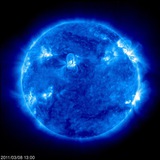
Solar wind flowing from this southern coronal hole could reach Earth on Dec. 16. Credit: SDO/AIA
Solar wind
speed: 498.7 km/sec
density: 7.5 protons/cm3
Updated: Today at 1515 UT

X-ray Solar Flares
6-hr max: C2 1341 UT Dec16
24-hr: C2 1341 UT Dec16
Updated: Today at: 1520 UT
Daily Sun: 16 Dec 21

Sunspot AR2907 is crackling with C-class solar flares. Credit: SDO/HMI
Planetary K-index
Now: Kp= 1 quiet
24-hr max: Kp= 3 quiet

Interplanetary Mag. Field
Btotal: 5.9 nT
Bz: 2.2 nT north
Updated: Today at 1515 UT
Coronal Holes: 16 Dec 21

Earth is inside a stream of solar wind flowing from this southern coronal hole. Credit: SDO/AIA
FAST-GROWING SUNSPOTS: Multiple large sunspots are growing near the sun's southeastern limb.The phalanx of dark cores is turning toward Earth, boosting the chances for an geoeffective eruption in the days ahead. NOAA forecasters estimate a 25% chance of M-class solar flares on Dec. 16th.
Solar wind
speed: 373.8 km/sec
density: 5.3 protons/cm3
Updated: Today at 1945 UT

X-ray Solar Flares
6-hr max: C1 1610 UT Dec17
24-hr: M1 0051 UT Dec17
Updated: Today at: 1950 UT
Daily Sun: 17 Dec 21

New sunspot AR2911 is very active and capable of M-class solar flares. Credit: SDO/HMI
Planetary K-index
Now: Kp= 1 quiet
24-hr max: Kp= 2 quiet

Interplanetary Mag. Field
Btotal: 2.3 nT
Bz: -0.4 nT south

Updated: Today at 1945 UT
Coronal Holes: 17 Dec 21

Solar wind flowing from this equatorial coronal hole could reach Earth on Dec. 21st. Credit: SDO/AIA
M-CLASS SOLAR FLARE:
New sunspot AR2911 unleashed an M1-class solar flare during the early hours of Dec. 17th (0051 UT). A pulse of extreme UV radiation and X-rays ionized the top of Earth's atmosphere, causing a shortwave radio blackout over the South Pacific. There are now at least three sunspots on the solar disk capable of producing flares of this magnitude.
Solar wind
speed: 355.5 km/sec
density: 6.3 protons/cm3
Updated: Today at 1955 UT

X-ray Solar Flares
6-hr max: C6 1801 UT Dec18
24-hr: C6 1801 UT Dec18
Updated: Today at: 2000 UT
Daily Sun: 18 Dec 21

Sunspots AR2907 and AR2908 have 'beta-gamma' magnetic fields that harbor energy for M-class solar flares. Credit: SDO/HMI
Planetary K-index
Now: Kp= 1 quiet
24-hr max: Kp= 1 quiet

Interplanetary Mag. Field
Btotal: 4.7 nT
Bz: 1.6 nT north

Updated: Today at 1955 UT
Coronal Holes: 18 Dec 21

Solar wind flowing from this equatorial coronal hole could reach Earth on Dec. 21-22. Credit: SDO/AIA
🔥CHANCE OF FLARES TODAY: NOAA forecasters say there is a 25% chance of M-class solar flares today. The likely source, sunspot complex AR2907-09, is almost directly facing Earth, which means any explosions would be geoeffective.