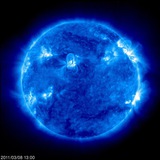
🌞 Daily Solar Activity Update - September 09, 2025 🌞
Hey space enthusiasts! Sunspots steady at 93 with AR4213's beta-gamma fields hinting at M-class potential—geomag calm after subtle grazes, cosmic rays dipping less deeply as a fresh coronal hole eyes mid-month winds.
Sunspot Number: 93 – AR4213 primed for M-flares.
Recent Flares: B9-class at 1220 UT today; C1-class max over 24 hours at 0323 UT today.
Flare Odds: 25% for M-class, 1% for X-class in both 0-24 and 24-48 hours. 💥
Geomagnetic Status: Quiet at Kp 2.67, with 24-hour max of 3.33.
Aurora Outlook: High latitudes at 25% severe storm risk today and tomorrow—mid-latitudes at 1% both days. 🌌
Solar Wind: At 495.6 km/s with density of 1.28 protons/cm³; coronal hole stream possible Sep 13-14.
Cosmic Rays: At -8.5% below average, up +0.9% in 48 hours.
Sky Highlights: 11 fireballs dazzled Sep 08 (9 sporadics, 2 September epsilon Perseids). Noctilucent clouds thriving through the season, with persistent late displays like Finland's Aug 21 shimmer. T CrB nova at mag 9.7—eruption forecast Nov 10, 2025, or June 25, 2026! ☄️
New hole brewing—any horizon watches lined up?
Hey space enthusiasts! Sunspots steady at 93 with AR4213's beta-gamma fields hinting at M-class potential—geomag calm after subtle grazes, cosmic rays dipping less deeply as a fresh coronal hole eyes mid-month winds.
Sunspot Number: 93 – AR4213 primed for M-flares.
Recent Flares: B9-class at 1220 UT today; C1-class max over 24 hours at 0323 UT today.
Flare Odds: 25% for M-class, 1% for X-class in both 0-24 and 24-48 hours. 💥
Geomagnetic Status: Quiet at Kp 2.67, with 24-hour max of 3.33.
Aurora Outlook: High latitudes at 25% severe storm risk today and tomorrow—mid-latitudes at 1% both days. 🌌
Solar Wind: At 495.6 km/s with density of 1.28 protons/cm³; coronal hole stream possible Sep 13-14.
Cosmic Rays: At -8.5% below average, up +0.9% in 48 hours.
Sky Highlights: 11 fireballs dazzled Sep 08 (9 sporadics, 2 September epsilon Perseids). Noctilucent clouds thriving through the season, with persistent late displays like Finland's Aug 21 shimmer. T CrB nova at mag 9.7—eruption forecast Nov 10, 2025, or June 25, 2026! ☄️
New hole brewing—any horizon watches lined up?
❤1🔥1
🌞 Daily Solar Activity Update - September 14, 2025 🌌
The Sun is buzzing with activity! Here's today's space weather report from SpaceWeather.com:
🔥 Solar Flares: No significant flares reported in the last 24 hours, but Active Region 4216 is showing potential for M-class flares. Keep an eye on this sunspot!
🌬️ Solar Wind: Speed at ~374.8 km/s with a density of 3.79 protons/cm³, indicating a calm solar wind environment.
☀️ Sunspots: Sunspot number is 92, reflecting moderate activity as Solar Cycle 25 nears its peak.
🌌 Geomagnetic Activity: A G1-Minor Geomagnetic Storm Watch is in effect today due to a coronal hole high-speed stream and a possible glancing CME impact. Expect minor power grid fluctuations and potential auroras in high-latitude regions like northern Michigan and Maine!
🌠 Cosmic Rays: Neutron counts are down 6.3% from the Space Age average, consistent with the solar maximum reducing cosmic ray influx.
The Sun is buzzing with activity! Here's today's space weather report from SpaceWeather.com:
🔥 Solar Flares: No significant flares reported in the last 24 hours, but Active Region 4216 is showing potential for M-class flares. Keep an eye on this sunspot!
🌬️ Solar Wind: Speed at ~374.8 km/s with a density of 3.79 protons/cm³, indicating a calm solar wind environment.
☀️ Sunspots: Sunspot number is 92, reflecting moderate activity as Solar Cycle 25 nears its peak.
🌌 Geomagnetic Activity: A G1-Minor Geomagnetic Storm Watch is in effect today due to a coronal hole high-speed stream and a possible glancing CME impact. Expect minor power grid fluctuations and potential auroras in high-latitude regions like northern Michigan and Maine!
🌠 Cosmic Rays: Neutron counts are down 6.3% from the Space Age average, consistent with the solar maximum reducing cosmic ray influx.
❤4🆒1
🌌 Space Weather Update — September 20, 2025 🌌
☀️ Solar Activity:
- Sunspot 4220: Unusual ring-shaped spot with a 'beta-gamma' magnetic field, capable of producing M-class flares.
- Sunspot Number: 158
- Solar Wind: 340.2 km/s, Density: 3.12 protons/cm³
- X-ray Solar Flares: Latest: C1 at 1533 UT, M1 at 2141 UT on Sep 19
🌠 Aurora and Geomagnetic Activity:
- Auroral Oval: Quiet, with Kp index: 0.33 (max in 24hr: 2.00 — both quiet)
- Probabilities (Mid-latitude next 24-48 hr):
- Active: 10-30%
- Minor storm: 1-10%
- Severe storm: 1%
🌬️ What's Coming:
- Equinox Alert: A solar wind stream could graze Earth on Sept. 22. Although usually too weak for storms, the "Russell-McPherron effect" at equinox could trigger a G1-class storm! Auroras possible at high latitudes.
🌡️ Other Indices:
- Thermosphere Climate Index: Today: 19.22 (warm)
- 10.7 cm Radio Flux: 160 sfu
- Cosmic Rays: -6.4% below the space age average (low, slightly rising)
- Latest Fireballs: 24 observed on Sep 19 (23 sporadics, 1 southern Taurid)
🌑 Noctilucent Clouds: Season is ending but still visible; late activity observed in Finland.
🪐 Near-Earth Asteroids: No current threats. 2349 PHAs tracked.
🔭 Nova Watch: T CrB magnitude steady at 9.8, awaiting outburst in the months ahead.
Stay tuned and clear skies! ✨
— Source: spaceweather.com
☀️ Solar Activity:
- Sunspot 4220: Unusual ring-shaped spot with a 'beta-gamma' magnetic field, capable of producing M-class flares.
- Sunspot Number: 158
- Solar Wind: 340.2 km/s, Density: 3.12 protons/cm³
- X-ray Solar Flares: Latest: C1 at 1533 UT, M1 at 2141 UT on Sep 19
🌠 Aurora and Geomagnetic Activity:
- Auroral Oval: Quiet, with Kp index: 0.33 (max in 24hr: 2.00 — both quiet)
- Probabilities (Mid-latitude next 24-48 hr):
- Active: 10-30%
- Minor storm: 1-10%
- Severe storm: 1%
🌬️ What's Coming:
- Equinox Alert: A solar wind stream could graze Earth on Sept. 22. Although usually too weak for storms, the "Russell-McPherron effect" at equinox could trigger a G1-class storm! Auroras possible at high latitudes.
🌡️ Other Indices:
- Thermosphere Climate Index: Today: 19.22 (warm)
- 10.7 cm Radio Flux: 160 sfu
- Cosmic Rays: -6.4% below the space age average (low, slightly rising)
- Latest Fireballs: 24 observed on Sep 19 (23 sporadics, 1 southern Taurid)
🌑 Noctilucent Clouds: Season is ending but still visible; late activity observed in Finland.
🪐 Near-Earth Asteroids: No current threats. 2349 PHAs tracked.
🔭 Nova Watch: T CrB magnitude steady at 9.8, awaiting outburst in the months ahead.
Stay tuned and clear skies! ✨
— Source: spaceweather.com
🔥3❤2👍1
🌌 Space Weather Update — September 22, 2025 🌌
☀️ Solar Activity:
Ten sunspot groups are active, with three (4216, 4220, 4224) having ‘beta-gamma’ fields capable of sparking M-class solar flares.
Sunspot Number: 157
Solar Wind: 482.8 km/s, Density: 5.18 protons/cm³
X-ray Solar Flares: Latest: C1 at 1229 UT today, C6 at 2116 UT on Sep 21
🌠 Aurora & Geomagnetic Status:
Kp Index: 3.00 (quiet)
Probabilities (Mid-latitudes, next 24-48 hr):
Active: 40%/20%
Minor storm: 25%/5%
Severe storm: 5%/1%
High latitude aurora probabilities: significant (60% severe storm next 24 hr, 25% next 48 hr)
Northern coronal hole: Solar wind could graze Earth Sept. 23 — geomagnetic activity possible!
🌬️ Equinox Special:
Today is the autumnal equinox! "Russell-McPherron effect" makes it a prime time for auroras. Magnetic fields of Earth & Sun often link, increasing geomagnetic storm chance and auroral displays.
🌡️ Other Indices:
Thermosphere Climate Index: 19.31 (warm)
10.7 cm Radio Flux: 176 sfu
Cosmic Rays: -6.5% below space age avg (low, slightly falling)
Latest Fireballs: 11 spotted Sep 21 (all sporadics)
🌑 Noctilucent Clouds:
Northern season ending with persistent late-season clouds—strong displays still seen in Finland.
🪐 Near-Earth Asteroids:
2349 PHAs tracked, no current threats. Multiple close approaches (none hazardous).
🔭 Nova Watch:
T CrB at mag 10.0, still awaiting famed eruption likely by Nov 2025 or June 2026!
Stay tuned and watch the skies! ✨
— Source: spaceweather.com
☀️ Solar Activity:
Ten sunspot groups are active, with three (4216, 4220, 4224) having ‘beta-gamma’ fields capable of sparking M-class solar flares.
Sunspot Number: 157
Solar Wind: 482.8 km/s, Density: 5.18 protons/cm³
X-ray Solar Flares: Latest: C1 at 1229 UT today, C6 at 2116 UT on Sep 21
🌠 Aurora & Geomagnetic Status:
Kp Index: 3.00 (quiet)
Probabilities (Mid-latitudes, next 24-48 hr):
Active: 40%/20%
Minor storm: 25%/5%
Severe storm: 5%/1%
High latitude aurora probabilities: significant (60% severe storm next 24 hr, 25% next 48 hr)
Northern coronal hole: Solar wind could graze Earth Sept. 23 — geomagnetic activity possible!
🌬️ Equinox Special:
Today is the autumnal equinox! "Russell-McPherron effect" makes it a prime time for auroras. Magnetic fields of Earth & Sun often link, increasing geomagnetic storm chance and auroral displays.
🌡️ Other Indices:
Thermosphere Climate Index: 19.31 (warm)
10.7 cm Radio Flux: 176 sfu
Cosmic Rays: -6.5% below space age avg (low, slightly falling)
Latest Fireballs: 11 spotted Sep 21 (all sporadics)
🌑 Noctilucent Clouds:
Northern season ending with persistent late-season clouds—strong displays still seen in Finland.
🪐 Near-Earth Asteroids:
2349 PHAs tracked, no current threats. Multiple close approaches (none hazardous).
🔭 Nova Watch:
T CrB at mag 10.0, still awaiting famed eruption likely by Nov 2025 or June 2026!
Stay tuned and watch the skies! ✨
— Source: spaceweather.com
🔥3
Space Weather Today pinned «🌌 Space Weather Update — September 22, 2025 🌌 ☀️ Solar Activity: Ten sunspot groups are active, with three (4216, 4220, 4224) having ‘beta-gamma’ fields capable of sparking M-class solar flares. Sunspot Number: 157 Solar Wind: 482.8 km/s, Density: 5.18…»
🚀 Space Weather Update — Sep 23, 2025
🌞 Solar Activity:
- Solar wind: 560.0 km/sec, low density
- Max Solar Flare: M1 class at 10:34 UT today
- Ten sunspot groups: High solar activity indicators, all currently stable and quiet
- Sunspot number: 152
🛰️ Geomagnetic Conditions:
- Kp index: 2.67 (quiet), 24-hr max 3.33 (quiet)
- Interplanetary Magnetic Field: Btotal = 6.67 nT, Bz = -5.22 nT (south)
- Coronal Hole: Solar wind from a northern coronal hole may graze Earth today
🌌 Cosmic Rays:
- Oulu Neutron Count: -6.5% below Space Age average, slowly declining as Solar Cycle 25 peaks
🔥 Aurora Forecast:
- Current auroral oval visible (NOAA Ovation)
- Geomagnetic storm probabilities:
- Mid-latitudes (0-24hr): Active: 30%, Minor: 10%, Severe: 1%
- High latitudes (0-24hr): Active: 15%, Minor: 30%, Severe: 40%
🌑 Latest Highlights:
- CME Alert: A CME launched on Sep 19 is about to strike interstellar Comet ATLAS — rare event!
- Solar Eclipse: First ever natural solar eclipse recorded in Earth orbit by NOAA CCOR-1 on Sep 21
☄️ Near-Earth Asteroids:
- 2,349 potentially hazardous asteroids today. No imminent threats.
🌠 Fireball Network:
- NASA cameras reported 7 fireballs over the US last night — all sporadic
🔭 Nova Watch:
- T CrB nova visual magnitude: m = 10.0 (unseen to naked eye), predicted explosion: Nov 2025 or June 2026
📝 Atmospheric Update:
- Stratospheric radiation levels remain low as solar activity repels cosmic rays
Stay tuned and look up — rare cosmic events unfolding!
#SpaceWeather #Aurora #SolarActivity #CME #Asteroids #Nova #Fireballs
🌞 Solar Activity:
- Solar wind: 560.0 km/sec, low density
- Max Solar Flare: M1 class at 10:34 UT today
- Ten sunspot groups: High solar activity indicators, all currently stable and quiet
- Sunspot number: 152
🛰️ Geomagnetic Conditions:
- Kp index: 2.67 (quiet), 24-hr max 3.33 (quiet)
- Interplanetary Magnetic Field: Btotal = 6.67 nT, Bz = -5.22 nT (south)
- Coronal Hole: Solar wind from a northern coronal hole may graze Earth today
🌌 Cosmic Rays:
- Oulu Neutron Count: -6.5% below Space Age average, slowly declining as Solar Cycle 25 peaks
🔥 Aurora Forecast:
- Current auroral oval visible (NOAA Ovation)
- Geomagnetic storm probabilities:
- Mid-latitudes (0-24hr): Active: 30%, Minor: 10%, Severe: 1%
- High latitudes (0-24hr): Active: 15%, Minor: 30%, Severe: 40%
🌑 Latest Highlights:
- CME Alert: A CME launched on Sep 19 is about to strike interstellar Comet ATLAS — rare event!
- Solar Eclipse: First ever natural solar eclipse recorded in Earth orbit by NOAA CCOR-1 on Sep 21
☄️ Near-Earth Asteroids:
- 2,349 potentially hazardous asteroids today. No imminent threats.
🌠 Fireball Network:
- NASA cameras reported 7 fireballs over the US last night — all sporadic
🔭 Nova Watch:
- T CrB nova visual magnitude: m = 10.0 (unseen to naked eye), predicted explosion: Nov 2025 or June 2026
📝 Atmospheric Update:
- Stratospheric radiation levels remain low as solar activity repels cosmic rays
Stay tuned and look up — rare cosmic events unfolding!
#SpaceWeather #Aurora #SolarActivity #CME #Asteroids #Nova #Fireballs
❤7🔥4
M6 flare resurgence from newborn sunspot savage—Bz south skim (-0.44 nT) sustains G2 geomagnetic grumbles as M6-CME from AR4300 barrels toward Earth, mingling with coronal hole streams for aurora avalanches crashing 45°N barriers! High-lats 79% severe for relentless ribbon riots, mid-lats 25% severe teetering on the tempest's threshold. Cosmic rays plunge to -8.2% low (-0.7% 48h slide) in Cycle 25's radiation rift; T CrB's nova prelude pulses (mag ~10.0 from trends), priming June'26 +2 cataclysmic crescendo.
👍5🤔4❤🔥1❤1🤡1
Daily Space Weather Update - January 14, 2026
🌞 Solar Activity Overview: The Sun is currently quiet after a period of heightened activity earlier this week. The last notable solar flare was an M3.3 event on January 11. 12 No major flares reported in the past 48 hours.
🌀 Geomagnetic Conditions: Earth’s magnetic field is calm today with no active storms. Solar wind speed is at 563 km/sec, with interplanetary magnetic field strength Bt 5 nT and Bz 0 nT (pointing north, reducing storm potential). 6 The last geomagnetic storm was a minor G1 on January 11. 12
💥 Recent Events: A possible “Cannibal CME” struck Earth on January 10, sparking geomagnetic activity that peaked at G2 levels around January 12. 10 7 Big flares have returned recently, but activity has subsided.
🌌 Aurora Forecast: Low probability for auroras tonight due to quiet conditions. Best chances in high latitudes if any minor disturbances occur. 6
☄️ Near-Earth Asteroids: Today marks a close approach by asteroid 2025 XN1 at 9.3 lunar distances. No threat to Earth. Total known potentially hazardous asteroids: 2349. 5
Stay tuned for updates! For more details, check spaceweather.com.
#SpaceWeather #SolarActivity #Astronomy #Aurora
🌞 Solar Activity Overview: The Sun is currently quiet after a period of heightened activity earlier this week. The last notable solar flare was an M3.3 event on January 11. 12 No major flares reported in the past 48 hours.
🌀 Geomagnetic Conditions: Earth’s magnetic field is calm today with no active storms. Solar wind speed is at 563 km/sec, with interplanetary magnetic field strength Bt 5 nT and Bz 0 nT (pointing north, reducing storm potential). 6 The last geomagnetic storm was a minor G1 on January 11. 12
💥 Recent Events: A possible “Cannibal CME” struck Earth on January 10, sparking geomagnetic activity that peaked at G2 levels around January 12. 10 7 Big flares have returned recently, but activity has subsided.
🌌 Aurora Forecast: Low probability for auroras tonight due to quiet conditions. Best chances in high latitudes if any minor disturbances occur. 6
☄️ Near-Earth Asteroids: Today marks a close approach by asteroid 2025 XN1 at 9.3 lunar distances. No threat to Earth. Total known potentially hazardous asteroids: 2349. 5
Stay tuned for updates! For more details, check spaceweather.com.
#SpaceWeather #SolarActivity #Astronomy #Aurora
👍7🆒2
Daily Solar Activity Update - January 15, 2026
Good morning, space enthusiasts! Here’s your quick rundown on today’s space weather from SpaceWeather.com:
Solar Cycle Status: Solar Cycle 25 is nearing its peak, leading to heightened activity. This is evident in reduced cosmic ray levels entering Earth’s atmosphere, with neutron counts reflecting the intensified solar output. 2 6
Sunspot Activity: An active sunspot emerged earlier this week (noted on Jan 12), large and potentially explosive, rotating into view over the sun’s southeastern limb. This could boost solar flares in the coming days. 3
CME Impact and Geomagnetic Storms: A coronal mass ejection (CME) has just struck Earth today, sparking G1 to G2-class geomagnetic storms. This unexpected hit could disrupt radio signals and power grids mildly, but it’s great news for aurora hunters! 10
Aurora Forecast: With the ongoing storms, expect possible auroral displays at high latitudes tonight. Sky watchers in northern regions, keep an eye out!
Stay safe and keep looking up! 🌞🔭 #SpaceWeather #SolarActivity #Aurora
(Source: SpaceWeather.com)
Good morning, space enthusiasts! Here’s your quick rundown on today’s space weather from SpaceWeather.com:
Solar Cycle Status: Solar Cycle 25 is nearing its peak, leading to heightened activity. This is evident in reduced cosmic ray levels entering Earth’s atmosphere, with neutron counts reflecting the intensified solar output. 2 6
Sunspot Activity: An active sunspot emerged earlier this week (noted on Jan 12), large and potentially explosive, rotating into view over the sun’s southeastern limb. This could boost solar flares in the coming days. 3
CME Impact and Geomagnetic Storms: A coronal mass ejection (CME) has just struck Earth today, sparking G1 to G2-class geomagnetic storms. This unexpected hit could disrupt radio signals and power grids mildly, but it’s great news for aurora hunters! 10
Aurora Forecast: With the ongoing storms, expect possible auroral displays at high latitudes tonight. Sky watchers in northern regions, keep an eye out!
Stay safe and keep looking up! 🌞🔭 #SpaceWeather #SolarActivity #Aurora
(Source: SpaceWeather.com)
❤5👍4
Daily Space Weather Update - January 16, 2026
🚀 Solar Wind Storm Alert! Earth has entered a high-speed solar wind stream blowing at nearly 700 km/s (about 1.6 million mph), exerting significant pressure on our planet’s magnetosphere. 2 This could lead to enhanced auroral activity in the coming hours.
⚡ Geomagnetic Storms in Progress: A recent coronal mass ejection (CME) has struck Earth, sparking G1 to G2-class geomagnetic storms. 16 High-latitude skywatchers, keep an eye out for vibrant auroras tonight!
🌌 Cosmic Rays Update: We’re near the peak of Solar Cycle 25, which means cosmic ray levels entering Earth’s atmosphere are reflecting this heightened solar activity. 19
Stay tuned for more updates, space enthusiasts! Source: spaceweather.com
#SpaceWeather #SolarActivity #Aurora #Astronomy
🚀 Solar Wind Storm Alert! Earth has entered a high-speed solar wind stream blowing at nearly 700 km/s (about 1.6 million mph), exerting significant pressure on our planet’s magnetosphere. 2 This could lead to enhanced auroral activity in the coming hours.
⚡ Geomagnetic Storms in Progress: A recent coronal mass ejection (CME) has struck Earth, sparking G1 to G2-class geomagnetic storms. 16 High-latitude skywatchers, keep an eye out for vibrant auroras tonight!
🌌 Cosmic Rays Update: We’re near the peak of Solar Cycle 25, which means cosmic ray levels entering Earth’s atmosphere are reflecting this heightened solar activity. 19
Stay tuned for more updates, space enthusiasts! Source: spaceweather.com
#SpaceWeather #SolarActivity #Aurora #Astronomy
👍8❤1
Daily Space Weather Update - January 17, 2026
Good morning, space enthusiasts! Here’s your quick rundown on today’s solar activity from SpaceWeather.com and NOAA data. Solar Cycle 25 is approaching its maximum, leading to heightened activity and fewer cosmic rays bombarding Earth.
Sunspots and Flares: There are currently 9 active sunspot regions on the Sun’s disk. Solar activity remains low overall, but there’s a chance for M-class solar flares today, which could cause minor radio blackouts.
Geomagnetic Conditions: The solar wind storm that started yesterday continues, with winds blowing at nearly 700 km/s (1.6 million mph). This is pressing on Earth’s magnetosphere, potentially sparking G1-G2 (minor to moderate) geomagnetic storms. High-latitude skywatchers: Be alert for auroras tonight!
Aurora Forecast: Possible displays at polar regions due to ongoing disturbances. Kp index could reach 5-6.
Other Notes: Several near-Earth asteroids are passing safely today, including 2025 BL at 4.7 Lunar Distances and 2018 SB2 at 16.2 LD. No threats, but fun to track!
Stay tuned for updates, and remember to check SpaceWeather.com for real-time alerts. Clear skies! ☀️🌌 #SpaceWeather #SolarActivity #Aurora #Astronomy
Good morning, space enthusiasts! Here’s your quick rundown on today’s solar activity from SpaceWeather.com and NOAA data. Solar Cycle 25 is approaching its maximum, leading to heightened activity and fewer cosmic rays bombarding Earth.
Sunspots and Flares: There are currently 9 active sunspot regions on the Sun’s disk. Solar activity remains low overall, but there’s a chance for M-class solar flares today, which could cause minor radio blackouts.
Geomagnetic Conditions: The solar wind storm that started yesterday continues, with winds blowing at nearly 700 km/s (1.6 million mph). This is pressing on Earth’s magnetosphere, potentially sparking G1-G2 (minor to moderate) geomagnetic storms. High-latitude skywatchers: Be alert for auroras tonight!
Aurora Forecast: Possible displays at polar regions due to ongoing disturbances. Kp index could reach 5-6.
Other Notes: Several near-Earth asteroids are passing safely today, including 2025 BL at 4.7 Lunar Distances and 2018 SB2 at 16.2 LD. No threats, but fun to track!
Stay tuned for updates, and remember to check SpaceWeather.com for real-time alerts. Clear skies! ☀️🌌 #SpaceWeather #SolarActivity #Aurora #Astronomy
👍9
Daily Space Weather Update - January 18, 2026
🌞 Solar Activity Snapshot 🌞
Solar Wind Speed: 488 km/s
Interplanetary Magnetic Field: Bt 9 nT, Bz -3 nT
Solar Radio Flux (10.7 cm): 159 sfu
Current conditions are mostly quiet, with only minor potential for HF radio degradation on the sunlit side and brief navigation signal issues. 19
However, a highly volatile sunspot region is rotating into Earth-facing view after producing M-class flares in recent days. This could lead to increased solar flares and possible geomagnetic activity soon – keep an eye out for auroras! 15
3-Day Forecast (Jan 18-20):
Geomagnetic Storms: None expected.
Radio Blackouts: 55% chance of minor-moderate (R1-R2), 5% chance of strong (R3-R5).
Solar Radiation Storms: 5% chance of minor or greater.
Stay tuned for updates, space enthusiasts! 🚀 #SpaceWeather #SolarActivity
🌞 Solar Activity Snapshot 🌞
Solar Wind Speed: 488 km/s
Interplanetary Magnetic Field: Bt 9 nT, Bz -3 nT
Solar Radio Flux (10.7 cm): 159 sfu
Current conditions are mostly quiet, with only minor potential for HF radio degradation on the sunlit side and brief navigation signal issues. 19
However, a highly volatile sunspot region is rotating into Earth-facing view after producing M-class flares in recent days. This could lead to increased solar flares and possible geomagnetic activity soon – keep an eye out for auroras! 15
3-Day Forecast (Jan 18-20):
Geomagnetic Storms: None expected.
Radio Blackouts: 55% chance of minor-moderate (R1-R2), 5% chance of strong (R3-R5).
Solar Radiation Storms: 5% chance of minor or greater.
Stay tuned for updates, space enthusiasts! 🚀 #SpaceWeather #SolarActivity
👍9❤2
Daily Solar Activity Update - January 19, 2026
🌞 Solar Flares: Sunspot 4341 produced a significant X1.9-class solar flare on January 18th at 1809 UTC. The explosion lasted for hours. 2
☁️ CME Impact: A CME has just hit Earth today, with impacts strong enough to cause G1/G2-class geomagnetic storms. 9 This may lead to enhanced aurora activity at high latitudes.
🌀 Solar Cycle Status: Solar Cycle 25 is near its peak, as reflected in the cosmic ray counts entering Earth’s atmosphere. 6
For more details, check out SpaceWeather.com.
🌞 Solar Flares: Sunspot 4341 produced a significant X1.9-class solar flare on January 18th at 1809 UTC. The explosion lasted for hours. 2
☁️ CME Impact: A CME has just hit Earth today, with impacts strong enough to cause G1/G2-class geomagnetic storms. 9 This may lead to enhanced aurora activity at high latitudes.
🌀 Solar Cycle Status: Solar Cycle 25 is near its peak, as reflected in the cosmic ray counts entering Earth’s atmosphere. 6
For more details, check out SpaceWeather.com.
🔥8❤2
🌞 Daily Solar Activity Update - January 20, 2026 🌞
Here’s the latest from spaceweather.com on solar conditions:
Sunspot Number: 162 27
Solar Wind: Speed at 896.5 km/sec with a density of 0.32 protons/cm³ 20 . Earth is currently in a stream from a coronal hole, contributing to these high speeds.
Geomagnetic Storm: The severe (G4-class) storm that sparked on Jan. 19 due to a super-fast CME is now subsiding, but it might not be fully over yet 31 . This could still trigger auroras in high-latitude regions.
Recent Solar Flares: A significant X1.9-class flare occurred on Jan. 18 from sunspot 4341 5 , which produced the CME responsible for the recent storm.
Proton Flux: A category S2 solar proton storm was active on Jan. 19, causing shortwave radio blackouts in the Arctic Circle 35 .
Aurora Forecast: With the ongoing geomagnetic activity, Arctic sky watchers should remain alert for possible auroras, especially if the storm persists 40 .
Here’s the latest from spaceweather.com on solar conditions:
Sunspot Number: 162 27
Solar Wind: Speed at 896.5 km/sec with a density of 0.32 protons/cm³ 20 . Earth is currently in a stream from a coronal hole, contributing to these high speeds.
Geomagnetic Storm: The severe (G4-class) storm that sparked on Jan. 19 due to a super-fast CME is now subsiding, but it might not be fully over yet 31 . This could still trigger auroras in high-latitude regions.
Recent Solar Flares: A significant X1.9-class flare occurred on Jan. 18 from sunspot 4341 5 , which produced the CME responsible for the recent storm.
Proton Flux: A category S2 solar proton storm was active on Jan. 19, causing shortwave radio blackouts in the Arctic Circle 35 .
Aurora Forecast: With the ongoing geomagnetic activity, Arctic sky watchers should remain alert for possible auroras, especially if the storm persists 40 .
👍7❤1
Daily Space Weather Update - January 21, 2026
Hey everyone! Here’s your quick daily scoop on solar activity from SpaceWeather.com 3 :
Solar Wind Conditions: Speed at 684.6 km/sec with a very low density of 0.04 protons/cm³. This suggests we’re in a fast solar wind stream, possibly from a coronal hole, which could stir up some geomagnetic activity.
Recent Solar Flares: An M1-class flare peaked at 0740 UT today. Keep an eye out for potential radio blackouts or other effects!
Recent Highlights: Following the X1.9 flare on Jan 18 from sunspot 4341 7 and the CME impact on Jan 20 that sparked a severe G4 geomagnetic storm with stunning auroras (especially over Europe) 6 , things might still be lively. Aurora hunters in high latitudes – check your skies tonight!
For more details and live data, head over to https://spaceweather.com.
Stay space-aware! ☀️🌌 #SpaceWeather #SolarActivity
Hey everyone! Here’s your quick daily scoop on solar activity from SpaceWeather.com 3 :
Solar Wind Conditions: Speed at 684.6 km/sec with a very low density of 0.04 protons/cm³. This suggests we’re in a fast solar wind stream, possibly from a coronal hole, which could stir up some geomagnetic activity.
Recent Solar Flares: An M1-class flare peaked at 0740 UT today. Keep an eye out for potential radio blackouts or other effects!
Recent Highlights: Following the X1.9 flare on Jan 18 from sunspot 4341 7 and the CME impact on Jan 20 that sparked a severe G4 geomagnetic storm with stunning auroras (especially over Europe) 6 , things might still be lively. Aurora hunters in high latitudes – check your skies tonight!
For more details and live data, head over to https://spaceweather.com.
Stay space-aware! ☀️🌌 #SpaceWeather #SolarActivity
Daily Solar Activity Update - January 23, 2026 🌞⚡
Solar Highlights:
Sunspot count: 206 with 12 active groups. AR4345 has a beta-gamma magnetic field, increasing chances for M-class flares. AR4341 recently unleashed an X2-class flare—more activity expected this weekend!
Solar wind speed: 593.4 km/s, density: 1.03 protons/cm³.
Recent flares: Max C3 (6-hr) and C9 (24-hr). Flare probabilities: 60% for M-class, 15% for X-class today and tomorrow.
Geomagnetic Conditions:
Current Kp index: 4.33 (unsettled), with a 24-hr max of 5.33 (minor storm). Earth is in a solar wind stream from a coronal hole.
Storm chances (mid-latitudes): 35% active, 10% minor today; dropping slightly tomorrow.
High latitudes: Up to 45% severe storm potential—prime for auroras!
Aurora Forecast:
Enhanced activity possible at high latitudes. Recent severe storm (Kp=7.6 on Jan 19) sparked unusual auroras in the South Atlantic Anomaly, including purple bands in Brazil. Keep an eye on the oval!
Solar Cycle 25 is nearing its peak, with cosmic rays down 15% from average. Stay tuned for potential flares and storms! 🚀
Solar Highlights:
Sunspot count: 206 with 12 active groups. AR4345 has a beta-gamma magnetic field, increasing chances for M-class flares. AR4341 recently unleashed an X2-class flare—more activity expected this weekend!
Solar wind speed: 593.4 km/s, density: 1.03 protons/cm³.
Recent flares: Max C3 (6-hr) and C9 (24-hr). Flare probabilities: 60% for M-class, 15% for X-class today and tomorrow.
Geomagnetic Conditions:
Current Kp index: 4.33 (unsettled), with a 24-hr max of 5.33 (minor storm). Earth is in a solar wind stream from a coronal hole.
Storm chances (mid-latitudes): 35% active, 10% minor today; dropping slightly tomorrow.
High latitudes: Up to 45% severe storm potential—prime for auroras!
Aurora Forecast:
Enhanced activity possible at high latitudes. Recent severe storm (Kp=7.6 on Jan 19) sparked unusual auroras in the South Atlantic Anomaly, including purple bands in Brazil. Keep an eye on the oval!
Solar Cycle 25 is nearing its peak, with cosmic rays down 15% from average. Stay tuned for potential flares and storms! 🚀
👍2