Solar wind
speed: 358.7 km/sec
density: 6.1 protons/cm3
more data: ACE, DSCOVR
Updated: Today at 0455 UT
X-ray Solar Flares
6-hr max: A3 0432 UT Jul13
24-hr: B1 1538 UT Jul12
explanation | more data
Updated: Today at: 0500 UT
speed: 358.7 km/sec
density: 6.1 protons/cm3
more data: ACE, DSCOVR
Updated: Today at 0455 UT
X-ray Solar Flares
6-hr max: A3 0432 UT Jul13
24-hr: B1 1538 UT Jul12
explanation | more data
Updated: Today at: 0500 UT
Solar wind
speed: 321.1 km/sec
density: 7.2 protons/cm3
more data: ACE, DSCOVR
Updated: Today at 1735 UT
X-ray Solar Flares
6-hr max: A4 1652 UT Jul13
24-hr: A4 1652 UT Jul13
explanation | more data
Updated: Today at: 1740 UT
speed: 321.1 km/sec
density: 7.2 protons/cm3
more data: ACE, DSCOVR
Updated: Today at 1735 UT
X-ray Solar Flares
6-hr max: A4 1652 UT Jul13
24-hr: A4 1652 UT Jul13
explanation | more data
Updated: Today at: 1740 UT
CHANCE OF MINOR STORMS TODAY: NOAA forecasters say there is a slight chance of G1-class geomagnetic storms today, July 13th, when Earth enters a fast moving stream of solar wind. The gaseous material is flowing from an equatorial hole in the sun's atmosphere.

Solar wind
speed: 375.0 km/sec
density: 14.2 protons/cm3
more data: ACE, DSCOVR
Updated: Today at 1755 UT
X-ray Solar Flares
6-hr max: A8 1732 UT Jul14
24-hr: B2 1835 UT Jul13
explanation | more data
Updated: Today at: 1800 UT
speed: 375.0 km/sec
density: 14.2 protons/cm3
more data: ACE, DSCOVR
Updated: Today at 1755 UT
X-ray Solar Flares
6-hr max: A8 1732 UT Jul14
24-hr: B2 1835 UT Jul13
explanation | more data
Updated: Today at: 1800 UT
Solar wind
speed: 432.2 km/sec
density: 15.9 protons/cm3
more data: ACE, DSCOVR
Updated: Today at 2120 UT
X-ray Solar Flares
6-hr max: B5 1856 UT Jul15
24-hr: B5 1856 UT Jul15
explanation | more data
Updated: Today at: 2125 UT
speed: 432.2 km/sec
density: 15.9 protons/cm3
more data: ACE, DSCOVR
Updated: Today at 2120 UT
X-ray Solar Flares
6-hr max: B5 1856 UT Jul15
24-hr: B5 1856 UT Jul15
explanation | more data
Updated: Today at: 2125 UT
Solar wind
speed: 455.8 km/sec
density: 5.3 protons/cm3
more data: ACE, DSCOVR
Updated: Today at 1220 UT
X-ray Solar Flares
6-hr max: C1 0837 UT Jul16
24-hr: C1 0837 UT Jul16
explanation | more data
Updated: Today at: 1225 UT
speed: 455.8 km/sec
density: 5.3 protons/cm3
more data: ACE, DSCOVR
Updated: Today at 1220 UT
X-ray Solar Flares
6-hr max: C1 0837 UT Jul16
24-hr: C1 0837 UT Jul16
explanation | more data
Updated: Today at: 1225 UT
FARSIDE EXPLOSION TOUCHES EARTH: Imagine an explosion on the farside of the sun so powerful, we could feel it here on Earth. It happened on July 13th. The debris emerged in a circular cloud known as a 'halo CME':
Above: The July 13th CME imaged by SOHO coronagraphs
When space weather forecasters first saw this explosion, there was a moment of excitement. It appeared to be heading directly toward Earth. However, data from NASA's STEREO-A spacecraft indicated otherwise. The CME was heading directly away from us--a farside event.
Now for the interesting part: Although the explosion occured on the farside, separated from Earth by the massive body of the sun, it still peppered our planet with high-energy particles. The Energetic and Relativistic Nuclei and Electron (ERNE) detector onboard SOHO recorded a surge in radiation not long after the CME appeared:
How did this radiation reach Earth? Rami Vainio, a professor of space physics at the University of Turku (Finland), who works with ERNE data says "it’s not possible to answer that question definitely without a detailed analysis involving multiple spacecraft." However, he speculates that the lift-off of the CME may have created a global shock wave on the farside of the sun. Particles spilling over the edge might have spiraled toward our planet.
Of particular interest are the green data points (51 to 100 MeV). These are the most energetic protons ERNE can detect. An uptick in green after the CME indicates unusually "hard" radiation---the kind accelerated in the leading edge of a fast-moving CME.
The source of the blast might have been the same sunspot (AR2838) that produced the first X-flare of Solar Cycle 25 on July 3rd. That sunspot is currently transiting the farside of the sun approximately where the CME came from. Within the next week AR2838 is expected to return--and then, maybe, the real fun begins. Stay tuned!
Above: The July 13th CME imaged by SOHO coronagraphs
When space weather forecasters first saw this explosion, there was a moment of excitement. It appeared to be heading directly toward Earth. However, data from NASA's STEREO-A spacecraft indicated otherwise. The CME was heading directly away from us--a farside event.
Now for the interesting part: Although the explosion occured on the farside, separated from Earth by the massive body of the sun, it still peppered our planet with high-energy particles. The Energetic and Relativistic Nuclei and Electron (ERNE) detector onboard SOHO recorded a surge in radiation not long after the CME appeared:
How did this radiation reach Earth? Rami Vainio, a professor of space physics at the University of Turku (Finland), who works with ERNE data says "it’s not possible to answer that question definitely without a detailed analysis involving multiple spacecraft." However, he speculates that the lift-off of the CME may have created a global shock wave on the farside of the sun. Particles spilling over the edge might have spiraled toward our planet.
Of particular interest are the green data points (51 to 100 MeV). These are the most energetic protons ERNE can detect. An uptick in green after the CME indicates unusually "hard" radiation---the kind accelerated in the leading edge of a fast-moving CME.
The source of the blast might have been the same sunspot (AR2838) that produced the first X-flare of Solar Cycle 25 on July 3rd. That sunspot is currently transiting the farside of the sun approximately where the CME came from. Within the next week AR2838 is expected to return--and then, maybe, the real fun begins. Stay tuned!
www.swsc-journal.org
Halo coronal mass ejections during Solar Cycle 24: reconstruction of the global scenario and geoeffectiveness | Journal of Space…
Journal of Space Weather and Space Climate, a link between all the communities involved in Space Weather and in Space Climate
Solar wind
speed: 406.7 km/sec
density: 8.1 protons/cm3
more data: ACE, DSCOVR
Updated: Today at 1506 UT
X-ray Solar Flares
6-hr max: A9 1340 UT Jul17
24-hr: B7 0317 UT Jul17
explanation | more data
Updated: Today at: 1510 UT
speed: 406.7 km/sec
density: 8.1 protons/cm3
more data: ACE, DSCOVR
Updated: Today at 1506 UT
X-ray Solar Flares
6-hr max: A9 1340 UT Jul17
24-hr: B7 0317 UT Jul17
explanation | more data
Updated: Today at: 1510 UT
Solar wind
speed: 380.1 km/sec
density: 16.4 protons/cm3
more data: ACE, DSCOVR
Updated: Today at 0625 UT
X-ray Solar Flares
6-hr max: B4 0135 UT Jul19
24-hr: B9 0709 UT Jul18
explanation | more data
Updated: Today at: 0630 UT
speed: 380.1 km/sec
density: 16.4 protons/cm3
more data: ACE, DSCOVR
Updated: Today at 0625 UT
X-ray Solar Flares
6-hr max: B4 0135 UT Jul19
24-hr: B9 0709 UT Jul18
explanation | more data
Updated: Today at: 0630 UT
🔥 Solar wind
speed: 447.9 km/sec
density: 4.2 protons/cm3
more data: ACE, DSCOVR
Updated: Today at 0408 UT
X-ray Solar Flares
6-hr max: B6 2214 UT Jul19
24-hr: C1 1907 UT Jul19
explanation | more data
Updated: Today at: 0415 UT
speed: 447.9 km/sec
density: 4.2 protons/cm3
more data: ACE, DSCOVR
Updated: Today at 0408 UT
X-ray Solar Flares
6-hr max: B6 2214 UT Jul19
24-hr: C1 1907 UT Jul19
explanation | more data
Updated: Today at: 0415 UT
X-FLARE SUNSPOT RETURNS: On July 3rd, sunspot AR2838 unleashed the first X-flare of Solar Cycle 25, then promptly departed on a 2-week journey around the farside of the sun.
It's back. The formerly-flaring sunspot is quietly rotating over the sun's northeastern limb, right here. Has it spent its fury since we last saw it--or does some remain? Stay tuned.
It's back. The formerly-flaring sunspot is quietly rotating over the sun's northeastern limb, right here. Has it spent its fury since we last saw it--or does some remain? Stay tuned.
Spaceweather.com
First X-flare of Solar Cycle 25
July 3, 2021: Now, Solar Cycle 25 has really begun. On July 3rd, new sunspot AR2838 produced the first X-class solar flare since Sept. 2017. NASA’s Solar Dynamics Observatory recorded the ext…
Solar wind
speed: 384.6 km/sec
density: 12.3 protons/cm3
more data: ACE, DSCOVR
Updated: Today at 0605 UT
X-ray Solar Flares
6-hr max: B3 0037 UT Jul21
24-hr: C1 2327 UT Jul20
explanation | more data
Updated: Today at: 0610 UT
speed: 384.6 km/sec
density: 12.3 protons/cm3
more data: ACE, DSCOVR
Updated: Today at 0605 UT
X-ray Solar Flares
6-hr max: B3 0037 UT Jul21
24-hr: C1 2327 UT Jul20
explanation | more data
Updated: Today at: 0610 UT
SIDEWAYS SOLAR FLARE: A filament of magnetism near sunspot AR2846 erupted yesterday, sparking a B-class solar flare and hurling a cloud of plasma into space.
Normally, the location of the blast site would rule out an impact on Earth. However, the explosion's debris squirted out sideways. See the movie. NOAA analysts are evaluating the possibility of a glancing blow later this week.
Normally, the location of the blast site would rule out an impact on Earth. However, the explosion's debris squirted out sideways. See the movie. NOAA analysts are evaluating the possibility of a glancing blow later this week.
Solar wind
speed: 428.7 km/sec
density: 2.9 protons/cm3
more data: ACE, DSCOVR
Updated: Today at 1854 UT
X-ray Solar Flares
6-hr max: B4 1316 UT Jul22
24-hr: C1 2005 UT Jul21
explanation | more data
Updated: Today at: 1900 UT
speed: 428.7 km/sec
density: 2.9 protons/cm3
more data: ACE, DSCOVR
Updated: Today at 1854 UT
X-ray Solar Flares
6-hr max: B4 1316 UT Jul22
24-hr: C1 2005 UT Jul21
explanation | more data
Updated: Today at: 1900 UT
A CRACK IN EARTH'S MAGNETIC FIELD: During the early hours of July 22nd (0330 - 1000 UT) a crack opened in Earth's magnetic field: data. Solar wind poured in, fueling a period of geomagnetic unrest (Kp=4). So far no reports of auroras have been received, probably due to the glare of northern summer sunlight. Quiet conditions have since resumed.
science.nasa.gov
Cracks in Earth's Magnetic Shield | Science Mission Directorate
California-sized cracks in our planet's magnetic field can remain open for hours, allowing the solar wind to gush through and power stormy space weather.
Solar wind
speed: 389.4 km/sec
density: 4.8 protons/cm3
more data: ACE, DSCOVR
Updated: Today at 0545 UT
X-ray Solar Flares
6-hr max: B4 0219 UT Jul23
24-hr: B4 1316 UT Jul22
explanation | more data
Updated: Today at: 0550 UT
speed: 389.4 km/sec
density: 4.8 protons/cm3
more data: ACE, DSCOVR
Updated: Today at 0545 UT
X-ray Solar Flares
6-hr max: B4 0219 UT Jul23
24-hr: B4 1316 UT Jul22
explanation | more data
Updated: Today at: 0550 UT
Solar wind
speed: 358.6 km/sec
density: 3.5 protons/cm3
more data: ACE, DSCOVR
Updated: Today at 0816 UT
X-ray Solar Flares
6-hr max: B8 0219 UT Jul24
24-hr: C4 0033 UT Jul24
explanation | more data
Updated: Today at: 0820 UT
speed: 358.6 km/sec
density: 3.5 protons/cm3
more data: ACE, DSCOVR
Updated: Today at 0816 UT
X-ray Solar Flares
6-hr max: B8 0219 UT Jul24
24-hr: C4 0033 UT Jul24
explanation | more data
Updated: Today at: 0820 UT
Solar wind
speed: 332.0 km/sec
density: 3.6 protons/cm3
more data: ACE, DSCOVR
Updated: Today at 1500 UT
X-ray Solar Flares
6-hr max: B3 0905 UT Jul24
24-hr: C4 0033 UT Jul24
explanation | more data
Updated: Today at: 1505 UT
speed: 332.0 km/sec
density: 3.6 protons/cm3
more data: ACE, DSCOVR
Updated: Today at 1500 UT
X-ray Solar Flares
6-hr max: B3 0905 UT Jul24
24-hr: C4 0033 UT Jul24
explanation | more data
Updated: Today at: 1505 UT
Solar wind
speed: 321.0 km/sec
density: 3.5 protons/cm3
more data: ACE, DSCOVR
Updated: Today at 0745 UT
X-ray Solar Flares
6-hr max: B2 0457 UT Jul25
24-hr: B4 0816 UT Jul24
explanation | more data
Updated: Today at: 0750 UT
speed: 321.0 km/sec
density: 3.5 protons/cm3
more data: ACE, DSCOVR
Updated: Today at 0745 UT
X-ray Solar Flares
6-hr max: B2 0457 UT Jul25
24-hr: B4 0816 UT Jul24
explanation | more data
Updated: Today at: 0750 UT
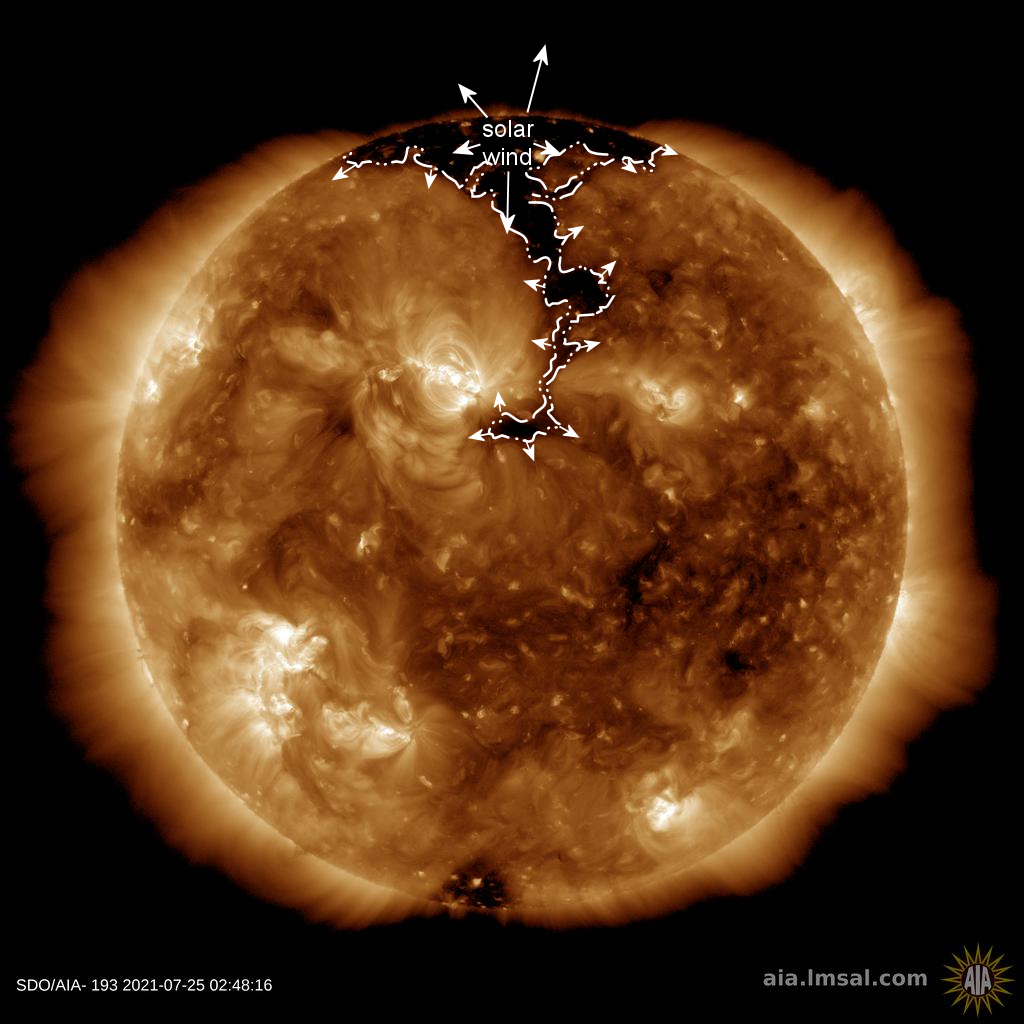
ALL QUIET ALERT: A CME expected to hit Earth on July 23rd or 24th has missed. Our planet's magnetic field is quiet and should remain so until July 28th when a new stream of solar wind arrives. The gaseous material is flowing from a sinuous hole in the sun's atmosphere.
Solar wind
speed: 317.9 km/sec
density: 4.1 protons/cm3
more data: ACE, DSCOVR
Updated: Today at 0450 UT
X-ray Solar Flares
6-hr max: B2 2349 UT Jul25
24-hr: B2 0457 UT Jul25
explanation | more data
Updated: Today at: 0455 UT
speed: 317.9 km/sec
density: 4.1 protons/cm3
more data: ACE, DSCOVR
Updated: Today at 0450 UT
X-ray Solar Flares
6-hr max: B2 2349 UT Jul25
24-hr: B2 0457 UT Jul25
explanation | more data
Updated: Today at: 0455 UT