A DANGEROUS SUNSPOT: Giant sunspot AR3354 is not directly facing Earth anymore, but it is still dangerous. The sunspot has a 'beta-gamma-delta' magnetic field that harbors energy for strong X-class solar flares. Even a sideways blast could affect our planet with radio blackouts and glancing-blow CMEs.
👍7
Solar wind
speed: 414.0 km/sec
density: 2.82 protons/cm3
more data: ACE, DSCOVR
Updated: Today at 0825 UT
X-ray Solar Flares
6-hr max: C2 1800 UT Jul24
24-hr: C9 0426 UT Jul24
explanation | more data
Updated: Today at: 2030 UT
speed: 414.0 km/sec
density: 2.82 protons/cm3
more data: ACE, DSCOVR
Updated: Today at 0825 UT
X-ray Solar Flares
6-hr max: C2 1800 UT Jul24
24-hr: C9 0426 UT Jul24
explanation | more data
Updated: Today at: 2030 UT
👍5
A HALO CME IS COMING: Minor G1-class geomagnetic storms are possible on July 27th when a faint halo CME is expected to hit Earth's magnetic field. The storm cloud was hurled toward us on July 23rd (~1530 UT) by a complex eruption involving a C5-class solar flare in sunspot AR3376 and the liftoff of a relatively nearby magnetic filament. The details of this forecast may change in response to ongoing modeling by NOAA analysts.
👍6🤔1
Solar wind
speed: 511.1 km/sec
density: 7.82 protons/cm3
Updated: Today at 1127 UT
X-ray Solar Flares
6-hr max: M4 1037 UT Jul26
24-hr: M4 1037 UT Jul26
Updated: Today at: 1130 UT
speed: 511.1 km/sec
density: 7.82 protons/cm3
Updated: Today at 1127 UT
X-ray Solar Flares
6-hr max: M4 1037 UT Jul26
24-hr: M4 1037 UT Jul26
Updated: Today at: 1130 UT
👍5
MYSTERY CME SPARKS GEOMAGNETIC STORM: Unexpectedly, a CME hit Earth's magnetic field on July 25th (2235 UT), sparking a G1-class geomagnetic storm. It is unclear if this is the early arrival of a CME originally expected on July 27th or a completely different CME which was previously overlooked. Because of the uncertainty, a minor geomagnetic storm watch is still in effect for July 27th.
👍6
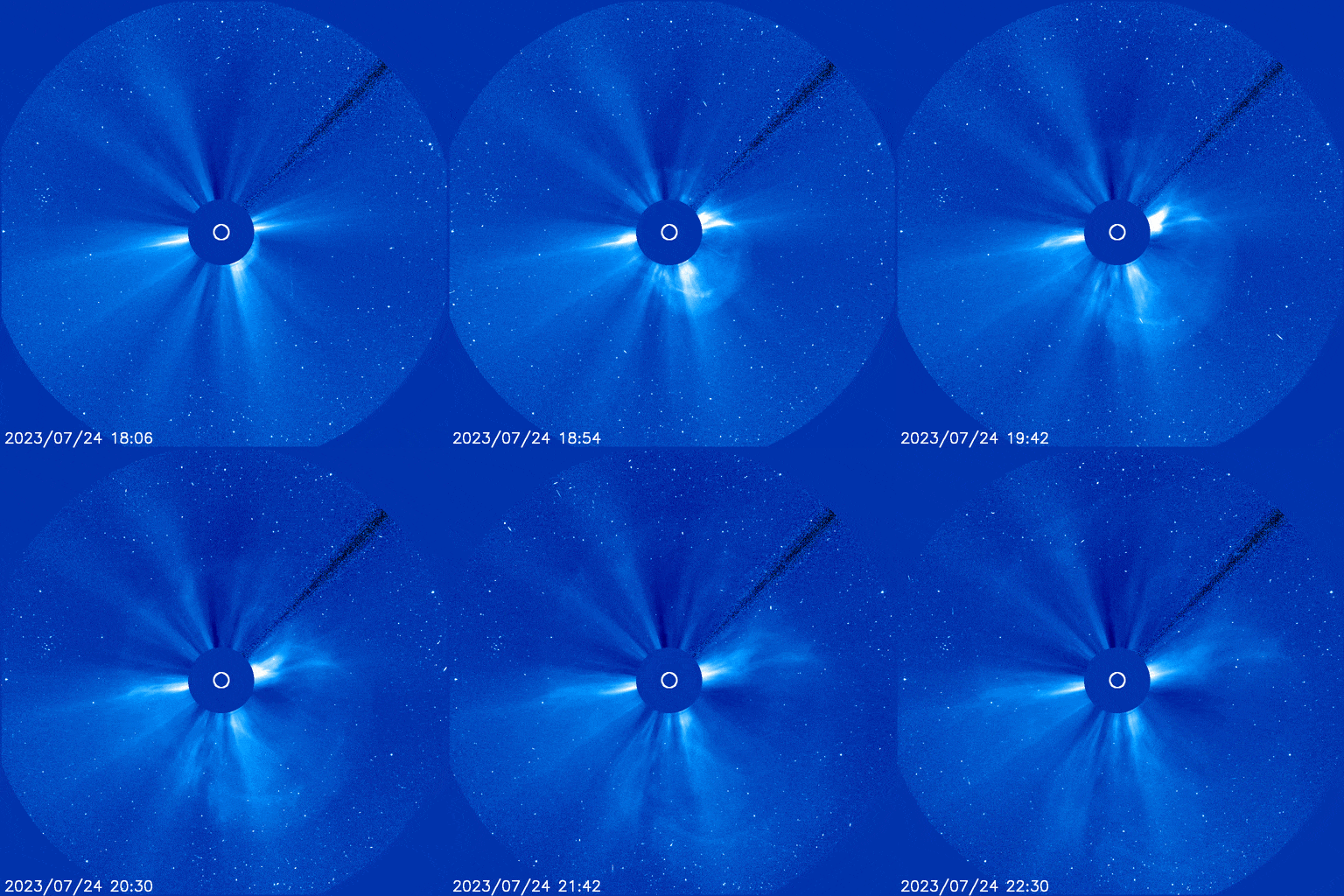
A FARSIDE CME JUST HIT SOLAR ORBITER: Two days ago, a bright CME rocketed away from the farside of the sun. Its plane-of-sky speed in SOHO coronagraph images exceeded 1,500 km/s (3.4 million mph):
https://spaceweather.com/images2023/24jul23/farsidecme_opt.gif
If this CME had hit Earth, a strong (possibly severe) geomagnetic storm would have surely resulted. Instead, it flew in the opposite direction and hit Europe's Solar Orbiter (SolO) spacecraft.
The CME reached SolO on July 26th (0200 UT), barely 32 hours after it left the sun. Considering that a typical CME would take two or three days to reach the spacecraft at its current location, a transit of only 32 hours confirms this CME was a fast-mover.
"This was definitely a big event," says George Ho of the Johns Hopkins Applied Physics Lab, co-principal investigator for the Energetic Particle Detector suite onboard Solar Orbiter. Ho checked the data right after the initial explosion on July 24th and saw a 10,000-fold increase of 50 MeV ions reaching the spacecraft. "This indicates a strong incoming interplanetary shock."
https://spaceweather.com/images2023/24jul23/farsidecme_opt.gif
If this CME had hit Earth, a strong (possibly severe) geomagnetic storm would have surely resulted. Instead, it flew in the opposite direction and hit Europe's Solar Orbiter (SolO) spacecraft.
The CME reached SolO on July 26th (0200 UT), barely 32 hours after it left the sun. Considering that a typical CME would take two or three days to reach the spacecraft at its current location, a transit of only 32 hours confirms this CME was a fast-mover.
"This was definitely a big event," says George Ho of the Johns Hopkins Applied Physics Lab, co-principal investigator for the Energetic Particle Detector suite onboard Solar Orbiter. Ho checked the data right after the initial explosion on July 24th and saw a 10,000-fold increase of 50 MeV ions reaching the spacecraft. "This indicates a strong incoming interplanetary shock."
👍9
BIG FARSIDE SUNSPOT: There's a spot on the farside of the sun so large it is affecting the way the whole sun vibrates. Helioseismic echoes pinpoint the active region in the sun's southern hemisphere not far behind the sun's southeastern limb. It should rotate into view this weekend. https://spaceweather.com/images2023/26jul23/helioseismic.jpg

🔥5
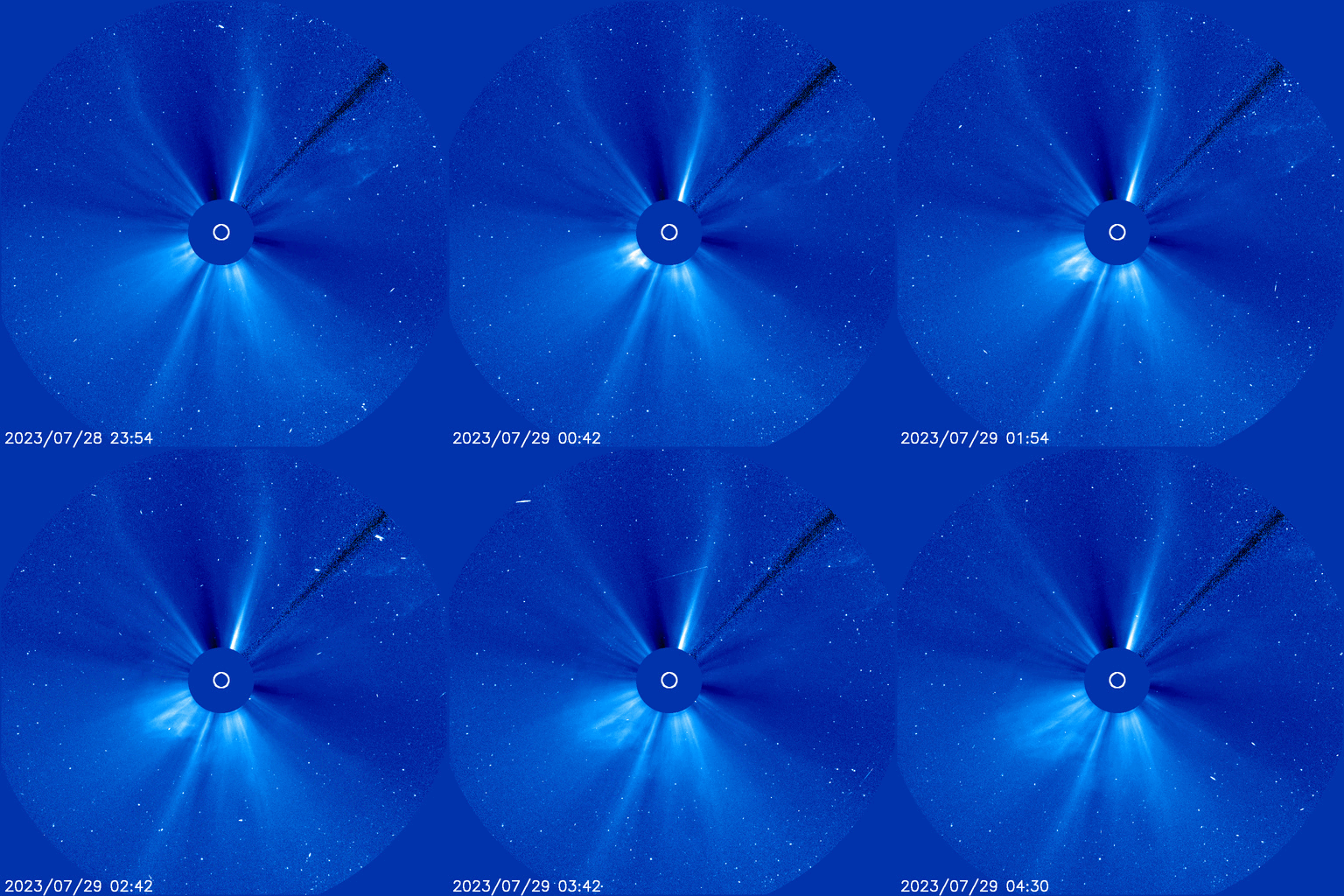
GEOMAGNETIC STORM WATCH (G2): Geomagnetic storms are possible on Aug. 1st when a CME is expected to hit Earth's magnetic field. Minor G1-class storms are likely with a chance of escalating to category G2. The CME was hurled almost directly toward Earth by the eruption of a magnetic filament in the sun's northern hemisphere on July 28th.
https://spaceweather.com/images2023/29jul23/fainthalo.gif
https://spaceweather.com/images2023/29jul23/fainthalo.gif
👍5