Solar wind
speed: 481.6 km/sec
density: 1.63 protons/cm3
Updated: Today at 0533 UT
X-ray Solar Flares
6-hr max: M1 1514 UT Jun27
24-hr: M1 1514 UT Jun27
Updated: Today at: 1740 UT
speed: 481.6 km/sec
density: 1.63 protons/cm3
Updated: Today at 0533 UT
X-ray Solar Flares
6-hr max: M1 1514 UT Jun27
24-hr: M1 1514 UT Jun27
Updated: Today at: 1740 UT
👍2
NEW FAST-GROWING SUNSPOT: Sunspot AR3354 didn't exist yesterday. Today it is 5 times wider than Earth. A 24 hour movie from NASA's Solar Dynamics Observatory shows the sunspot's rapid development. It merits watching as a possible source of Earth-directed solar flares.
👍5
Solar wind
speed: 475.4 km/sec
density: 2.89 protons/cm3
more data: ACE, DSCOVR
Updated: Today at 0510 UT
X-ray Solar Flares
6-hr max: C4 1256 UT Jul01
24-hr: C4 1256 UT Jul01
explanation | more data
Updated: Today at: 1715 UT
speed: 475.4 km/sec
density: 2.89 protons/cm3
more data: ACE, DSCOVR
Updated: Today at 0510 UT
X-ray Solar Flares
6-hr max: C4 1256 UT Jul01
24-hr: C4 1256 UT Jul01
explanation | more data
Updated: Today at: 1715 UT
👍3
MINOR GEOMAGNETIC STORM WATCH: NOAA forecasters say that a CME might graze Earth's magnetic field on July 1st. It was launched into space three days ago by an erupting magnetic filament in the sun's northern hemisphere. The glancing blow, if it occurs, could spark a minor G1-class geomagnetic storm.
👍4
Solar wind
speed: 451.4 km/sec
density: 4.38 protons/cm3
more data: ACE, DSCOVR
Updated: Today at 0327 UT
X-ray Solar Flares
6-hr max: C3 0940 UT Jul02
24-hr: M2 0235 UT Jul02
explanation | more data
Updated: Today at: 1530 UT
speed: 451.4 km/sec
density: 4.38 protons/cm3
more data: ACE, DSCOVR
Updated: Today at 0327 UT
X-ray Solar Flares
6-hr max: C3 0940 UT Jul02
24-hr: M2 0235 UT Jul02
explanation | more data
Updated: Today at: 1530 UT
👍4
THE CALM BEFORE THE STORM? Giant sunspot AR3354 has a 'beta-gamma-delta' class magnetic field that harbors energy for X-class solar flares. Yet it has been strangely quiet for days. Is this the calm before the storm? Strong flares remain possible despite the low activity of the past 48+ hours.
👍7
Solar wind
speed: 435.4 km/sec
density: 4.45 protons/cm3
Updated: Today at 0536 UT
X-ray Solar Flares
6-hr max: C5 1521 UT Jul03
24-hr: X1 2314 UT Jul02
Updated: Today at: 1740 UT
speed: 435.4 km/sec
density: 4.45 protons/cm3
Updated: Today at 0536 UT
X-ray Solar Flares
6-hr max: C5 1521 UT Jul03
24-hr: X1 2314 UT Jul02
Updated: Today at: 1740 UT
👍2
THE FULL MOON: There's a full Moon tonight, and according to folklore it has a special name: The "Buck Moon." A better name this year might be "Fire Moon." Smoke from Canada is circling the globe, tinting moonrises with the color of wildfire. Look east at sunset for the Fire Moon rising.
👍6
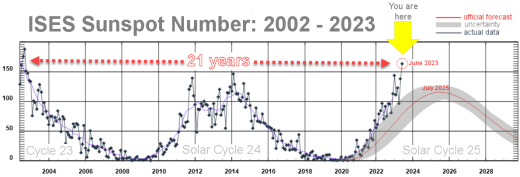
SUNSPOT COUNTS HIT A 21-YEAR HIGH: The sun is partying like it's 2002. That's the last time sunspot counts were as high as they are now. The monthly average sunspot number for June 2023 was 163, according to the Royal Observatory of Belgium's Solar Influences Data Analysis Center. This eclipses every month since Sept. 2022:
https://spaceweather.com/images2023/02jul23/sunspotcounts_strip.jpg
Above: This plot is based on NOAA's interactive Solar Cycle Progression. Check it out!
Solar Cycle 25 wasn't expected to be this strong. When it began in Dec. 2019, forecasters believed it would be a weak cycle akin to its immediate predecessor Solar Cycle 24. If that forecast had panned out, Solar Cycle 25 would be one of the weakest solar cycles in a century.
Instead, Solar Cycle 25 has shot past Solar Cycle 24 and may be on pace to rival some of the stronger cycles of the 20th century. The last time sunspot numbers were this high, the sun was on the verge of launching the Great Halloween Storms of 2003, which included the strongest X-ray solar flare ever recorded (X45), auroras as far south as Texas, and a CME so powerful it was ultimately detected by the Voyager spacecraft at the edge of the solar system.
https://spaceweather.com/images2023/02jul23/sunspotcounts_strip.jpg
Above: This plot is based on NOAA's interactive Solar Cycle Progression. Check it out!
Solar Cycle 25 wasn't expected to be this strong. When it began in Dec. 2019, forecasters believed it would be a weak cycle akin to its immediate predecessor Solar Cycle 24. If that forecast had panned out, Solar Cycle 25 would be one of the weakest solar cycles in a century.
Instead, Solar Cycle 25 has shot past Solar Cycle 24 and may be on pace to rival some of the stronger cycles of the 20th century. The last time sunspot numbers were this high, the sun was on the verge of launching the Great Halloween Storms of 2003, which included the strongest X-ray solar flare ever recorded (X45), auroras as far south as Texas, and a CME so powerful it was ultimately detected by the Voyager spacecraft at the edge of the solar system.
👍4🔥3
Solar wind
speed: 357.2 km/sec
density: 10.47 protons/cm3
Updated: Today at 0837 UT
X-ray Solar Flares
6-hr max: C8 1928 UT Jul04
24-hr: M1 1235 UT Jul04
Updated: Today at: 2040 UT
speed: 357.2 km/sec
density: 10.47 protons/cm3
Updated: Today at 0837 UT
X-ray Solar Flares
6-hr max: C8 1928 UT Jul04
24-hr: M1 1235 UT Jul04
Updated: Today at: 2040 UT
👍1
A DANGEROUS SUNSPOT: Giant sunspot AR3354 is not directly facing Earth anymore, but it is still dangerous. The sunspot has a 'beta-gamma-delta' magnetic field that harbors energy for strong X-class solar flares. Even a sideways blast could affect our planet with radio blackouts and glancing-blow CMEs.
👍7
Solar wind
speed: 414.0 km/sec
density: 2.82 protons/cm3
more data: ACE, DSCOVR
Updated: Today at 0825 UT
X-ray Solar Flares
6-hr max: C2 1800 UT Jul24
24-hr: C9 0426 UT Jul24
explanation | more data
Updated: Today at: 2030 UT
speed: 414.0 km/sec
density: 2.82 protons/cm3
more data: ACE, DSCOVR
Updated: Today at 0825 UT
X-ray Solar Flares
6-hr max: C2 1800 UT Jul24
24-hr: C9 0426 UT Jul24
explanation | more data
Updated: Today at: 2030 UT
👍5
A HALO CME IS COMING: Minor G1-class geomagnetic storms are possible on July 27th when a faint halo CME is expected to hit Earth's magnetic field. The storm cloud was hurled toward us on July 23rd (~1530 UT) by a complex eruption involving a C5-class solar flare in sunspot AR3376 and the liftoff of a relatively nearby magnetic filament. The details of this forecast may change in response to ongoing modeling by NOAA analysts.
👍6🤔1