Solar wind
speed: 413.2 km/sec
density: 3.78 protons/cm3
more data: ACE, DSCOVR
Updated: Today at 0257 UT
X-ray Solar Flares
6-hr max: M1 1121 UT Jun22
24-hr: M1 1121 UT Jun22
explanation | more data
Updated: Today at: 1500 UT
speed: 413.2 km/sec
density: 3.78 protons/cm3
more data: ACE, DSCOVR
Updated: Today at 0257 UT
X-ray Solar Flares
6-hr max: M1 1121 UT Jun22
24-hr: M1 1121 UT Jun22
explanation | more data
Updated: Today at: 1500 UT
👍3
GEOMAGNETIC STORM WATCH: NOAA forecasters say there is a chance of minor G1-class geomagnetic storms on June 23rd when a CME might hit Earth's magnetic field. This is the same CME hurled into space by an X1-class solar flare on June 20th. At first it appeared the CME would miss Earth; however, additional modeling suggests a glancing blow might be possible.
👍6
Solar wind
speed: 402.2 km/sec
density: 3.39 protons/cm3
more data: ACE, DSCOVR
Updated: Today at 0307 UT
X-ray Solar Flares
6-hr max: C2 1004 UT Jun23
24-hr: M4 2344 UT Jun22
explanation | more data
Updated: Today at: 1510 UT
speed: 402.2 km/sec
density: 3.39 protons/cm3
more data: ACE, DSCOVR
Updated: Today at 0307 UT
X-ray Solar Flares
6-hr max: C2 1004 UT Jun23
24-hr: M4 2344 UT Jun22
explanation | more data
Updated: Today at: 1510 UT
👍2
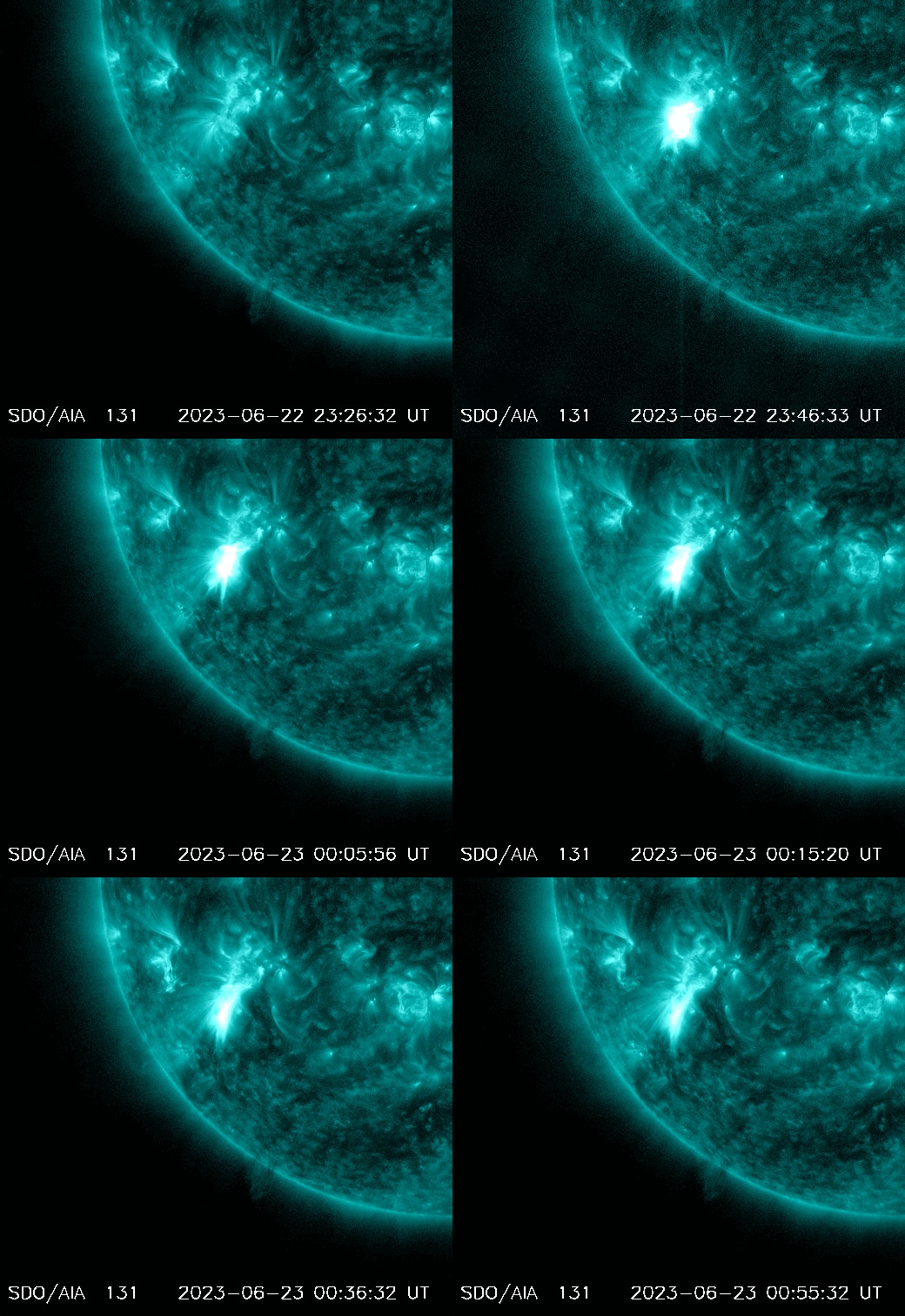
ANOTHER SIGNIFICANT SOLAR FLARE: Active sunspot AR3341, which produced an X-flare on June 20th, exploded again on June 22nd: movie. This time it's an M4.5-class flare. The eruption hurled a CME into space but we do not yet know if it has an Earth-directed component. https://spaceweather.com/images2023/22jun23/m4p5_anim_strip.gif
🔥6
Solar wind
speed: 463.1 km/sec
density: 7.87 protons/cm3
more data: ACE, DSCOVR
Updated: Today at 0517 UT
X-ray Solar Flares
6-hr max: M1 1217 UT Jun24
24-hr: M1 1217 UT Jun24
explanation | more data
Updated: Today at: 1720 UT
speed: 463.1 km/sec
density: 7.87 protons/cm3
more data: ACE, DSCOVR
Updated: Today at 0517 UT
X-ray Solar Flares
6-hr max: M1 1217 UT Jun24
24-hr: M1 1217 UT Jun24
explanation | more data
Updated: Today at: 1720 UT
🔥1
POSSIBLE GLANCING-BLOW CME: Minor G1-class geomagnetic storms are possible on June 27th if, as NOAA models suggest, a CME might graze Earth's magnetic field. The slow moving CME was hurled into space on June 22nd by an M4.8-class solar flare.
👍2
Solar wind
speed: 553.9 km/sec
density: 1.52 protons/cm3
more data: ACE, DSCOVR
Updated: Today at 0347 UT
X-ray Solar Flares
6-hr max: C7 1225 UT Jun26
24-hr: C7 1225 UT Jun26
explanation | more data
Updated: Today at: 1550 UT
speed: 553.9 km/sec
density: 1.52 protons/cm3
more data: ACE, DSCOVR
Updated: Today at 0347 UT
X-ray Solar Flares
6-hr max: C7 1225 UT Jun26
24-hr: C7 1225 UT Jun26
explanation | more data
Updated: Today at: 1550 UT
👍2
CHANCE OF FLARES TODAY: Growing sunspot AR3340 has developed a 'delta-class' magnetic field that harbors energy for strong solar flares. NOAA forecasters estimate a 40% chance of M-class flares and a 10% chance of X-flares on June 26th.
👍4
Solar wind
speed: 481.6 km/sec
density: 1.63 protons/cm3
Updated: Today at 0533 UT
X-ray Solar Flares
6-hr max: M1 1514 UT Jun27
24-hr: M1 1514 UT Jun27
Updated: Today at: 1740 UT
speed: 481.6 km/sec
density: 1.63 protons/cm3
Updated: Today at 0533 UT
X-ray Solar Flares
6-hr max: M1 1514 UT Jun27
24-hr: M1 1514 UT Jun27
Updated: Today at: 1740 UT
👍2
NEW FAST-GROWING SUNSPOT: Sunspot AR3354 didn't exist yesterday. Today it is 5 times wider than Earth. A 24 hour movie from NASA's Solar Dynamics Observatory shows the sunspot's rapid development. It merits watching as a possible source of Earth-directed solar flares.
👍5
Solar wind
speed: 475.4 km/sec
density: 2.89 protons/cm3
more data: ACE, DSCOVR
Updated: Today at 0510 UT
X-ray Solar Flares
6-hr max: C4 1256 UT Jul01
24-hr: C4 1256 UT Jul01
explanation | more data
Updated: Today at: 1715 UT
speed: 475.4 km/sec
density: 2.89 protons/cm3
more data: ACE, DSCOVR
Updated: Today at 0510 UT
X-ray Solar Flares
6-hr max: C4 1256 UT Jul01
24-hr: C4 1256 UT Jul01
explanation | more data
Updated: Today at: 1715 UT
👍3
MINOR GEOMAGNETIC STORM WATCH: NOAA forecasters say that a CME might graze Earth's magnetic field on July 1st. It was launched into space three days ago by an erupting magnetic filament in the sun's northern hemisphere. The glancing blow, if it occurs, could spark a minor G1-class geomagnetic storm.
👍4
Solar wind
speed: 451.4 km/sec
density: 4.38 protons/cm3
more data: ACE, DSCOVR
Updated: Today at 0327 UT
X-ray Solar Flares
6-hr max: C3 0940 UT Jul02
24-hr: M2 0235 UT Jul02
explanation | more data
Updated: Today at: 1530 UT
speed: 451.4 km/sec
density: 4.38 protons/cm3
more data: ACE, DSCOVR
Updated: Today at 0327 UT
X-ray Solar Flares
6-hr max: C3 0940 UT Jul02
24-hr: M2 0235 UT Jul02
explanation | more data
Updated: Today at: 1530 UT
👍4
THE CALM BEFORE THE STORM? Giant sunspot AR3354 has a 'beta-gamma-delta' class magnetic field that harbors energy for X-class solar flares. Yet it has been strangely quiet for days. Is this the calm before the storm? Strong flares remain possible despite the low activity of the past 48+ hours.
👍7