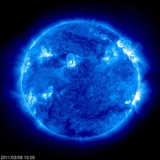
MINOR GEOMAGNETIC STORM WATCH: NOAA forecasters say that minor G1-class geomagnetic storms are possible on June 2nd when a stream of solar wind is expected to hit Earth's magnetic field. The gaseous material is flowing from a pair of holes in the sun's atmosphere.
👍5
Solar wind
speed: 326.6 km/sec
density: 3.30 protons/cm3
more data: ACE, DSCOVR
Updated: Today at 0831 UT
X-ray Solar Flares
6-hr max: C1 1656 UT Jun08
24-hr: C7 0459 UT Jun08
explanation | more data
Updated: Today at: 2035 UT
speed: 326.6 km/sec
density: 3.30 protons/cm3
more data: ACE, DSCOVR
Updated: Today at 0831 UT
X-ray Solar Flares
6-hr max: C1 1656 UT Jun08
24-hr: C7 0459 UT Jun08
explanation | more data
Updated: Today at: 2035 UT
👍2
CHANCE OF FLARES: NOAA forecasters say there is a 30% chance of M-class solar flares and a 10% chance of X-flares today, June 8th. The likely source would be sunspot AR3327, which has an unstable 'delta-class' magnetic field. Any explosions will be geoeffective as the sunspot is almost directly facing Earth.
👍3
NEW SUNSPOTS: A pair of new sunspot groups is emerging near the sun's southeastern limb: movie. One of them is potentially large and could pose a threat for flares as it turns toward Earth later this week.
👍7👏1
Solar wind
speed: 633.0 km/sec
density: 3.94 protons/cm3
more data: ACE, DSCOVR
Updated: Today at 1120 UT
X-ray Solar Flares
6-hr max: C2 1725 UT Jun15
24-hr: C9 1255 UT Jun15
explanation | more data
Updated: Today at: 2325 UT
speed: 633.0 km/sec
density: 3.94 protons/cm3
more data: ACE, DSCOVR
Updated: Today at 1120 UT
X-ray Solar Flares
6-hr max: C2 1725 UT Jun15
24-hr: C9 1255 UT Jun15
explanation | more data
Updated: Today at: 2325 UT
👍2
CO-ROTATING INTERACTION REGION: A co-rotating interation region (CIR) hit Earth today, June 15th, briefly opening a crack in our planet's magnetic field and sparking a minor G1-class geomagnetic storm. CIRs are transition zones between slow- and fast-moving solar wind streams. Solar wind plasma piles up in these regions, producing shock-like structures that mimick CMEs.
👍4
CIR SPARKS G2-CLASS GEOMAGNETIC STORM: Last night, Earth lit up like a Christmas tree with auroras at both poles. The reason: A co-rotating interaction region (CIR) hit our planet's magnetic field. "The display in New Zealand was one for the ages," reports Ian Griffin from Hoopers Inlet on the Otago Peninsula: https://spaceweather.com/images2023/16jun23/nz_strip.jpg

❤5👏1
Solar wind
speed: 450.8 km/sec
density: 8.33 protons/cm3
more data: ACE, DSCOVR
Updated: Today at 0535 UT
X-ray Solar Flares
6-hr max: M1 1214 UT Jun19
24-hr: M1 0350 UT Jun19
explanation | more data
Updated: Today at: 1740 UT
speed: 450.8 km/sec
density: 8.33 protons/cm3
more data: ACE, DSCOVR
Updated: Today at 0535 UT
X-ray Solar Flares
6-hr max: M1 1214 UT Jun19
24-hr: M1 0350 UT Jun19
explanation | more data
Updated: Today at: 1740 UT
👍6🥰1
A GLANCING-BLOW CME IS COMING (UPDATED): Sunspot AR3335 exploded on June 18th, producing an M2.5-class solar flare (new movie) and a minor shortwave radio blackout over the Atlantic Ocean (map). The explosion lasted long enough to lift a CME out of the sun's atmosphere. NOAA has modeled the CME and determined that it could deliver a glancing blow to Earth's magnetic field on June 21-22.
👍5🔥3
Solar wind
speed: 413.2 km/sec
density: 3.78 protons/cm3
more data: ACE, DSCOVR
Updated: Today at 0257 UT
X-ray Solar Flares
6-hr max: M1 1121 UT Jun22
24-hr: M1 1121 UT Jun22
explanation | more data
Updated: Today at: 1500 UT
speed: 413.2 km/sec
density: 3.78 protons/cm3
more data: ACE, DSCOVR
Updated: Today at 0257 UT
X-ray Solar Flares
6-hr max: M1 1121 UT Jun22
24-hr: M1 1121 UT Jun22
explanation | more data
Updated: Today at: 1500 UT
👍3
GEOMAGNETIC STORM WATCH: NOAA forecasters say there is a chance of minor G1-class geomagnetic storms on June 23rd when a CME might hit Earth's magnetic field. This is the same CME hurled into space by an X1-class solar flare on June 20th. At first it appeared the CME would miss Earth; however, additional modeling suggests a glancing blow might be possible.
👍6
Solar wind
speed: 402.2 km/sec
density: 3.39 protons/cm3
more data: ACE, DSCOVR
Updated: Today at 0307 UT
X-ray Solar Flares
6-hr max: C2 1004 UT Jun23
24-hr: M4 2344 UT Jun22
explanation | more data
Updated: Today at: 1510 UT
speed: 402.2 km/sec
density: 3.39 protons/cm3
more data: ACE, DSCOVR
Updated: Today at 0307 UT
X-ray Solar Flares
6-hr max: C2 1004 UT Jun23
24-hr: M4 2344 UT Jun22
explanation | more data
Updated: Today at: 1510 UT
👍2