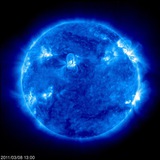
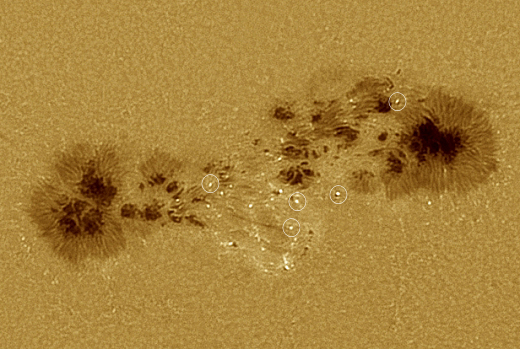
ELLERMAN BOMBS: At the beginning of the week, sunspot AR3315 didn't exist. Now it is the biggest and most dangerous sunspot on the solar disk. Maximilian Teodorescu photographed the fast-growing active region yesterday and found it crackling with bomb-blasts:
https://spaceweather.com/images2023/27may23/ebombs_strip.jpg
These are Ellerman bombs--magnetic explosions about one-millionth as powerful as true solar flares. A handful are circled above for reference. They are named after physicist Ferdinand Ellerman who studied the tiny blasts in the early 20th century. Of course, "tiny" is relative. A single Ellerman bomb releases about 1026 ergs of energy--equal to about 100,000 World War II atomic bombs.
Explosions like these are a sign of magnetic complexity in a sunspot. Opposite polarities bump together, reconnect, and--boom. A full-fledged flare may not be far behind.
https://spaceweather.com/images2023/27may23/ebombs_strip.jpg
These are Ellerman bombs--magnetic explosions about one-millionth as powerful as true solar flares. A handful are circled above for reference. They are named after physicist Ferdinand Ellerman who studied the tiny blasts in the early 20th century. Of course, "tiny" is relative. A single Ellerman bomb releases about 1026 ergs of energy--equal to about 100,000 World War II atomic bombs.
Explosions like these are a sign of magnetic complexity in a sunspot. Opposite polarities bump together, reconnect, and--boom. A full-fledged flare may not be far behind.
👍15
SUBSIDING CHANCE OF FLARES: Dangerous sunspot AR3315 became less dangerous today. Its magnetic field has decayed, losing the delta configuration that gave it potential energy for X-class solar flares. Lesser M-class flares are still possible, though, with NOAA estimating a 40%-chance of M-flares on May 30th.
👍4
MINOR GEOMAGNETIC STORM WATCH: NOAA forecasters say that minor G1-class geomagnetic storms are possible on June 2nd when a stream of solar wind is expected to hit Earth's magnetic field. The gaseous material is flowing from a pair of holes in the sun's atmosphere.
👍5
Solar wind
speed: 326.6 km/sec
density: 3.30 protons/cm3
more data: ACE, DSCOVR
Updated: Today at 0831 UT
X-ray Solar Flares
6-hr max: C1 1656 UT Jun08
24-hr: C7 0459 UT Jun08
explanation | more data
Updated: Today at: 2035 UT
speed: 326.6 km/sec
density: 3.30 protons/cm3
more data: ACE, DSCOVR
Updated: Today at 0831 UT
X-ray Solar Flares
6-hr max: C1 1656 UT Jun08
24-hr: C7 0459 UT Jun08
explanation | more data
Updated: Today at: 2035 UT
👍2
CHANCE OF FLARES: NOAA forecasters say there is a 30% chance of M-class solar flares and a 10% chance of X-flares today, June 8th. The likely source would be sunspot AR3327, which has an unstable 'delta-class' magnetic field. Any explosions will be geoeffective as the sunspot is almost directly facing Earth.
👍3
NEW SUNSPOTS: A pair of new sunspot groups is emerging near the sun's southeastern limb: movie. One of them is potentially large and could pose a threat for flares as it turns toward Earth later this week.
👍7👏1
Solar wind
speed: 633.0 km/sec
density: 3.94 protons/cm3
more data: ACE, DSCOVR
Updated: Today at 1120 UT
X-ray Solar Flares
6-hr max: C2 1725 UT Jun15
24-hr: C9 1255 UT Jun15
explanation | more data
Updated: Today at: 2325 UT
speed: 633.0 km/sec
density: 3.94 protons/cm3
more data: ACE, DSCOVR
Updated: Today at 1120 UT
X-ray Solar Flares
6-hr max: C2 1725 UT Jun15
24-hr: C9 1255 UT Jun15
explanation | more data
Updated: Today at: 2325 UT
👍2
CO-ROTATING INTERACTION REGION: A co-rotating interation region (CIR) hit Earth today, June 15th, briefly opening a crack in our planet's magnetic field and sparking a minor G1-class geomagnetic storm. CIRs are transition zones between slow- and fast-moving solar wind streams. Solar wind plasma piles up in these regions, producing shock-like structures that mimick CMEs.
👍4