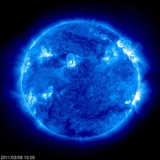
THE CALM BEFORE THE STORM? Giant sunspot AR3311 has been relatively calm for the past 48 hours. It might be the calm before the storm. The sunspot has an unstable 'beta-gamma-delta' magnetic field that harbors energy for strong X-class solar flares. NOAA forecasters estimate a 10% chance of an X-flare on May 24th.
👍5🔥1
FARSIDE SUNSPOT: There's a sunspot on the farside of the sun so large, it is affecting the way the whole sun vibrates. Helioseismic maps reveal the active region about 10 days away from turning toward Earth. This could herald a period of geoeffective solar activity in June.
🔥5👍4
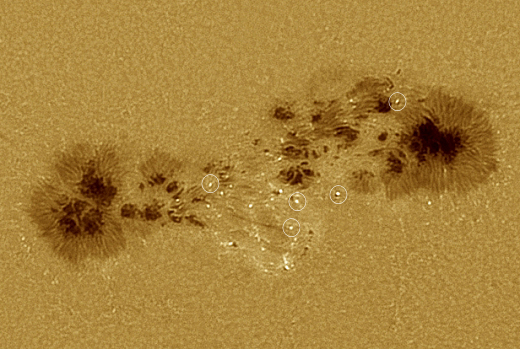
ELLERMAN BOMBS: At the beginning of the week, sunspot AR3315 didn't exist. Now it is the biggest and most dangerous sunspot on the solar disk. Maximilian Teodorescu photographed the fast-growing active region yesterday and found it crackling with bomb-blasts:
https://spaceweather.com/images2023/27may23/ebombs_strip.jpg
These are Ellerman bombs--magnetic explosions about one-millionth as powerful as true solar flares. A handful are circled above for reference. They are named after physicist Ferdinand Ellerman who studied the tiny blasts in the early 20th century. Of course, "tiny" is relative. A single Ellerman bomb releases about 1026 ergs of energy--equal to about 100,000 World War II atomic bombs.
Explosions like these are a sign of magnetic complexity in a sunspot. Opposite polarities bump together, reconnect, and--boom. A full-fledged flare may not be far behind.
https://spaceweather.com/images2023/27may23/ebombs_strip.jpg
These are Ellerman bombs--magnetic explosions about one-millionth as powerful as true solar flares. A handful are circled above for reference. They are named after physicist Ferdinand Ellerman who studied the tiny blasts in the early 20th century. Of course, "tiny" is relative. A single Ellerman bomb releases about 1026 ergs of energy--equal to about 100,000 World War II atomic bombs.
Explosions like these are a sign of magnetic complexity in a sunspot. Opposite polarities bump together, reconnect, and--boom. A full-fledged flare may not be far behind.
👍15
SUBSIDING CHANCE OF FLARES: Dangerous sunspot AR3315 became less dangerous today. Its magnetic field has decayed, losing the delta configuration that gave it potential energy for X-class solar flares. Lesser M-class flares are still possible, though, with NOAA estimating a 40%-chance of M-flares on May 30th.
👍4
MINOR GEOMAGNETIC STORM WATCH: NOAA forecasters say that minor G1-class geomagnetic storms are possible on June 2nd when a stream of solar wind is expected to hit Earth's magnetic field. The gaseous material is flowing from a pair of holes in the sun's atmosphere.
👍5
Solar wind
speed: 326.6 km/sec
density: 3.30 protons/cm3
more data: ACE, DSCOVR
Updated: Today at 0831 UT
X-ray Solar Flares
6-hr max: C1 1656 UT Jun08
24-hr: C7 0459 UT Jun08
explanation | more data
Updated: Today at: 2035 UT
speed: 326.6 km/sec
density: 3.30 protons/cm3
more data: ACE, DSCOVR
Updated: Today at 0831 UT
X-ray Solar Flares
6-hr max: C1 1656 UT Jun08
24-hr: C7 0459 UT Jun08
explanation | more data
Updated: Today at: 2035 UT
👍2
CHANCE OF FLARES: NOAA forecasters say there is a 30% chance of M-class solar flares and a 10% chance of X-flares today, June 8th. The likely source would be sunspot AR3327, which has an unstable 'delta-class' magnetic field. Any explosions will be geoeffective as the sunspot is almost directly facing Earth.
👍3