Solar wind
speed: 500.9 km/sec
density: 3.12 protons/cm3
Updated: Today at 0407 UT
X-ray Solar Flares
6-hr max: M2 1604 UT May21
24-hr: M5 2306 UT May20
Updated: Today at: 1610 UT
speed: 500.9 km/sec
density: 3.12 protons/cm3
Updated: Today at 0407 UT
X-ray Solar Flares
6-hr max: M2 1604 UT May21
24-hr: M5 2306 UT May20
Updated: Today at: 1610 UT
👍3
Space Weather Today pinned «Solar wind speed: 500.9 km/sec density: 3.12 protons/cm3 Updated: Today at 0407 UT X-ray Solar Flares 6-hr max: M2 1604 UT May21 24-hr: M5 2306 UT May20 Updated: Today at: 1610 UT»
A DANGEROUS SUNSPOT: Growing sunspot AR3311 has an unstable 'beta-gamma-delta' magnetic field that harbors energy for strong solar flares. NOAA forecasters say there is a 75% chance of M-class flares and a 35% chance of X-flares on May 21st.
🔥3👏2
Solar wind
speed: 596.4 km/sec
density: 9.70 protons/cm3
Updated: Today at 0550 UT
X-ray Solar Flares
6-hr max: M1 1337 UT May22
24-hr: M1 1337 UT May22
Updated: Today at: 1755 UT
speed: 596.4 km/sec
density: 9.70 protons/cm3
Updated: Today at 0550 UT
X-ray Solar Flares
6-hr max: M1 1337 UT May22
24-hr: M1 1337 UT May22
Updated: Today at: 1755 UT
👍3
Space Weather Today pinned «Solar wind speed: 596.4 km/sec density: 9.70 protons/cm3 Updated: Today at 0550 UT X-ray Solar Flares 6-hr max: M1 1337 UT May22 24-hr: M1 1337 UT May22 Updated: Today at: 1755 UT»
Solar Activity Alert: Potential Flares Today
Get ready for potential solar fireworks as sunspot AR3311 exhibits an unstable nature with its 'beta-gamma-delta' magnetic field configuration, which holds the potential for intense solar flares. According to NOAA forecasters, there is a 75% probability of M-class flares and a 30% chance of X-flares on May 22nd. Keep an eye on the skies as the sun prepares to unleash its energetic bursts of electromagnetic radiation.
Get ready for potential solar fireworks as sunspot AR3311 exhibits an unstable nature with its 'beta-gamma-delta' magnetic field configuration, which holds the potential for intense solar flares. According to NOAA forecasters, there is a 75% probability of M-class flares and a 30% chance of X-flares on May 22nd. Keep an eye on the skies as the sun prepares to unleash its energetic bursts of electromagnetic radiation.
👍6
SUBSIDING CHANCE OF FLARES: NOAA forecasters have decreased the odds of an X-class flare from 30% (yesterday) to 20% (today). This is in response to decay in the magnetic field of sunspot AR3311, currently the biggest threat for flares on the solar disk. 20% is still plenty, though, for an X-class explosion.
👍3
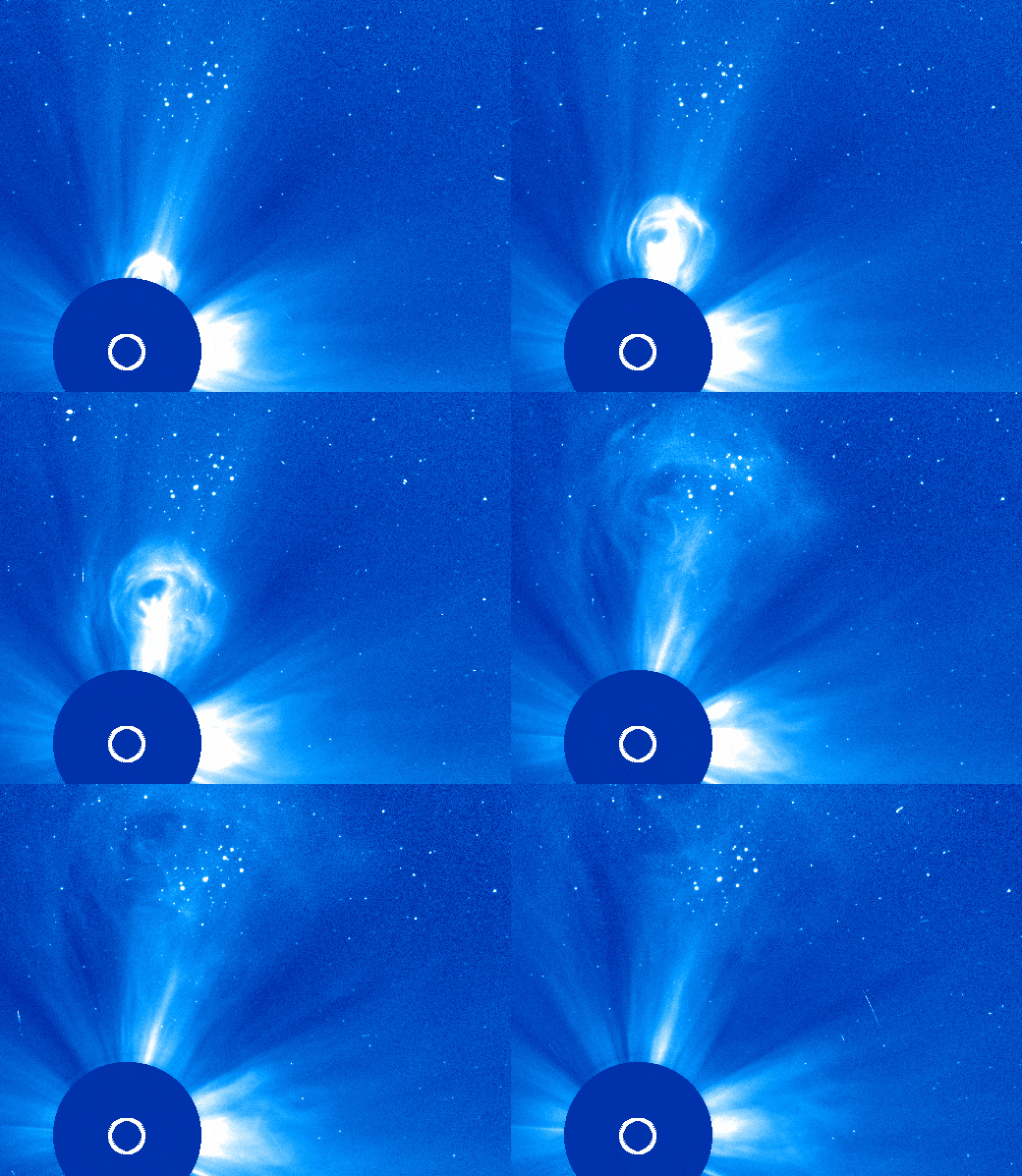
A SOLAR STORM AND THE PLEIADES: Before the launch of the Solar and Heliospheric Observatory (SOHO) in 1995, astronomers had never seen anything like this. Behold, a solar storm passing directly in front of the Pleiades:
https://spaceweather.com/images2023/24may23/pleaides_anim_strip2_opt2.gif
SOHO recorded this rare conjunction on May 21st. An erupting filament of magnetism near the sun's north pole propelled the CME into space just as the Seven Sisters were passing by. Electra, Taygete, Maia, Celaeno, Alcyone, Sterope, and Merope spent nearly three hours shining through the translucent solar storm.
When SOHO left Earth almost 30 years ago, it carried the first realtime coronagraph into space. Coronagraphs are devices that create an artificial eclipse, blocking the glare of the sun to reveal nearby stars, planets, and comets. No telescope on Earth could see something as faint as the Pleiades only a few degrees from the sun, but SOHO does it all the time.
https://spaceweather.com/images2023/24may23/pleaides_anim_strip2_opt2.gif
SOHO recorded this rare conjunction on May 21st. An erupting filament of magnetism near the sun's north pole propelled the CME into space just as the Seven Sisters were passing by. Electra, Taygete, Maia, Celaeno, Alcyone, Sterope, and Merope spent nearly three hours shining through the translucent solar storm.
When SOHO left Earth almost 30 years ago, it carried the first realtime coronagraph into space. Coronagraphs are devices that create an artificial eclipse, blocking the glare of the sun to reveal nearby stars, planets, and comets. No telescope on Earth could see something as faint as the Pleiades only a few degrees from the sun, but SOHO does it all the time.
👍7
THE CALM BEFORE THE STORM? Giant sunspot AR3311 has been relatively calm for the past 48 hours. It might be the calm before the storm. The sunspot has an unstable 'beta-gamma-delta' magnetic field that harbors energy for strong X-class solar flares. NOAA forecasters estimate a 10% chance of an X-flare on May 24th.
👍5🔥1