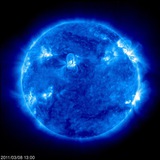
PARTIALLY ECLIPSED X-FLARE: Earth-orbiting satellites have just detected an M9.6-class solar flare from a sunspot group hiding just behind the sun's southeastern limb. In fact, the explosion was probably X-class albeit partially eclipsed by the edge of the sun. The active region will turn to face Earth later this week.
👍3🔥2⚡1
Space Weather Today pinned «Solar wind speed: 476.7 km/sec density: 7.17 protons/cm3 Updated: Today at 0320 UT X-ray Solar Flares 6-hr max: C4 1214 UT May16 24-hr: C4 1214 UT May16 Updated: Today at: 1525 UT»
Solar wind
speed: 429.8 km/sec
density: 4.34 protons/cm3
Updated: Today at 0312 UT
X-ray Solar Flares
6-hr max: C6 1443 UT May17
24-hr: M9 1643 UT May16
Updated: Today at: 1515 UT
speed: 429.8 km/sec
density: 4.34 protons/cm3
Updated: Today at 0312 UT
X-ray Solar Flares
6-hr max: C6 1443 UT May17
24-hr: M9 1643 UT May16
Updated: Today at: 1515 UT
👍1
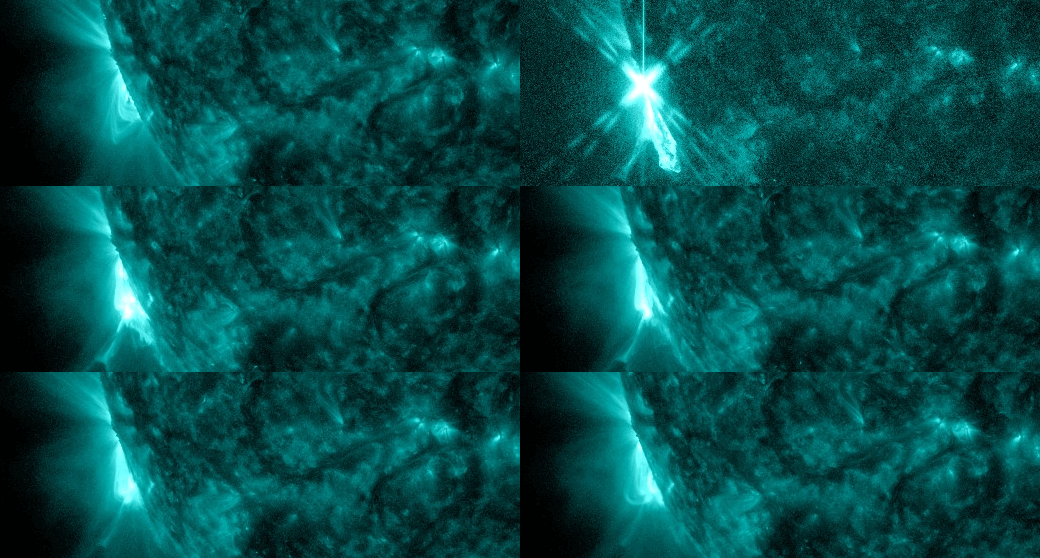
PARTIALLY ECLIPSED X-FLARE: Yesterday, May 16th, Earth-orbiting satellites detected an M9.6-class solar flare from a sunspot hiding behind the sun's southeastern limb. It was only percentage points away from being an X-flare. In fact, it probably was an X-flare partially eclipsed by the edge of the sun.https://spaceweather.com/images2023/16may23/m9p6_teal_anim_strip.gif
👍3
Solar wind
speed: 341.7 km/sec
density: 4.95 protons/cm3
Updated: Today at 0335 UT
X-ray Solar Flares
6-hr max: C6 1239 UT May19
24-hr: M5 0048 UT May19
Updated: Today at: 1540 UT
speed: 341.7 km/sec
density: 4.95 protons/cm3
Updated: Today at 0335 UT
X-ray Solar Flares
6-hr max: C6 1239 UT May19
24-hr: M5 0048 UT May19
Updated: Today at: 1540 UT
👍3
Space Weather Today pinned «Solar wind speed: 341.7 km/sec density: 4.95 protons/cm3 Updated: Today at 0335 UT X-ray Solar Flares 6-hr max: C6 1239 UT May19 24-hr: M5 0048 UT May19 Updated: Today at: 1540 UT»
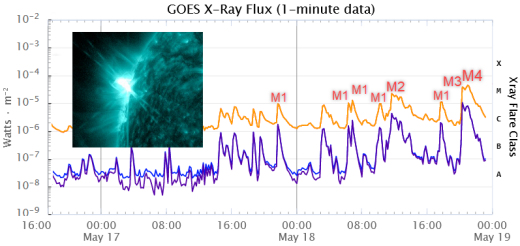
INTENSIFYING SOLAR ACTIVITY: By the time you finish reading this, the sun will have probably flared again. Earth-orbiting satellites are detecting an almost non-stop fusillade of M-class flares so closely-spaced they overlap in time:
https://spaceweather.com/images2023/18may23/crackling_strip.jpg
https://spaceweather.com/images2023/18may23/crackling_strip.jpg
👍6
GLANCING-BLOW CME: NOAA forecasters say that a CME might deliver a glancing blow to Earth's magnetic field on May 21st. It left the sun May 17th, propelled by an erupting filament of magnetism in the sun's southern hemisphere. The impact could produce minor G1-class geomagnetic storms.
👍4
Solar wind
speed: 500.9 km/sec
density: 3.12 protons/cm3
Updated: Today at 0407 UT
X-ray Solar Flares
6-hr max: M2 1604 UT May21
24-hr: M5 2306 UT May20
Updated: Today at: 1610 UT
speed: 500.9 km/sec
density: 3.12 protons/cm3
Updated: Today at 0407 UT
X-ray Solar Flares
6-hr max: M2 1604 UT May21
24-hr: M5 2306 UT May20
Updated: Today at: 1610 UT
👍3
Space Weather Today pinned «Solar wind speed: 500.9 km/sec density: 3.12 protons/cm3 Updated: Today at 0407 UT X-ray Solar Flares 6-hr max: M2 1604 UT May21 24-hr: M5 2306 UT May20 Updated: Today at: 1610 UT»
A DANGEROUS SUNSPOT: Growing sunspot AR3311 has an unstable 'beta-gamma-delta' magnetic field that harbors energy for strong solar flares. NOAA forecasters say there is a 75% chance of M-class flares and a 35% chance of X-flares on May 21st.
🔥3👏2
Solar wind
speed: 596.4 km/sec
density: 9.70 protons/cm3
Updated: Today at 0550 UT
X-ray Solar Flares
6-hr max: M1 1337 UT May22
24-hr: M1 1337 UT May22
Updated: Today at: 1755 UT
speed: 596.4 km/sec
density: 9.70 protons/cm3
Updated: Today at 0550 UT
X-ray Solar Flares
6-hr max: M1 1337 UT May22
24-hr: M1 1337 UT May22
Updated: Today at: 1755 UT
👍3
Space Weather Today pinned «Solar wind speed: 596.4 km/sec density: 9.70 protons/cm3 Updated: Today at 0550 UT X-ray Solar Flares 6-hr max: M1 1337 UT May22 24-hr: M1 1337 UT May22 Updated: Today at: 1755 UT»