INTENSIFYING SOLAR ACTIVITY: Sunspot complex AR3293-3296 is crackling with strong M-class solar flares--six of them today so far. This short movie from NASA's Solar Dynamics Observatory includes the stongest, an M7-class explosion:
https://spaceweather.com/images2023/03may23/m7_teal_strip_opt.gif
Pulses of extreme UV radiation are causing a rolling series of shortwave radio blackouts around the dayside of Earth. Loss of signal has been greatest over Africa where ham radio operators may have noticed fade-outs at all frequencies below 30 MHz.
https://spaceweather.com/images2023/03may23/m7_teal_strip_opt.gif
Pulses of extreme UV radiation are causing a rolling series of shortwave radio blackouts around the dayside of Earth. Loss of signal has been greatest over Africa where ham radio operators may have noticed fade-outs at all frequencies below 30 MHz.

🔥5
Solar wind
speed: 476.7 km/sec
density: 7.17 protons/cm3
Updated: Today at 0320 UT
X-ray Solar Flares
6-hr max: C4 1214 UT May16
24-hr: C4 1214 UT May16
Updated: Today at: 1525 UT
speed: 476.7 km/sec
density: 7.17 protons/cm3
Updated: Today at 0320 UT
X-ray Solar Flares
6-hr max: C4 1214 UT May16
24-hr: C4 1214 UT May16
Updated: Today at: 1525 UT
👍3
MINOR CME IMPACT STILL POSSIBLE TODAY: NOAA forecasters say that a CME could hit Earth's magnetic field midday (UT) on May 16th. Relatively faint and slow-moving, it was hurled into space on May 12th by an erupting filament of magnetism in the sun's southern hemisphere. No more than minor G1-class geomagnetic storms are expected.
👍3
PARTIALLY ECLIPSED X-FLARE: Earth-orbiting satellites have just detected an M9.6-class solar flare from a sunspot group hiding just behind the sun's southeastern limb. In fact, the explosion was probably X-class albeit partially eclipsed by the edge of the sun. The active region will turn to face Earth later this week.
👍3🔥2⚡1
Space Weather Today pinned «Solar wind speed: 476.7 km/sec density: 7.17 protons/cm3 Updated: Today at 0320 UT X-ray Solar Flares 6-hr max: C4 1214 UT May16 24-hr: C4 1214 UT May16 Updated: Today at: 1525 UT»
Solar wind
speed: 429.8 km/sec
density: 4.34 protons/cm3
Updated: Today at 0312 UT
X-ray Solar Flares
6-hr max: C6 1443 UT May17
24-hr: M9 1643 UT May16
Updated: Today at: 1515 UT
speed: 429.8 km/sec
density: 4.34 protons/cm3
Updated: Today at 0312 UT
X-ray Solar Flares
6-hr max: C6 1443 UT May17
24-hr: M9 1643 UT May16
Updated: Today at: 1515 UT
👍1
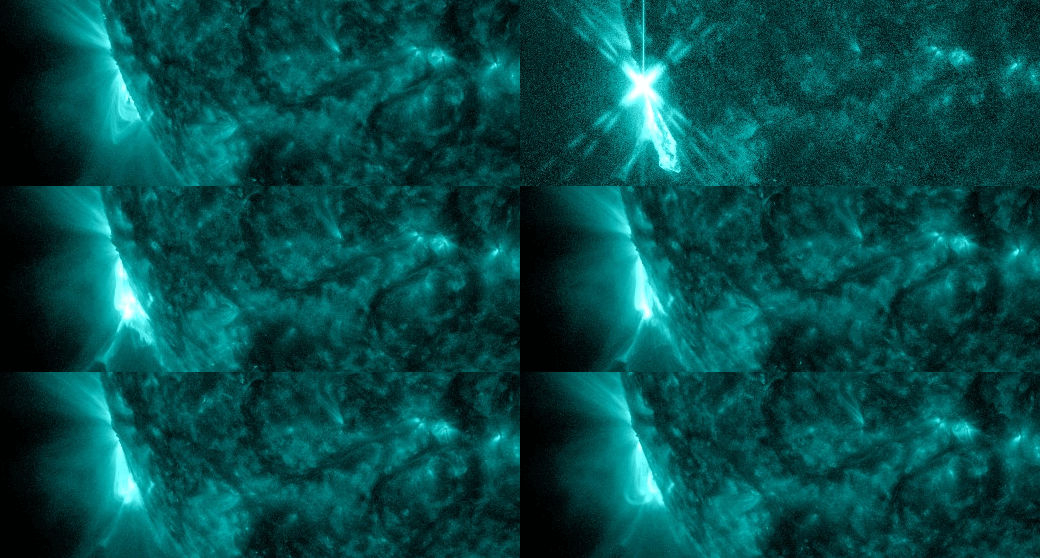
PARTIALLY ECLIPSED X-FLARE: Yesterday, May 16th, Earth-orbiting satellites detected an M9.6-class solar flare from a sunspot hiding behind the sun's southeastern limb. It was only percentage points away from being an X-flare. In fact, it probably was an X-flare partially eclipsed by the edge of the sun.https://spaceweather.com/images2023/16may23/m9p6_teal_anim_strip.gif
👍3
Solar wind
speed: 341.7 km/sec
density: 4.95 protons/cm3
Updated: Today at 0335 UT
X-ray Solar Flares
6-hr max: C6 1239 UT May19
24-hr: M5 0048 UT May19
Updated: Today at: 1540 UT
speed: 341.7 km/sec
density: 4.95 protons/cm3
Updated: Today at 0335 UT
X-ray Solar Flares
6-hr max: C6 1239 UT May19
24-hr: M5 0048 UT May19
Updated: Today at: 1540 UT
👍3
Space Weather Today pinned «Solar wind speed: 341.7 km/sec density: 4.95 protons/cm3 Updated: Today at 0335 UT X-ray Solar Flares 6-hr max: C6 1239 UT May19 24-hr: M5 0048 UT May19 Updated: Today at: 1540 UT»
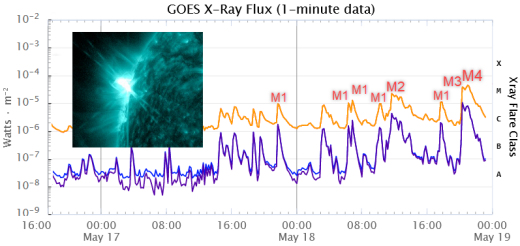
INTENSIFYING SOLAR ACTIVITY: By the time you finish reading this, the sun will have probably flared again. Earth-orbiting satellites are detecting an almost non-stop fusillade of M-class flares so closely-spaced they overlap in time:
https://spaceweather.com/images2023/18may23/crackling_strip.jpg
https://spaceweather.com/images2023/18may23/crackling_strip.jpg
👍6
GLANCING-BLOW CME: NOAA forecasters say that a CME might deliver a glancing blow to Earth's magnetic field on May 21st. It left the sun May 17th, propelled by an erupting filament of magnetism in the sun's southern hemisphere. The impact could produce minor G1-class geomagnetic storms.
👍4
Solar wind
speed: 500.9 km/sec
density: 3.12 protons/cm3
Updated: Today at 0407 UT
X-ray Solar Flares
6-hr max: M2 1604 UT May21
24-hr: M5 2306 UT May20
Updated: Today at: 1610 UT
speed: 500.9 km/sec
density: 3.12 protons/cm3
Updated: Today at 0407 UT
X-ray Solar Flares
6-hr max: M2 1604 UT May21
24-hr: M5 2306 UT May20
Updated: Today at: 1610 UT
👍3