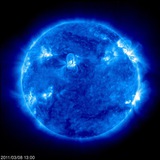
MINOR GEOMAGNETIC STORM WATCH: NOAA forecasters say that minor G1-class geomagnetic storms are possible on May 2nd and 3rd due to the collective effect of several faint CMEs that left the sun over the weekend. They were launched into space by multiple eruptions from sunspot AR3288 and nearby magnetic filaments. A series of near misses and weak impacts could add up to high-latitude auroras in the next 48 hours.
👍4
A SUDDEN DECREASE IN COSMIC RADIATION: Last month, during the late hours of April 23rd, a CME hit Earth's magnetic field. The impact sparked a severe geomagnetic storm with auroras so bright they could be seen as far south as Texas. Invisible to the human eye, something else happened. There was a sudden decrease in cosmic radiation:
https://spaceweather.com/images2023/02may23/forbush_data_crop2_strip.jpg
In a matter of hours, cosmic rays peppering Earth's atmosphere dropped to their lowest levels since 2015. Neutron monitors in Oulu, Finland, detected the drop, which lasted for days.
This is called a "Forbush decrease," named after American physicist Scott Forbush who studied cosmic rays in the early 20th century. It happens when a coronal mass ejection (CME) sweeps past Earth and pushes galactic cosmic rays away from our planet. It sounds counterintuitive, but big solar storms can cause sharp decreases in space radiation.
This Forbush decrease is over, but more are in the offing. Solar Max is coming and soon the sun will be hurling many more CMEs in our direction. Their cumulative effect could create a sustained decrease in cosmic radiation, lowering dose rates for astronauts and air travelers.
https://spaceweather.com/images2023/02may23/forbush_data_crop2_strip.jpg
In a matter of hours, cosmic rays peppering Earth's atmosphere dropped to their lowest levels since 2015. Neutron monitors in Oulu, Finland, detected the drop, which lasted for days.
This is called a "Forbush decrease," named after American physicist Scott Forbush who studied cosmic rays in the early 20th century. It happens when a coronal mass ejection (CME) sweeps past Earth and pushes galactic cosmic rays away from our planet. It sounds counterintuitive, but big solar storms can cause sharp decreases in space radiation.
This Forbush decrease is over, but more are in the offing. Solar Max is coming and soon the sun will be hurling many more CMEs in our direction. Their cumulative effect could create a sustained decrease in cosmic radiation, lowering dose rates for astronauts and air travelers.

👍3🔥3
INTENSIFYING SOLAR ACTIVITY: Sunspot complex AR3293-3296 is crackling with strong M-class solar flares--six of them today so far. This short movie from NASA's Solar Dynamics Observatory includes the stongest, an M7-class explosion:
https://spaceweather.com/images2023/03may23/m7_teal_strip_opt.gif
Pulses of extreme UV radiation are causing a rolling series of shortwave radio blackouts around the dayside of Earth. Loss of signal has been greatest over Africa where ham radio operators may have noticed fade-outs at all frequencies below 30 MHz.
https://spaceweather.com/images2023/03may23/m7_teal_strip_opt.gif
Pulses of extreme UV radiation are causing a rolling series of shortwave radio blackouts around the dayside of Earth. Loss of signal has been greatest over Africa where ham radio operators may have noticed fade-outs at all frequencies below 30 MHz.

🔥5
Solar wind
speed: 476.7 km/sec
density: 7.17 protons/cm3
Updated: Today at 0320 UT
X-ray Solar Flares
6-hr max: C4 1214 UT May16
24-hr: C4 1214 UT May16
Updated: Today at: 1525 UT
speed: 476.7 km/sec
density: 7.17 protons/cm3
Updated: Today at 0320 UT
X-ray Solar Flares
6-hr max: C4 1214 UT May16
24-hr: C4 1214 UT May16
Updated: Today at: 1525 UT
👍3
MINOR CME IMPACT STILL POSSIBLE TODAY: NOAA forecasters say that a CME could hit Earth's magnetic field midday (UT) on May 16th. Relatively faint and slow-moving, it was hurled into space on May 12th by an erupting filament of magnetism in the sun's southern hemisphere. No more than minor G1-class geomagnetic storms are expected.
👍3
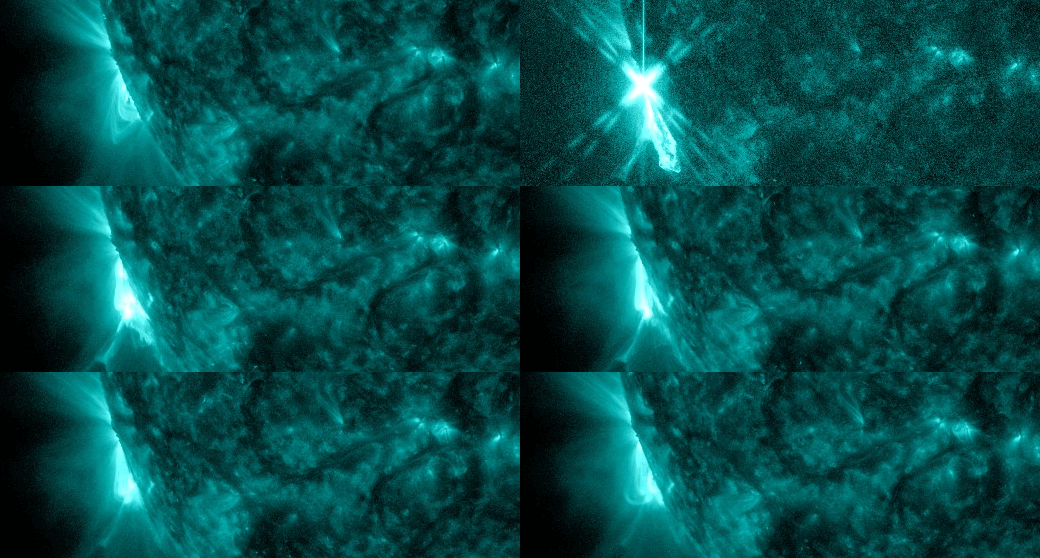
PARTIALLY ECLIPSED X-FLARE: Earth-orbiting satellites have just detected an M9.6-class solar flare from a sunspot group hiding just behind the sun's southeastern limb. In fact, the explosion was probably X-class albeit partially eclipsed by the edge of the sun. The active region will turn to face Earth later this week.
👍3🔥2⚡1
Space Weather Today pinned «Solar wind speed: 476.7 km/sec density: 7.17 protons/cm3 Updated: Today at 0320 UT X-ray Solar Flares 6-hr max: C4 1214 UT May16 24-hr: C4 1214 UT May16 Updated: Today at: 1525 UT»
Solar wind
speed: 429.8 km/sec
density: 4.34 protons/cm3
Updated: Today at 0312 UT
X-ray Solar Flares
6-hr max: C6 1443 UT May17
24-hr: M9 1643 UT May16
Updated: Today at: 1515 UT
speed: 429.8 km/sec
density: 4.34 protons/cm3
Updated: Today at 0312 UT
X-ray Solar Flares
6-hr max: C6 1443 UT May17
24-hr: M9 1643 UT May16
Updated: Today at: 1515 UT
👍1
PARTIALLY ECLIPSED X-FLARE: Yesterday, May 16th, Earth-orbiting satellites detected an M9.6-class solar flare from a sunspot hiding behind the sun's southeastern limb. It was only percentage points away from being an X-flare. In fact, it probably was an X-flare partially eclipsed by the edge of the sun.https://spaceweather.com/images2023/16may23/m9p6_teal_anim_strip.gif
👍3
Solar wind
speed: 341.7 km/sec
density: 4.95 protons/cm3
Updated: Today at 0335 UT
X-ray Solar Flares
6-hr max: C6 1239 UT May19
24-hr: M5 0048 UT May19
Updated: Today at: 1540 UT
speed: 341.7 km/sec
density: 4.95 protons/cm3
Updated: Today at 0335 UT
X-ray Solar Flares
6-hr max: C6 1239 UT May19
24-hr: M5 0048 UT May19
Updated: Today at: 1540 UT
👍3
Space Weather Today pinned «Solar wind speed: 341.7 km/sec density: 4.95 protons/cm3 Updated: Today at 0335 UT X-ray Solar Flares 6-hr max: C6 1239 UT May19 24-hr: M5 0048 UT May19 Updated: Today at: 1540 UT»