Space Weather Today pinned «Solar wind speed: 532.2 km/sec density: 17.87 protons/cm3 Updated: Today at 0540 UT X-ray Solar Flares 6-hr max: C4 1529 UT Apr18 24-hr: C4 1529 UT Apr18 Updated: Today at: 1745 UT»
Solar wind
speed: 453.1 km/sec
density: 7.56 protons/cm3
Updated: Today at 0351 UT
X-ray Solar Flares
6-hr max: C2 1347 UT Apr19
24-hr: C3 0841 UT Apr19
Updated: Today at: 1555 UT
speed: 453.1 km/sec
density: 7.56 protons/cm3
Updated: Today at 0351 UT
X-ray Solar Flares
6-hr max: C2 1347 UT Apr19
24-hr: C3 0841 UT Apr19
Updated: Today at: 1555 UT
👍2
Space Weather Today pinned «Solar wind speed: 453.1 km/sec density: 7.56 protons/cm3 Updated: Today at 0351 UT X-ray Solar Flares 6-hr max: C2 1347 UT Apr19 24-hr: C3 0841 UT Apr19 Updated: Today at: 1555 UT»
Solar Eruption Could Trigger Minor Geomagnetic Storm Tomorrow
NOAA forecasters have issued a warning of a potential minor G1-class geomagnetic storm on April 20th, as a coronal mass ejection (CME) is expected to deliver a glancing blow to Earth's magnetic field. The CME resulted from a solar magnetic filament eruption on April 16th, which is now hurtling towards our planet. While the storm is not expected to cause major disruptions, it could lead to some minor fluctuations in power grids and satellite communication.
NOAA forecasters have issued a warning of a potential minor G1-class geomagnetic storm on April 20th, as a coronal mass ejection (CME) is expected to deliver a glancing blow to Earth's magnetic field. The CME resulted from a solar magnetic filament eruption on April 16th, which is now hurtling towards our planet. While the storm is not expected to cause major disruptions, it could lead to some minor fluctuations in power grids and satellite communication.
👍6
Solar wind
speed: 393.0 km/sec
density: 0.93 protons/cm3
Updated: Today at 1126 UT
X-ray Solar Flares
6-hr max: M1 1812 UT Apr21
24-hr: M1 1812 UT Apr21
Updated: Today at: 2330 UT
speed: 393.0 km/sec
density: 0.93 protons/cm3
Updated: Today at 1126 UT
X-ray Solar Flares
6-hr max: M1 1812 UT Apr21
24-hr: M1 1812 UT Apr21
Updated: Today at: 2330 UT
👍2
Space Weather Today pinned «Solar wind speed: 393.0 km/sec density: 0.93 protons/cm3 Updated: Today at 1126 UT X-ray Solar Flares 6-hr max: M1 1812 UT Apr21 24-hr: M1 1812 UT Apr21 Updated: Today at: 2330 UT»
Sun's Eruption Could Trigger Earth-Directed CME
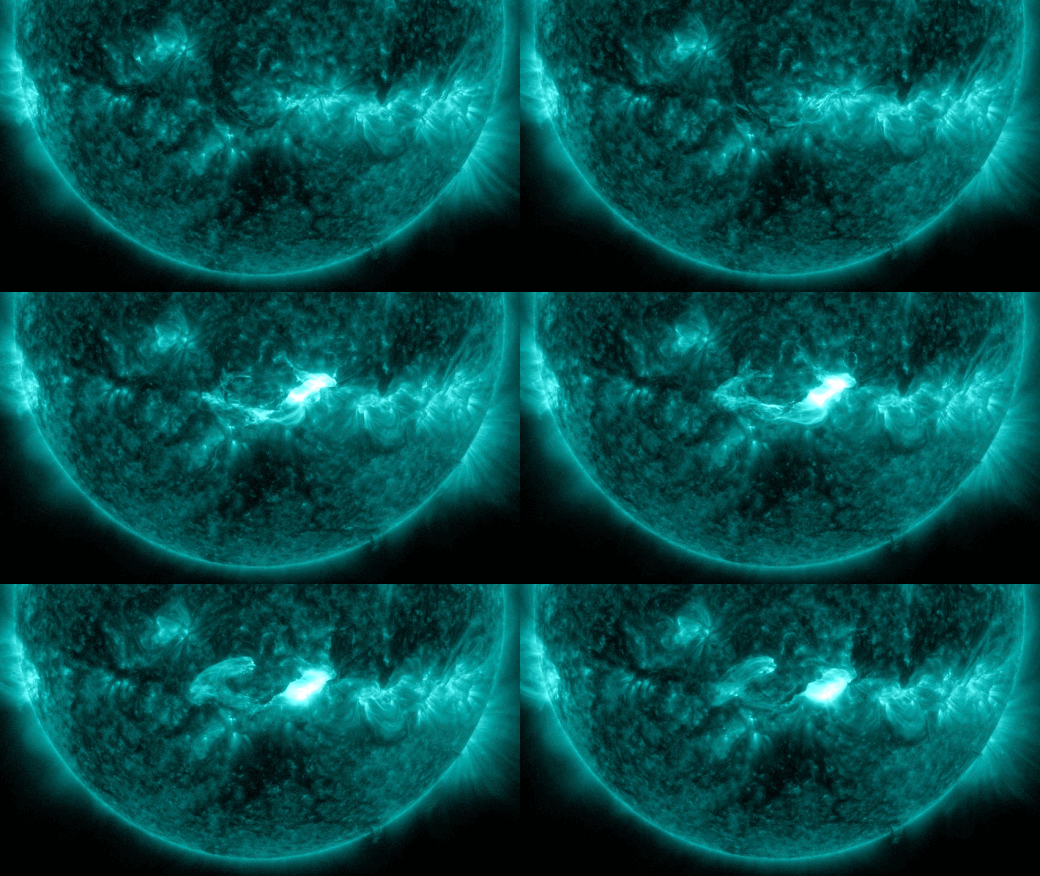
NASA's Solar Dynamics Observatory has detected a significant M2-class solar eruption, as a magnetic filament snaking across the sun's southern hemisphere erupted today.
The eruption may have launched a coronal mass ejection (CME) towards Earth, which is further supported by Type II and Type IV solar radio bursts detected by the US Air Force.
These radio bursts are natural emissions produced by shock waves preceding the CME as it passes through the sun's atmosphere, with drift rates in the Type II burst suggesting a CME velocity of about 580 km/s (1.3 million mph).
https://spaceweather.com/images2023/21apr23/filament_anim_teal_crop_strip.gif
NASA's Solar Dynamics Observatory has detected a significant M2-class solar eruption, as a magnetic filament snaking across the sun's southern hemisphere erupted today.
The eruption may have launched a coronal mass ejection (CME) towards Earth, which is further supported by Type II and Type IV solar radio bursts detected by the US Air Force.
These radio bursts are natural emissions produced by shock waves preceding the CME as it passes through the sun's atmosphere, with drift rates in the Type II burst suggesting a CME velocity of about 580 km/s (1.3 million mph).
https://spaceweather.com/images2023/21apr23/filament_anim_teal_crop_strip.gif
👍5
Slow-Moving CME Could Trigger Minor Geomagnetic Storm Today
NOAA forecasters have issued a warning of a possible minor G1-class geomagnetic storm today, April 21st, as a coronal mass ejection (CME) is expected to impact Earth's magnetic field.
The CME was ejected from the sun on April 16th, and its unusually slow pace in crossing the sun-Earth divide (5 days) suggests that it is unlikely to cause anything more than a minor storm.
While this may lead to minor fluctuations in power grids and satellite communication, it is not expected to cause significant disruptions. Stay tuned for further updates on the status of the storm.
NOAA forecasters have issued a warning of a possible minor G1-class geomagnetic storm today, April 21st, as a coronal mass ejection (CME) is expected to impact Earth's magnetic field.
The CME was ejected from the sun on April 16th, and its unusually slow pace in crossing the sun-Earth divide (5 days) suggests that it is unlikely to cause anything more than a minor storm.
While this may lead to minor fluctuations in power grids and satellite communication, it is not expected to cause significant disruptions. Stay tuned for further updates on the status of the storm.
🔥8👍3
Solar wind
speed: 524.4 km/sec
density: 7.68 protons/cm3
Updated: Today at 0540 UT
X-ray Solar Flares
6-hr max: C2 1305 UT Apr24
24-hr: C2 1305 UT Apr24
Updated: Today at: 1745 UT
speed: 524.4 km/sec
density: 7.68 protons/cm3
Updated: Today at 0540 UT
X-ray Solar Flares
6-hr max: C2 1305 UT Apr24
24-hr: C2 1305 UT Apr24
Updated: Today at: 1745 UT
👍3
THE STORM IS SUBSIDING: A severe G4-class geomagnetic storm that sparked auroras over Europe, China, and most of the United States on April 23-24 is subsiding. The storm was caused by a CME hitting Earth's magnetic field. Minor (G1) to moderate (G2) geomagnetic storm remain possible on March 24-25 as Earth exits the CME's wake.
🔥7
Solar wind
speed: 491.4 km/sec
density: 3.15 protons/cm3
Updated: Today at 0431 UT
X-ray Solar Flares
6-hr max: C2 1059 UT May02
24-hr: C7 2232 UT May01
Updated: Today at: 1635 UT
speed: 491.4 km/sec
density: 3.15 protons/cm3
Updated: Today at 0431 UT
X-ray Solar Flares
6-hr max: C2 1059 UT May02
24-hr: C7 2232 UT May01
Updated: Today at: 1635 UT
👍3
Space Weather Today pinned «Solar wind speed: 491.4 km/sec density: 3.15 protons/cm3 Updated: Today at 0431 UT X-ray Solar Flares 6-hr max: C2 1059 UT May02 24-hr: C7 2232 UT May01 Updated: Today at: 1635 UT»
A MONTH OF SUNSPOTS: April 2023 was a busy month on the sun, with the average sunspot number (96) exceeding official forecasts for the 26th month in a row. To illustrate this development, Senol Sanli of Bursa, Turkey, stacked 30 daily sun images from NASA's Solar Dynamics Observatory to create an April montage:
https://spaceweather.com/images2023/01may23/april_strip.jpg
"This single image shows every sunspot group in April," says Sanli. "It includes every numbered active region from AR3267 to AR3292."
The profusion of sunspots reinforces a growing consensus that Solar Maximum may be coming earlier than expected--perhaps as soon as late 2023. The peak could bring 50% to 100% more sunspots than we are seeing today, cementing Solar Cycle 25 as an above-average cycle. If so, Sanli's monthly sunspot montage might become quite congested indeed. Stay tuned.
https://spaceweather.com/images2023/01may23/april_strip.jpg
"This single image shows every sunspot group in April," says Sanli. "It includes every numbered active region from AR3267 to AR3292."
The profusion of sunspots reinforces a growing consensus that Solar Maximum may be coming earlier than expected--perhaps as soon as late 2023. The peak could bring 50% to 100% more sunspots than we are seeing today, cementing Solar Cycle 25 as an above-average cycle. If so, Sanli's monthly sunspot montage might become quite congested indeed. Stay tuned.

👍6
MINOR GEOMAGNETIC STORM WATCH: NOAA forecasters say that minor G1-class geomagnetic storms are possible on May 2nd and 3rd due to the collective effect of several faint CMEs that left the sun over the weekend. They were launched into space by multiple eruptions from sunspot AR3288 and nearby magnetic filaments. A series of near misses and weak impacts could add up to high-latitude auroras in the next 48 hours.
👍4