Space Weather Today pinned «Solar wind speed: 840.6 km/sec density: 5.70 protons/cm3 Updated: Today at 0251 UT X-ray Solar Flares 6-hr max: C4 1022 UT Feb27 24-hr: C4 1022 UT Feb27 Updated: Today at: 1455 UT»
THE SECOND CME MIGHT HAVE ALREADY ARRIVED: We're still waiting for a second CME to hit Earth's magnetic field *but* it might already be here. On Feb. 27th, between 1000 and 1300 UT, the Faraday Cup on NOAA's DSCOVR satellite went haywire due to a grounding fault. When it regained its senses, the solar wind speed had jumped to 800 km/s, the highest value in years. The CME might have arrived during that time. If so, it means the peak of the storm occurred on Feb 27th at category G3, and we can now expect subsiding G1- to G2-class activity on Feb. 28th.
👍18
Solar wind
speed: 619.7 km/sec
density: 0.44 protons/cm3
Updated: Today at 1032 UT
X-ray Solar Flares
6-hr max: M8 1750 UT Feb28
24-hr: M8 1750 UT Feb28
Updated: Today at: 2235 UT
speed: 619.7 km/sec
density: 0.44 protons/cm3
Updated: Today at 1032 UT
X-ray Solar Flares
6-hr max: M8 1750 UT Feb28
24-hr: M8 1750 UT Feb28
Updated: Today at: 2235 UT
👍1
STRONG GEOMAGNETIC STORMS: One and perhaps two CMEs hit Earth's magnetic field on Feb. 26th and 27th, sparking a series of strong G3-class geomagnetic storms with auroras in both hemispheres. Alexandre Croisier witnessed the light show over Mont Saint-Michel in France:
https://www.spaceweather.com/images2023/27feb23/france_strip.jpg
"The Northern Lights were really impressive, with a fantastic red color," says Croisier. "It was a short moment, only about 1 minute with such bright auroras, but truly wonderful to see from one of the most beautiful places in Europe."
Mont Saint-Michel is a small island located off the coast of Normandy. It is home to a stunning medieval abbey that rises majestically above the surrounding landscape. The island has a rich history dating back to the 8th century when it was first used as a religious retreat. Over the years, it has been a fortress, a prison, a place of pilgrimage--and now, the centerpiece of a fantastic auroral display.
https://www.spaceweather.com/images2023/27feb23/france_strip.jpg
"The Northern Lights were really impressive, with a fantastic red color," says Croisier. "It was a short moment, only about 1 minute with such bright auroras, but truly wonderful to see from one of the most beautiful places in Europe."
Mont Saint-Michel is a small island located off the coast of Normandy. It is home to a stunning medieval abbey that rises majestically above the surrounding landscape. The island has a rich history dating back to the 8th century when it was first used as a religious retreat. Over the years, it has been a fortress, a prison, a place of pilgrimage--and now, the centerpiece of a fantastic auroral display.

👍4
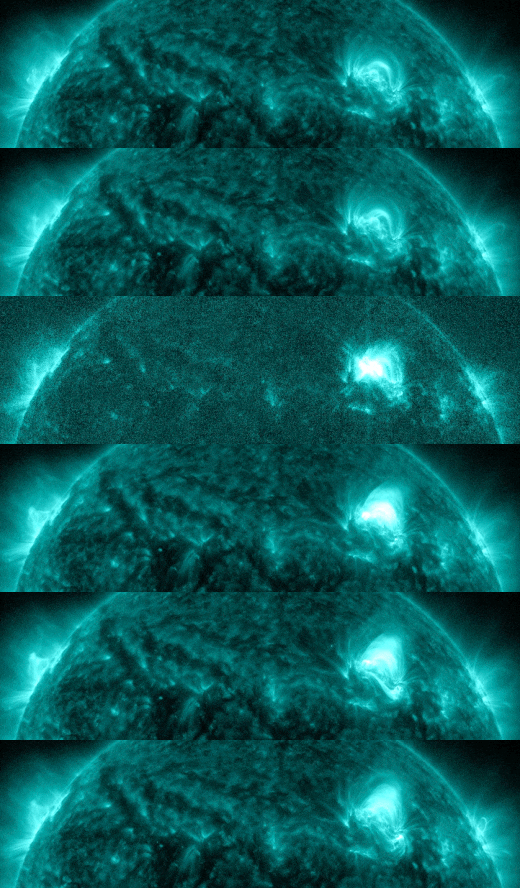
ANOTHER STRONG SOLAR FLARE: Sunspot AR3234 exploded today, Feb. 28th at 1750 UTC, producing an M8.6-class solar flare, percentage points below X-class. NASA's Solar Dynamics Observatory recorded the extreme ultraviolet flash:
https://www.spaceweather.com/images2023/28feb23/m9_teal_anim_crop_strip_opt.gif
An impulsive burst of X-rays ionized the top of Earth's atmosphere, causing a shortwave radio blackout over the Americas. Aviators and ham radio operators may have noticed loss of signal below 30 MHz for a half hour or more after the flare. Stay tuned for updates about a possible CME.
https://www.spaceweather.com/images2023/28feb23/m9_teal_anim_crop_strip_opt.gif
An impulsive burst of X-rays ionized the top of Earth's atmosphere, causing a shortwave radio blackout over the Americas. Aviators and ham radio operators may have noticed loss of signal below 30 MHz for a half hour or more after the flare. Stay tuned for updates about a possible CME.
Solar wind
speed: 587.4 km/sec
density: 8.04 protons/cm3
Updated: Today at 0151 UT
X-ray Solar Flares
6-hr max: C4 1351 UT Mar01
24-hr: M8 1750 UT Feb28
Updated: Today at: 1355 UT
speed: 587.4 km/sec
density: 8.04 protons/cm3
Updated: Today at 0151 UT
X-ray Solar Flares
6-hr max: C4 1351 UT Mar01
24-hr: M8 1750 UT Feb28
Updated: Today at: 1355 UT
🔥2
MID-LATITUDE AURORAS: One and perhaps two CMEs hit Earth's magnetic field on Feb. 26th and 27th, sparking a series of strong G3-class geomagnetic storms. Auroras descended to unusually low latitudes including Albany, Missouri (+40N); Fort Collins, Colorado (+40.6N); West Oak, Nebraska (+41N); and La Grande, Oregon (+45N). Apparently, you don't have to live inside the Arctic Circle to see auroras--although it's better if you do.
❤6👍3
Space Weather Today pinned «Solar wind speed: 587.4 km/sec density: 8.04 protons/cm3 Updated: Today at 0151 UT X-ray Solar Flares 6-hr max: C4 1351 UT Mar01 24-hr: M8 1750 UT Feb28 Updated: Today at: 1355 UT»
Solar wind
speed: 472.0 km/sec
density: 10.80 protons/cm3
Updated: Today at 0646 UT
X-ray Solar Flares
6-hr max: C3 1628 UT Mar02
24-hr: C9 0450 UT Mar02
Updated: Today at: 1850 UT
speed: 472.0 km/sec
density: 10.80 protons/cm3
Updated: Today at 0646 UT
X-ray Solar Flares
6-hr max: C3 1628 UT Mar02
24-hr: C9 0450 UT Mar02
Updated: Today at: 1850 UT
👍3
GLANCING-BLOW CME POSSIBLE THIS WEEK: Yesterday's M8.6-class solar flare (movie) produced a faint CME. NOAA analysts have determined that it might deliver a glancing blow to Earth's magnetic field on March 4th. Minor G1-class geomagnetic storms are possible on that date.
👍4
Solar wind
speed: 584.5 km/sec
density: 0.59 protons/cm3
Updated: Today at 0156 UT
X-ray Solar Flares
6-hr max: M3 1032 UT Mar03
24-hr: M3 2116 UT Mar02
Updated: Today at: 1400 UT
speed: 584.5 km/sec
density: 0.59 protons/cm3
Updated: Today at 0156 UT
X-ray Solar Flares
6-hr max: M3 1032 UT Mar03
24-hr: M3 2116 UT Mar02
Updated: Today at: 1400 UT
👍1🔥1
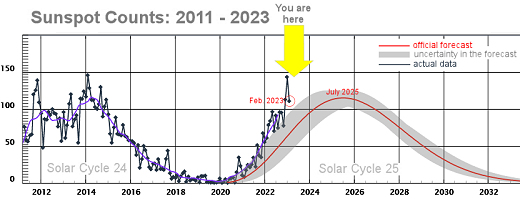
SOLAR CYCLE UPDATE: February was another strong month for Solar Cycle 25. According to NOAA, the average sunspot number was among the highest of the past 10 years:
https://www.spaceweather.com/images2023/02mar23/sunspotcounts_strip.jpg
Originally, forecasters thought Solar Cycle 25 would be about the same as Solar Cycle 24, one of the weakest solar cycles in a century. February's sunspot numbers are the latest sign that Solar Cycle 25 will exceed predictions. In fact, Solar Cycle 25 has outperformed the official forecast for more than 24 months in a row.
Solar Maximum is not expected until 2024 or 2025, so the solar cycle has plenty of time to strengthen even more, bringing additional X-flares, geomagnetic storms and auroras.
https://www.spaceweather.com/images2023/02mar23/sunspotcounts_strip.jpg
Originally, forecasters thought Solar Cycle 25 would be about the same as Solar Cycle 24, one of the weakest solar cycles in a century. February's sunspot numbers are the latest sign that Solar Cycle 25 will exceed predictions. In fact, Solar Cycle 25 has outperformed the official forecast for more than 24 months in a row.
Solar Maximum is not expected until 2024 or 2025, so the solar cycle has plenty of time to strengthen even more, bringing additional X-flares, geomagnetic storms and auroras.
👍3
GEOMAGNETIC STORM WATCH: Minor G1-class geomagnetic storms are possible on March 4th and 5th in response to an incoming CME. Hurled into space by the M8.6-class flare of Feb. 28th, the CME is not heading directly for Earth. Instead it will deliver only a glancing blow when it arrives.
👍3
Space Weather Today pinned «Solar wind speed: 584.5 km/sec density: 0.59 protons/cm3 Updated: Today at 0156 UT X-ray Solar Flares 6-hr max: M3 1032 UT Mar03 24-hr: M3 2116 UT Mar02 Updated: Today at: 1400 UT»
Solar wind
speed: 550.3 km/sec
density: 0.72 protons/cm3
Updated: Today at 0151 UT
X-ray Solar Flares
6-hr max: C6 0948 UT Mar06
24-hr: M5 0228 UT Mar06
Updated: Today at: 1355 UT
speed: 550.3 km/sec
density: 0.72 protons/cm3
Updated: Today at 0151 UT
X-ray Solar Flares
6-hr max: C6 0948 UT Mar06
24-hr: M5 0228 UT Mar06
Updated: Today at: 1355 UT
🔥1
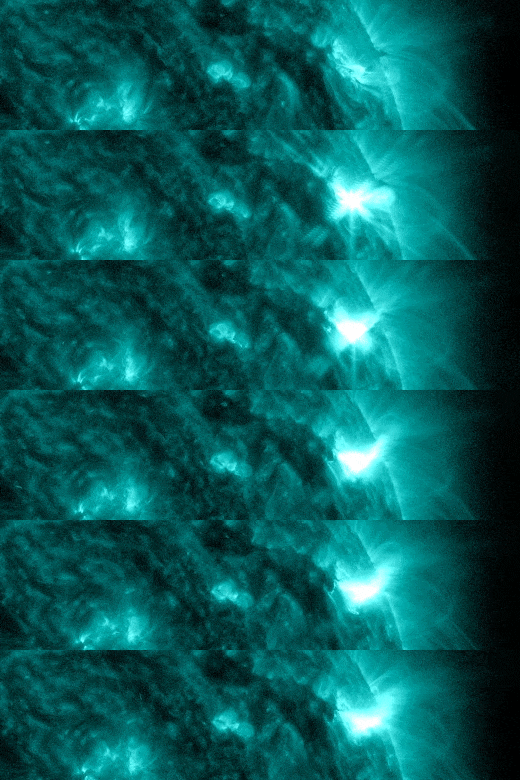
SOLAR FLARE AND CME: Solar activity is high with multiple strong M-class solar flares over the weekend. The strongest so far, an M5.8-class explosion from sunspot AR3243 on March 6th (0228 UTC), caused a shortwave radio blackout over Australia: https://www.spaceweather.com/images2023/06mar23/m6_teal_anim_strip_opt.gif
👏3