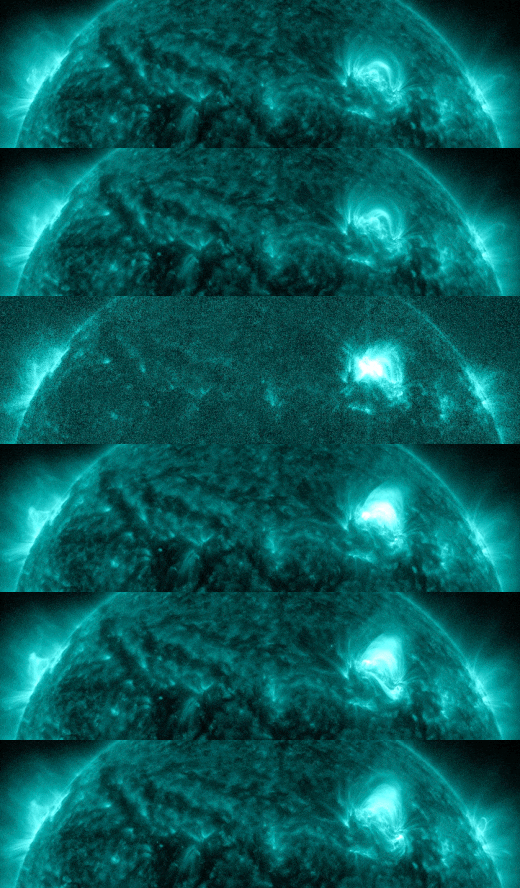
STRONG SOLAR ACTIVITY: Sunspot AR3234 is crackling with solar flares including multiple M4- and M5-class events on Feb. 21st. This interest-compressed movie from NASA's Solar Dynamics Observatory shows yesterday's extreme ultraviolet flashes:
https://www.spaceweather.com/images2023/21feb23/interestcompressed_strip_opt.gif
Pulses of radiation from AR3234 are ionizing the top of Earth's atmosphere, causing a rolling series of shortwave radio blackouts around all longitudes of our planet. While this activity continues, ham radio operators may notice intermittent loss of signal and other unusual propagation effects at frequencies below ~20 MHz.
https://www.spaceweather.com/images2023/21feb23/interestcompressed_strip_opt.gif
Pulses of radiation from AR3234 are ionizing the top of Earth's atmosphere, causing a rolling series of shortwave radio blackouts around all longitudes of our planet. While this activity continues, ham radio operators may notice intermittent loss of signal and other unusual propagation effects at frequencies below ~20 MHz.
👍6
Solar wind
speed: 540.3 km/sec
density: 1.84 protons/cm3
Updated: Today at 0200 UT
X-ray Solar Flares
6-hr max: M1 0901 UT Feb23
24-hr: M1 0614 UT Feb23
Updated: Today at: 1405 UT
speed: 540.3 km/sec
density: 1.84 protons/cm3
Updated: Today at 0200 UT
X-ray Solar Flares
6-hr max: M1 0901 UT Feb23
24-hr: M1 0614 UT Feb23
Updated: Today at: 1405 UT
🔥4
Space Weather Today pinned «Solar wind speed: 540.3 km/sec density: 1.84 protons/cm3 Updated: Today at 0200 UT X-ray Solar Flares 6-hr max: M1 0901 UT Feb23 24-hr: M1 0614 UT Feb23 Updated: Today at: 1405 UT»
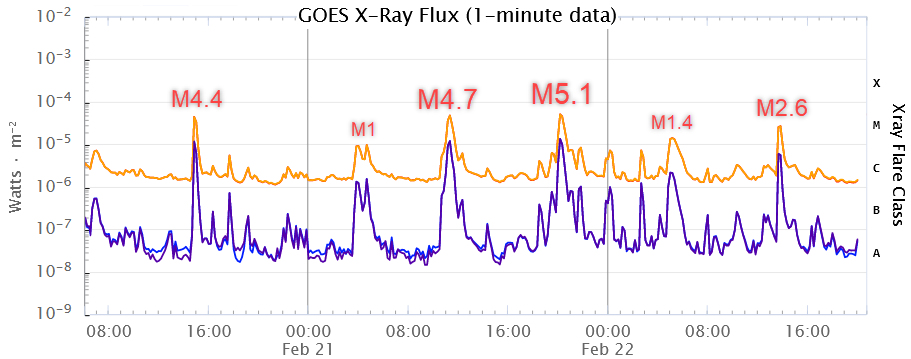
NO CMES ARE HEADING OUR WAY: For the past three days, the sun has emitted a non-stop fusillade of solar flares. Yet no CMEs are heading our way. Why not? The source of the explosions, sunspot AR3234, was not facing Earth. This is about to change, however, as the the sun's rotation turns the sunspot more directly toward our planet. https://www.spaceweather.com/images2023/22feb23/mflares.jpg
👍7
Solar wind
speed: 500.4 km/sec
density: 8.23 protons/cm3
Updated: Today at 0310 UT
X-ray Solar Flares
6-hr max: C2 1309 UT Feb24
24-hr: C8 1819 UT Feb23
Updated: Today at: 1515 UT
speed: 500.4 km/sec
density: 8.23 protons/cm3
Updated: Today at 0310 UT
X-ray Solar Flares
6-hr max: C2 1309 UT Feb24
24-hr: C8 1819 UT Feb23
Updated: Today at: 1515 UT
🔥3
Space Weather Today pinned «Solar wind speed: 500.4 km/sec density: 8.23 protons/cm3 Updated: Today at 0310 UT X-ray Solar Flares 6-hr max: C2 1309 UT Feb24 24-hr: C8 1819 UT Feb23 Updated: Today at: 1515 UT»
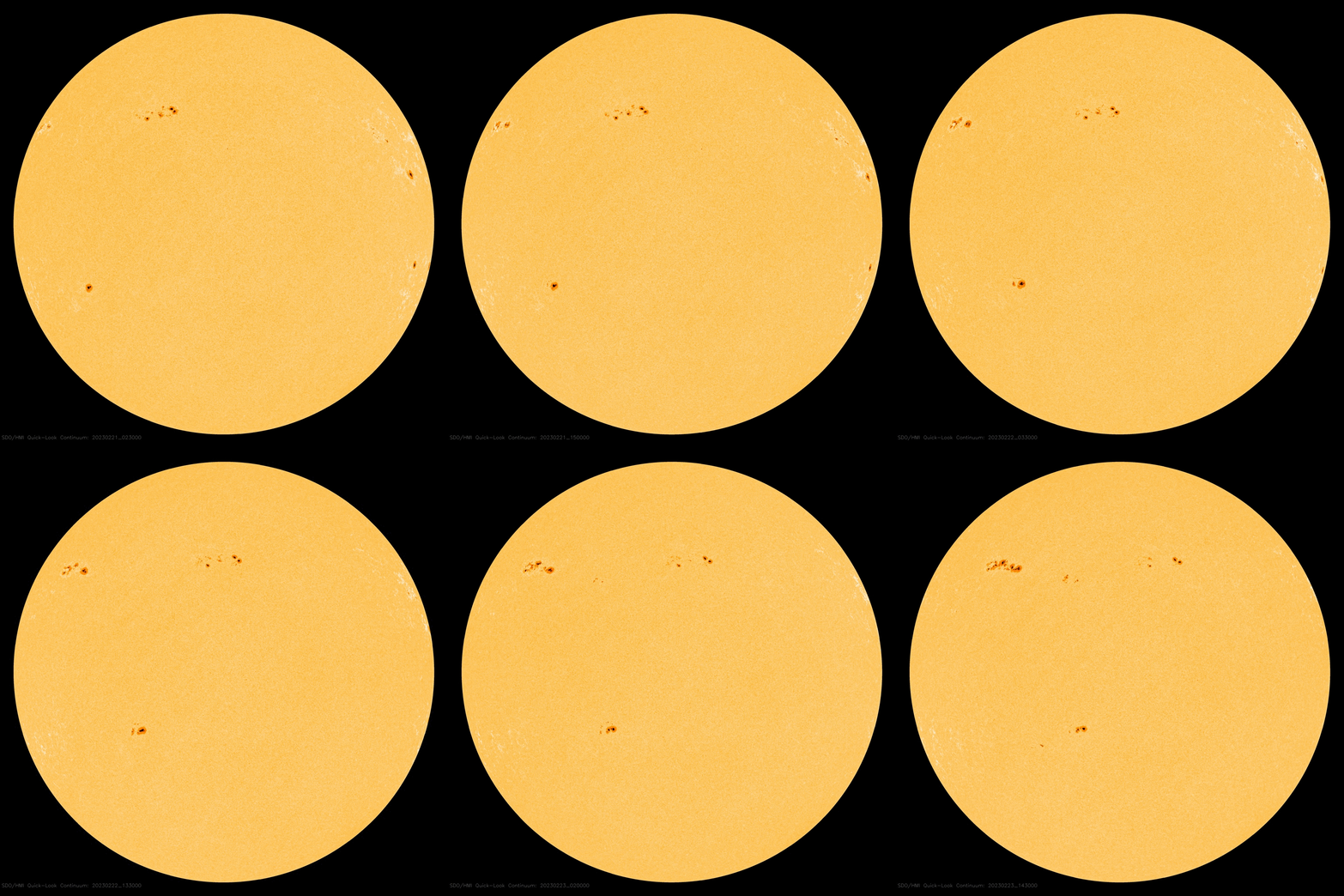
A DANGEROUS SUNSPOT: Active sunspot AR3234 is not only turning toward Earth, but also growing rapidly. This 48-hour movie from NASA's Solar Dynamics Observatory shows AR3234 quadrupling in size as it comes around the solar limb:
https://www.spaceweather.com/images2023/23feb23/evolution.gif
AR3234 has a 'delta-class' magnetic field that harbors energy for strong solar flares. NOAA forecasters estimate a 60% chance of M-class flares and a 20% chance of X-flares on Feb. 24th.
https://www.spaceweather.com/images2023/23feb23/evolution.gif
AR3234 has a 'delta-class' magnetic field that harbors energy for strong solar flares. NOAA forecasters estimate a 60% chance of M-class flares and a 20% chance of X-flares on Feb. 24th.
🔥6👍3
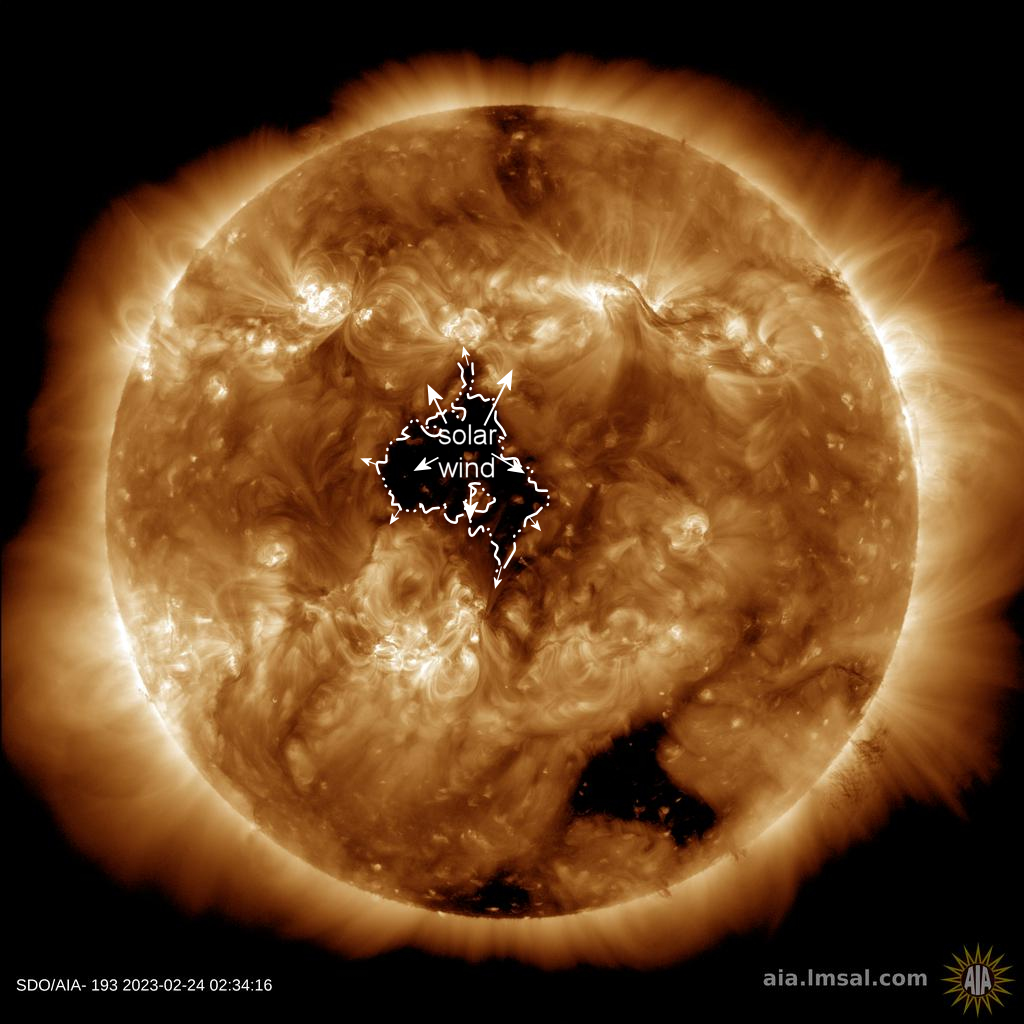
INCOMING SOLAR WIND STREAM: A stream of solar wind is approaching Earth. ETA: Feb. 26-27. The gaseous material is flowing from an equatorial hole in the sun's atmosphere, and it could spark a minor G1-class geomagnetic storm when it arrives. https://www.spaceweather.com/images2023/24feb23/ch.jpg
🔥6❤1👍1
Solar wind
speed: 840.6 km/sec
density: 5.70 protons/cm3
Updated: Today at 0251 UT
X-ray Solar Flares
6-hr max: C4 1022 UT Feb27
24-hr: C4 1022 UT Feb27
Updated: Today at: 1455 UT
speed: 840.6 km/sec
density: 5.70 protons/cm3
Updated: Today at 0251 UT
X-ray Solar Flares
6-hr max: C4 1022 UT Feb27
24-hr: C4 1022 UT Feb27
Updated: Today at: 1455 UT
🔥6
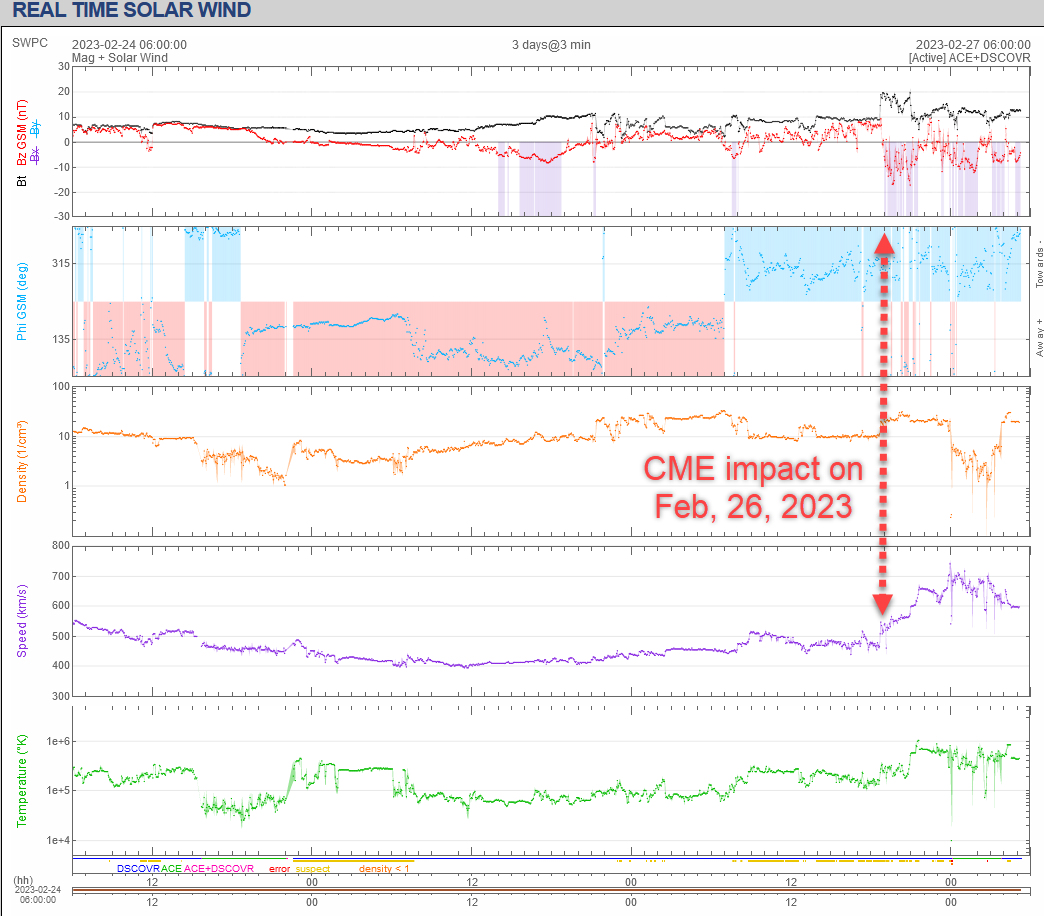
STRONG GEOMAGNETIC STORM: A strong G3-class geomagnetic storm is underway on Feb. 27th following the impact of a CME during the late hours of Feb. 26th. Solar wind around Earth is now blowing faster than 800 km/s, the highest value in years, and auroras have been sighted as far south as Colorado. A second CME might arrive later today, energizing the storm even more. Stay tuned. https://www.spaceweather.com/images2023/26feb23/cmeimpact2.jpg
🔥9
Space Weather Today pinned «Solar wind speed: 840.6 km/sec density: 5.70 protons/cm3 Updated: Today at 0251 UT X-ray Solar Flares 6-hr max: C4 1022 UT Feb27 24-hr: C4 1022 UT Feb27 Updated: Today at: 1455 UT»
THE SECOND CME MIGHT HAVE ALREADY ARRIVED: We're still waiting for a second CME to hit Earth's magnetic field *but* it might already be here. On Feb. 27th, between 1000 and 1300 UT, the Faraday Cup on NOAA's DSCOVR satellite went haywire due to a grounding fault. When it regained its senses, the solar wind speed had jumped to 800 km/s, the highest value in years. The CME might have arrived during that time. If so, it means the peak of the storm occurred on Feb 27th at category G3, and we can now expect subsiding G1- to G2-class activity on Feb. 28th.
👍18
Solar wind
speed: 619.7 km/sec
density: 0.44 protons/cm3
Updated: Today at 1032 UT
X-ray Solar Flares
6-hr max: M8 1750 UT Feb28
24-hr: M8 1750 UT Feb28
Updated: Today at: 2235 UT
speed: 619.7 km/sec
density: 0.44 protons/cm3
Updated: Today at 1032 UT
X-ray Solar Flares
6-hr max: M8 1750 UT Feb28
24-hr: M8 1750 UT Feb28
Updated: Today at: 2235 UT
👍1
STRONG GEOMAGNETIC STORMS: One and perhaps two CMEs hit Earth's magnetic field on Feb. 26th and 27th, sparking a series of strong G3-class geomagnetic storms with auroras in both hemispheres. Alexandre Croisier witnessed the light show over Mont Saint-Michel in France:
https://www.spaceweather.com/images2023/27feb23/france_strip.jpg
"The Northern Lights were really impressive, with a fantastic red color," says Croisier. "It was a short moment, only about 1 minute with such bright auroras, but truly wonderful to see from one of the most beautiful places in Europe."
Mont Saint-Michel is a small island located off the coast of Normandy. It is home to a stunning medieval abbey that rises majestically above the surrounding landscape. The island has a rich history dating back to the 8th century when it was first used as a religious retreat. Over the years, it has been a fortress, a prison, a place of pilgrimage--and now, the centerpiece of a fantastic auroral display.
https://www.spaceweather.com/images2023/27feb23/france_strip.jpg
"The Northern Lights were really impressive, with a fantastic red color," says Croisier. "It was a short moment, only about 1 minute with such bright auroras, but truly wonderful to see from one of the most beautiful places in Europe."
Mont Saint-Michel is a small island located off the coast of Normandy. It is home to a stunning medieval abbey that rises majestically above the surrounding landscape. The island has a rich history dating back to the 8th century when it was first used as a religious retreat. Over the years, it has been a fortress, a prison, a place of pilgrimage--and now, the centerpiece of a fantastic auroral display.

👍4
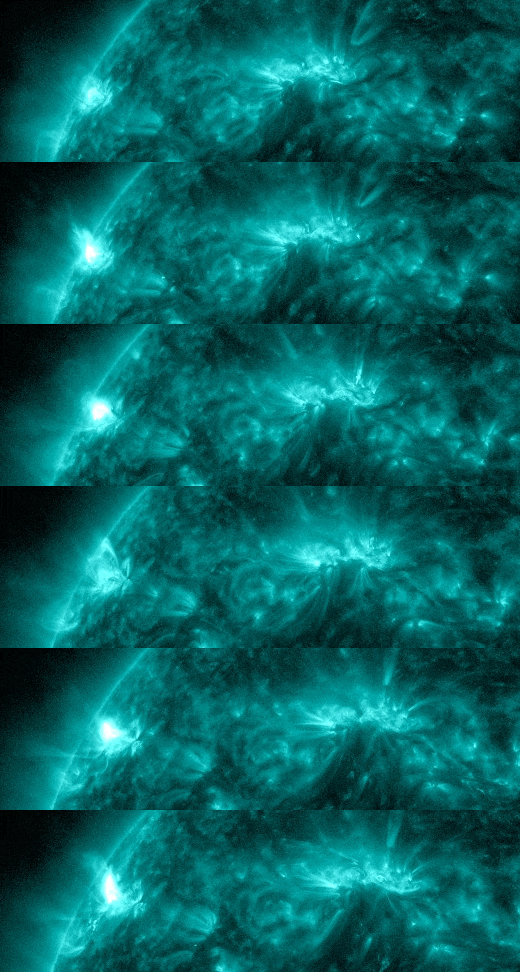
ANOTHER STRONG SOLAR FLARE: Sunspot AR3234 exploded today, Feb. 28th at 1750 UTC, producing an M8.6-class solar flare, percentage points below X-class. NASA's Solar Dynamics Observatory recorded the extreme ultraviolet flash:
https://www.spaceweather.com/images2023/28feb23/m9_teal_anim_crop_strip_opt.gif
An impulsive burst of X-rays ionized the top of Earth's atmosphere, causing a shortwave radio blackout over the Americas. Aviators and ham radio operators may have noticed loss of signal below 30 MHz for a half hour or more after the flare. Stay tuned for updates about a possible CME.
https://www.spaceweather.com/images2023/28feb23/m9_teal_anim_crop_strip_opt.gif
An impulsive burst of X-rays ionized the top of Earth's atmosphere, causing a shortwave radio blackout over the Americas. Aviators and ham radio operators may have noticed loss of signal below 30 MHz for a half hour or more after the flare. Stay tuned for updates about a possible CME.