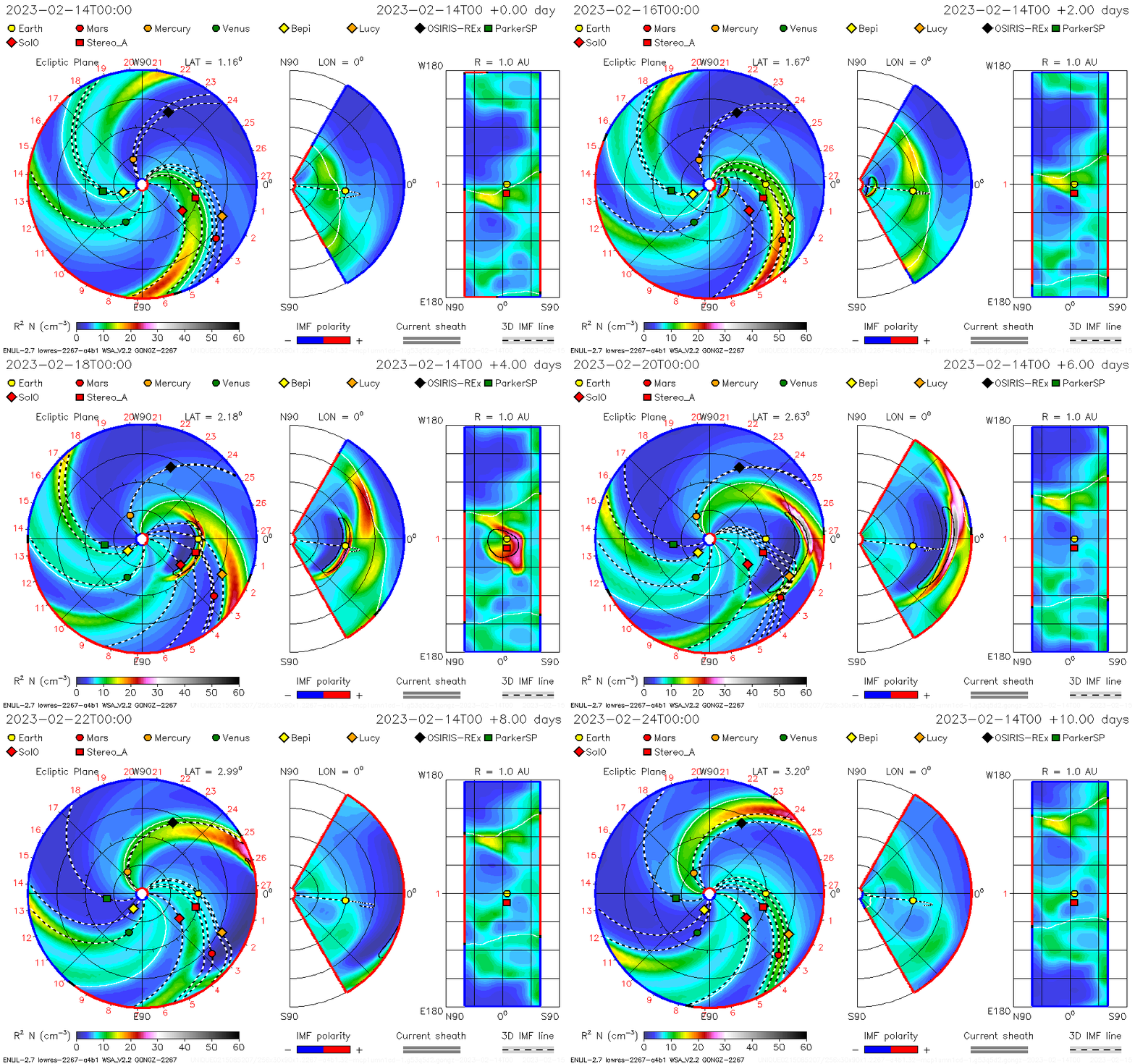
GEOMAGNETIC STORM WATCH: Photographers, warm up your cameras. A CME is heading for Earth, and it could spark a good display of auroras when it arrives later today or tomorrow. NASA's computer model of the CME suggests it will reach Earth on Feb. 17th at 1800 UT. First contact is expected to produce a minor G1-class geomagnetic storm, intensifying to moderate G2-class storming on Feb. 18th. During such storms, auroras can spill into the United States as far south as New York and Idaho. https://www.spaceweather.com/images2023/15feb23/nasamodel2.gif
👍5🔥2
Solar wind
speed: 427.2 km/sec
density: 5.32 protons/cm3
Updated: Today at 0401 UT
X-ray Solar Flares
6-hr max: C7 1200 UT Feb18
24-hr: X2 2016 UT Feb17
Updated: Today at: 1605 UT
speed: 427.2 km/sec
density: 5.32 protons/cm3
Updated: Today at 0401 UT
X-ray Solar Flares
6-hr max: C7 1200 UT Feb18
24-hr: X2 2016 UT Feb17
Updated: Today at: 1605 UT
👍3
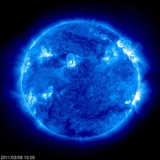
STRONG X2-CLASS SOLAR FLARE: New sunspot AR3229 erupted on Feb. 17th (2016 UT), producing a strong X2.2-class solar flare. NASA's Solar Dynamics Observatory (SDO) recorded the extreme ultraviolet pulse: https://www.spaceweather.com/images2023/17feb23/blackoutmap_strip.jpg
🔥6
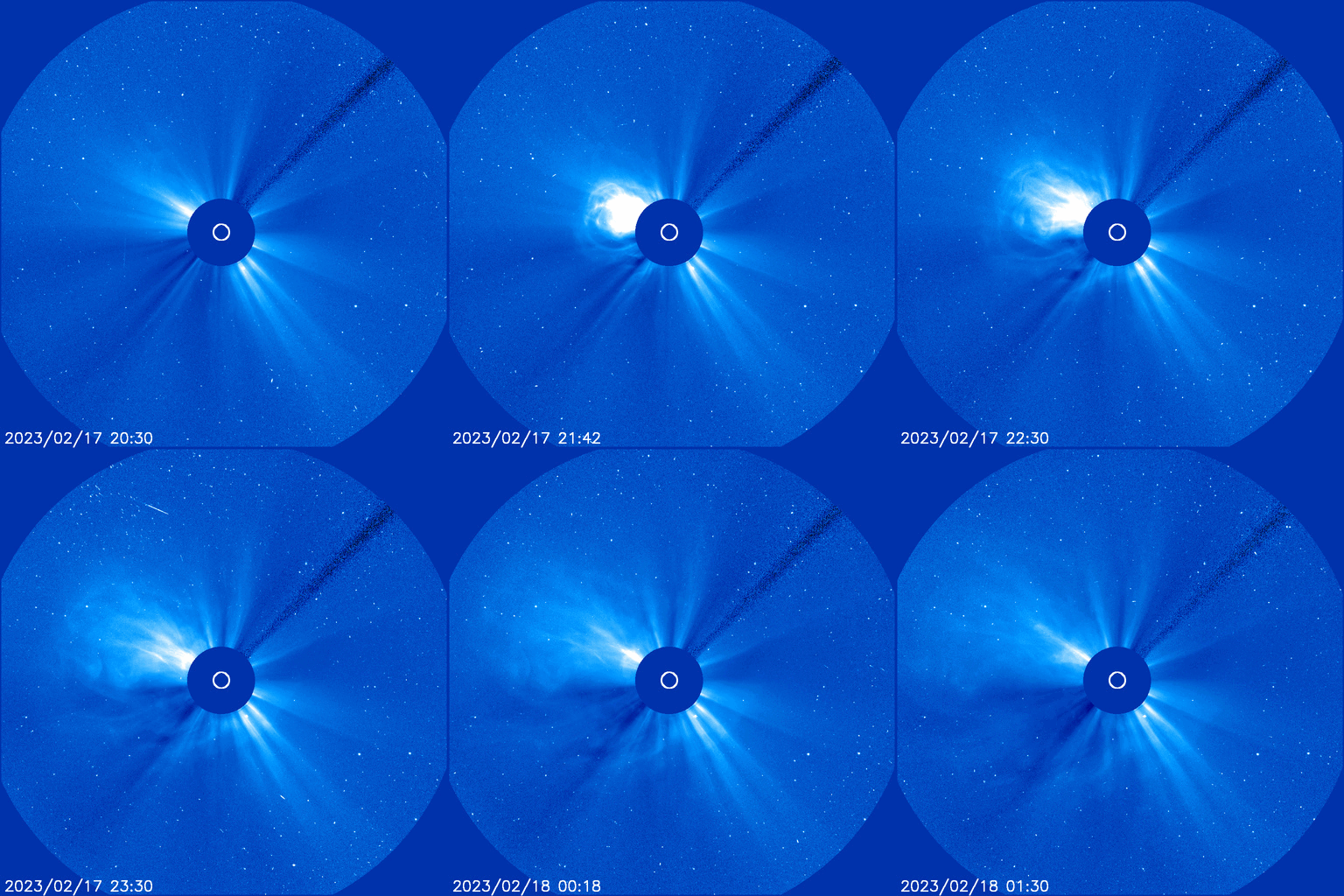
CONFIRMED: A CME IS COMING: Yesterday's X2.2-class solar flare (described below) produced a CME, and it has an Earth-directed component. Coronagraphs onboard the Solar and Heliospheric Observatory (SOHO) recorded a lopsided halo emerging from the blast site:
https://www.spaceweather.com/images2023/17feb23/x2_cme.gif
The flank of the CME will probably strike Earth on Feb. 20th. Geomagnetic storms ranging from category G1 (Minor) to G3 (Strong) are possible after the CME arrives. NOAA analysts are currently modeling the CME's internal structure and trajectory. Refinements to this forecast may be made, depending on their results.
https://www.spaceweather.com/images2023/17feb23/x2_cme.gif
The flank of the CME will probably strike Earth on Feb. 20th. Geomagnetic storms ranging from category G1 (Minor) to G3 (Strong) are possible after the CME arrives. NOAA analysts are currently modeling the CME's internal structure and trajectory. Refinements to this forecast may be made, depending on their results.
🔥12👍1
Solar wind
speed: 450.7 km/sec
density: 11.70 protons/cm3
Updated: Today at 0835 UT
X-ray Solar Flares
6-hr max: M4 1458 UT Feb20
24-hr: M4 1458 UT Feb20
Updated: Today at: 2040 UT
speed: 450.7 km/sec
density: 11.70 protons/cm3
Updated: Today at 0835 UT
X-ray Solar Flares
6-hr max: M4 1458 UT Feb20
24-hr: M4 1458 UT Feb20
Updated: Today at: 2040 UT
🔥4👍1
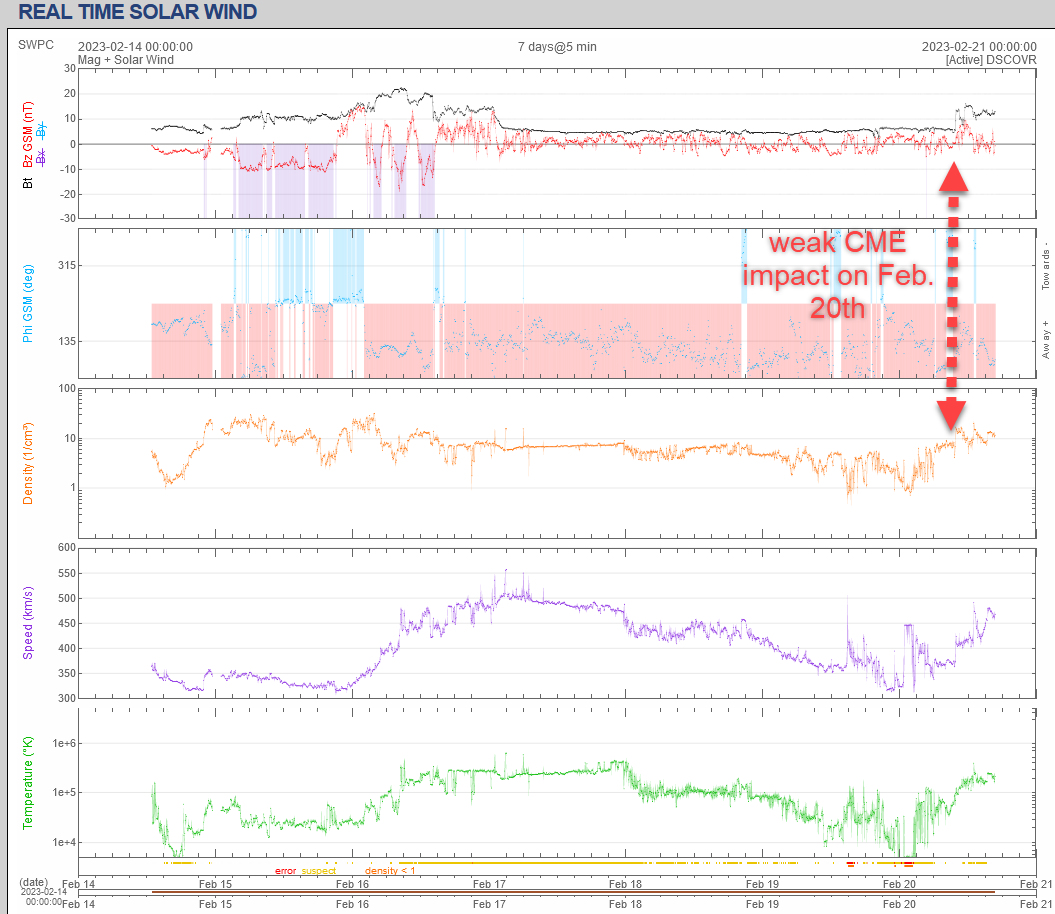
WEAK IMPACT: A CME struck Earth's magnetic field on Feb. 20th at 10:39 UTC. The impact was weak and did not cause a geomagnetic storm. If this was the CME from Friday's X2.2 flare (the jury's still out) then NOAA's forecast of a weak glancing blow was correct, and the geomagnetic storm watch can be cancelled. https://www.spaceweather.com/images2023/20feb23/weakimpact.jpg
👍4👏2
Jupiter and Venus in Zodiacal Lights
Taken by Ruslan Merzlyakov on February 13, 2023 @ Lanjaron, Spain
https://spaceweathergallery2.com/indiv_upload.php?upload_id=192866
Taken by Ruslan Merzlyakov on February 13, 2023 @ Lanjaron, Spain
https://spaceweathergallery2.com/indiv_upload.php?upload_id=192866
❤16
Solar wind
speed: 401.2 km/sec
density: 4.44 protons/cm3
Updated: Today at 0207 UT
X-ray Solar Flares
6-hr max: M4 1123 UT Feb21
24-hr: M4 1123 UT Feb21
Updated: Today at: 1410 UT
speed: 401.2 km/sec
density: 4.44 protons/cm3
Updated: Today at 0207 UT
X-ray Solar Flares
6-hr max: M4 1123 UT Feb21
24-hr: M4 1123 UT Feb21
Updated: Today at: 1410 UT
👍4
Aurora
Taken by Matt Melnyk on February 20, 2023 @ Calgary, Alberta, Canada
https://spaceweathergallery2.com/indiv_upload.php?upload_id=192982
Taken by Matt Melnyk on February 20, 2023 @ Calgary, Alberta, Canada
https://spaceweathergallery2.com/indiv_upload.php?upload_id=192982
❤9👍4
Solar wind
speed: 469.4 km/sec
density: 8.52 protons/cm3
Updated: Today at 0222 UT
X-ray Solar Flares
6-hr max: M2 1350 UT Feb22
24-hr: M5 2017 UT Feb21
Updated: Today at: 1425 UT
speed: 469.4 km/sec
density: 8.52 protons/cm3
Updated: Today at 0222 UT
X-ray Solar Flares
6-hr max: M2 1350 UT Feb22
24-hr: M5 2017 UT Feb21
Updated: Today at: 1425 UT
👍4
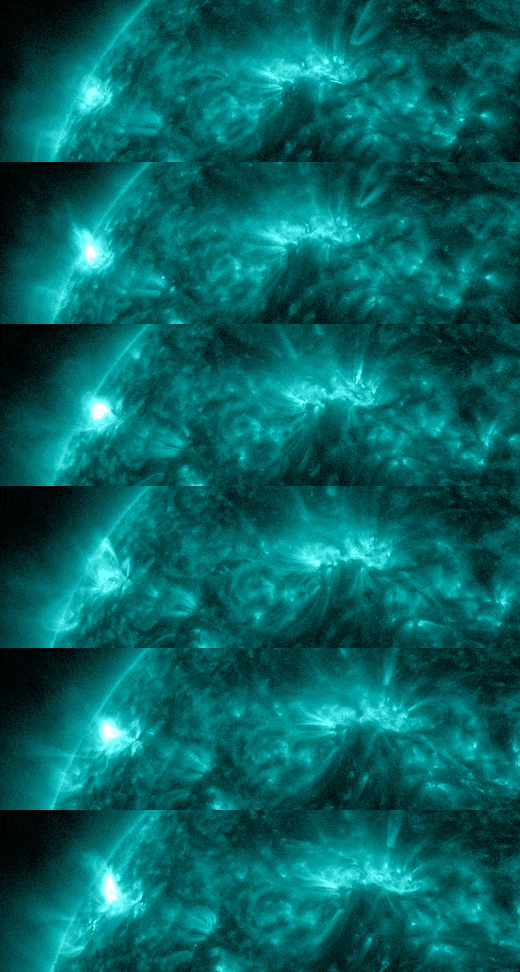
STRONG SOLAR ACTIVITY: Sunspot AR3234 is crackling with solar flares including multiple M4- and M5-class events on Feb. 21st. This interest-compressed movie from NASA's Solar Dynamics Observatory shows yesterday's extreme ultraviolet flashes:
https://www.spaceweather.com/images2023/21feb23/interestcompressed_strip_opt.gif
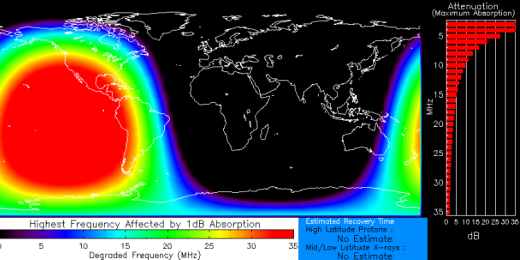
Pulses of radiation from AR3234 are ionizing the top of Earth's atmosphere, causing a rolling series of shortwave radio blackouts around all longitudes of our planet. While this activity continues, ham radio operators may notice intermittent loss of signal and other unusual propagation effects at frequencies below ~20 MHz.
https://www.spaceweather.com/images2023/21feb23/interestcompressed_strip_opt.gif
Pulses of radiation from AR3234 are ionizing the top of Earth's atmosphere, causing a rolling series of shortwave radio blackouts around all longitudes of our planet. While this activity continues, ham radio operators may notice intermittent loss of signal and other unusual propagation effects at frequencies below ~20 MHz.
👍6
Solar wind
speed: 540.3 km/sec
density: 1.84 protons/cm3
Updated: Today at 0200 UT
X-ray Solar Flares
6-hr max: M1 0901 UT Feb23
24-hr: M1 0614 UT Feb23
Updated: Today at: 1405 UT
speed: 540.3 km/sec
density: 1.84 protons/cm3
Updated: Today at 0200 UT
X-ray Solar Flares
6-hr max: M1 0901 UT Feb23
24-hr: M1 0614 UT Feb23
Updated: Today at: 1405 UT
🔥4
Space Weather Today pinned «Solar wind speed: 540.3 km/sec density: 1.84 protons/cm3 Updated: Today at 0200 UT X-ray Solar Flares 6-hr max: M1 0901 UT Feb23 24-hr: M1 0614 UT Feb23 Updated: Today at: 1405 UT»
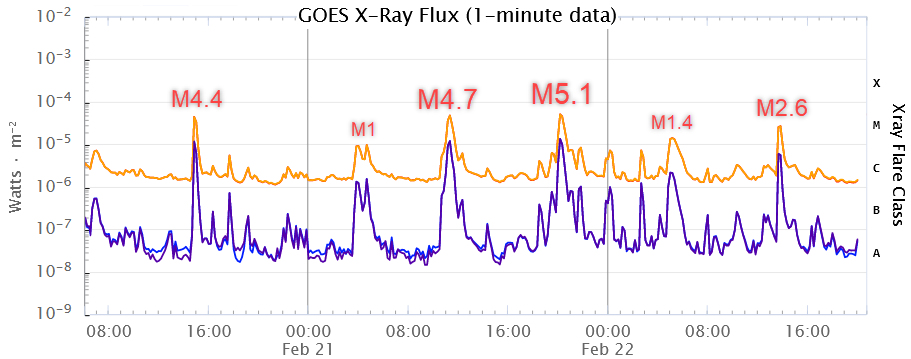
NO CMES ARE HEADING OUR WAY: For the past three days, the sun has emitted a non-stop fusillade of solar flares. Yet no CMEs are heading our way. Why not? The source of the explosions, sunspot AR3234, was not facing Earth. This is about to change, however, as the the sun's rotation turns the sunspot more directly toward our planet. https://www.spaceweather.com/images2023/22feb23/mflares.jpg
👍7