Space Weather Today pinned «Solar wind speed: 514.6 km/sec density: 11.30 protons/cm3 Updated: Today at 0210 UT X-ray Solar Flares 6-hr max: M2 1306 UT Jan26 24-hr: M2 1306 UT Jan26 Updated: Today at: 1415 UT»
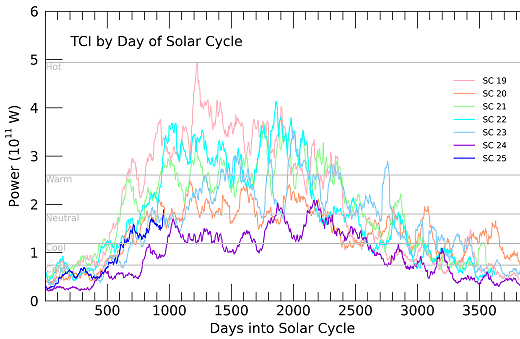
THE THERMOSPHERE IS WARMING UP: When solar activity is high, Earth's upper atmosphere puffs up like a marshmallow held over a campfire. That's happening now. Since Solar Cycle 25 began, the Thermosphere Climate Index (TCI) has increased nearly 10-fold:
https://www.spaceweather.com/images2023/26jan23/tci_sc_pctl_strip.jpg
TCI is a number published daily by NASA, which tells us how hot Earth’s upper atmosphere is. The thermosphere, the very highest layer of our atmosphere, literally touches space and is a sort of "first responder" to solar activity.
Linda Hunt of Science Systems and Applications, Inc. created the plot, above, which shows how TCI during Solar Cycle 25 compares to other solar cycles of the past. So far, the thermosphere is about twice as warm during Solar Cycle 25 as it was at the same point in the previous solar cycle: data.
"The sun is coming more alive now and looks ready to make a run at exceeding the max TCI of Solar Cycle 24," notes Dr. Marty Mlynczak of NASA.
As the thermosphere puffs up, it increases aerodynamic drag on Earth-orbiting satellites. Indeed, this is a key reason for the loss of dozens of Starlink satellites in Feb. 2022. If current trends continue, drag will increase even more as Solar Cycle 25 reaches its peak (Solar Maximum) in 2024 or 2025.
https://www.spaceweather.com/images2023/26jan23/tci_sc_pctl_strip.jpg
TCI is a number published daily by NASA, which tells us how hot Earth’s upper atmosphere is. The thermosphere, the very highest layer of our atmosphere, literally touches space and is a sort of "first responder" to solar activity.
Linda Hunt of Science Systems and Applications, Inc. created the plot, above, which shows how TCI during Solar Cycle 25 compares to other solar cycles of the past. So far, the thermosphere is about twice as warm during Solar Cycle 25 as it was at the same point in the previous solar cycle: data.
"The sun is coming more alive now and looks ready to make a run at exceeding the max TCI of Solar Cycle 24," notes Dr. Marty Mlynczak of NASA.
As the thermosphere puffs up, it increases aerodynamic drag on Earth-orbiting satellites. Indeed, this is a key reason for the loss of dozens of Starlink satellites in Feb. 2022. If current trends continue, drag will increase even more as Solar Cycle 25 reaches its peak (Solar Maximum) in 2024 or 2025.
👍11
Solar wind
speed: 395.7 km/sec
density: 10.91 protons/cm3
Updated: Today at 0226 UT
X-ray Solar Flares
6-hr max: C3 1207 UT Jan30
24-hr: C3 1207 UT Jan30
Updated: Today at: 1430 UT
speed: 395.7 km/sec
density: 10.91 protons/cm3
Updated: Today at 0226 UT
X-ray Solar Flares
6-hr max: C3 1207 UT Jan30
24-hr: C3 1207 UT Jan30
Updated: Today at: 1430 UT
🔥3👍1
Space Weather Today pinned «Solar wind speed: 395.7 km/sec density: 10.91 protons/cm3 Updated: Today at 0226 UT X-ray Solar Flares 6-hr max: C3 1207 UT Jan30 24-hr: C3 1207 UT Jan30 Updated: Today at: 1430 UT»
Moon to Occult Mars in Southern USA and Central America, Photo Op Alert!
Southern USA and Central America will witness the Moon passing in front of Mars tonight, Jan. 30-31, in a lunar occultation event. Mars will disappear for up to 2 hours with good photo opportunities when close to the Moon's edge. The event starts at around 8:30 PM PT.
https://spaceweathergallery2.com/submissions/pics/p/Peter-Zimnikoval-OnEarth_1674927792_lg.gif
Southern USA and Central America will witness the Moon passing in front of Mars tonight, Jan. 30-31, in a lunar occultation event. Mars will disappear for up to 2 hours with good photo opportunities when close to the Moon's edge. The event starts at around 8:30 PM PT.
https://spaceweathergallery2.com/submissions/pics/p/Peter-Zimnikoval-OnEarth_1674927792_lg.gif

❤6👍1🤔1
Solar wind
speed: 481.2 km/sec
density: 9.67 protons/cm3
Updated: Today at 0307 UT
X-ray Solar Flares
6-hr max: C4 1100 UT Jan31
24-hr: C4 1100 UT Jan31
Updated: Today at: 1510 UT
speed: 481.2 km/sec
density: 9.67 protons/cm3
Updated: Today at 0307 UT
X-ray Solar Flares
6-hr max: C4 1100 UT Jan31
24-hr: C4 1100 UT Jan31
Updated: Today at: 1510 UT
Space Weather Today pinned «Solar wind speed: 481.2 km/sec density: 9.67 protons/cm3 Updated: Today at 0307 UT X-ray Solar Flares 6-hr max: C4 1100 UT Jan31 24-hr: C4 1100 UT Jan31 Updated: Today at: 1510 UT»
WHAT'S HAPPENING IN THE STRATOSPHERE? Around the North Pole, the stratosphere has suddenly become very, very cold. NASA satellites are registering temperatures less than -85 C, the threshold for formation of rare polar stratospheric clouds (PSC). In the past few days, colorful PSCs have spilled outside the Arctic Circle, spreading as far south as Scotland. High-latitude sky watchers should remain alert for these clouds as the outbreak continues. https://spaceweathergallery2.com/submissions/pics/a/Alan-C-Tough-PSC_20230129_1646_actough_1675014775_lg.jpg

👍9❤2
Solar wind
speed: 345.0 km/sec
density: 8.47 protons/cm3
Updated: Today at 0226 UT
X-ray Solar Flares
6-hr max: C1 1337 UT Feb01
24-hr: C3 1616 UT Jan31
Updated: Today at: 1430 UT
speed: 345.0 km/sec
density: 8.47 protons/cm3
Updated: Today at 0226 UT
X-ray Solar Flares
6-hr max: C1 1337 UT Feb01
24-hr: C3 1616 UT Jan31
Updated: Today at: 1430 UT
👍1
Space Weather Today pinned «Solar wind speed: 345.0 km/sec density: 8.47 protons/cm3 Updated: Today at 0226 UT X-ray Solar Flares 6-hr max: C1 1337 UT Feb01 24-hr: C3 1616 UT Jan31 Updated: Today at: 1430 UT»
COMET ZTF HAS ARRIVED: It only took 50,000 years. During the Stone Age, faraway Comet ZTF (C/2022 E3) began falling toward the inner solar system. Today it finally reached Earth, only 0.28 AU away. This is what the comet looks like from point-blank range:
https://spaceweathergallery2.com/submissions/pics/m/Michael-Jaeger-2022E320230131UT355LRGBweb_1675202468_lg.jpg
"There is a strong curved dust tail, a long blue ion tail, and a vivid green coma," says photographer Michael Jaeger of Weißenkirchen in der Wachau, Austria. "It's a beautiful comet."
The ensemble is now glowing with an integrated magnitude near +4.8. It is barely visible to the naked eye (at best, a faint smudge), but a terrific target for small telescopes. Northern observers are favored. The comet is racing through Camelopardalis (the Giraffe), a constellation near the Big Dipper and the North Star. The best time to look is during the dark hours between midnight and dawn after the Moon has set.
https://spaceweathergallery2.com/submissions/pics/m/Michael-Jaeger-2022E320230131UT355LRGBweb_1675202468_lg.jpg
"There is a strong curved dust tail, a long blue ion tail, and a vivid green coma," says photographer Michael Jaeger of Weißenkirchen in der Wachau, Austria. "It's a beautiful comet."
The ensemble is now glowing with an integrated magnitude near +4.8. It is barely visible to the naked eye (at best, a faint smudge), but a terrific target for small telescopes. Northern observers are favored. The comet is racing through Camelopardalis (the Giraffe), a constellation near the Big Dipper and the North Star. The best time to look is during the dark hours between midnight and dawn after the Moon has set.

👍10❤2🤔2
ALL QUIET: Today, solar activity is low. There are five small sunspots on the solar disk. All of them are stable and quiet, posing no threat for strong solar flares.
❤8
Solar wind
speed: 423.8 km/sec
density: 3.20 protons/cm3
Updated: Today at 0220 UT
X-ray Solar Flares
6-hr max: C1 1412 UT Feb02
24-hr: C5 2248 UT Feb01
Updated: Today at: 1425 UT
speed: 423.8 km/sec
density: 3.20 protons/cm3
Updated: Today at 0220 UT
X-ray Solar Flares
6-hr max: C1 1412 UT Feb02
24-hr: C5 2248 UT Feb01
Updated: Today at: 1425 UT
👍4
Space Weather Today pinned «Solar wind speed: 423.8 km/sec density: 3.20 protons/cm3 Updated: Today at 0220 UT X-ray Solar Flares 6-hr max: C1 1412 UT Feb02 24-hr: C5 2248 UT Feb01 Updated: Today at: 1425 UT»
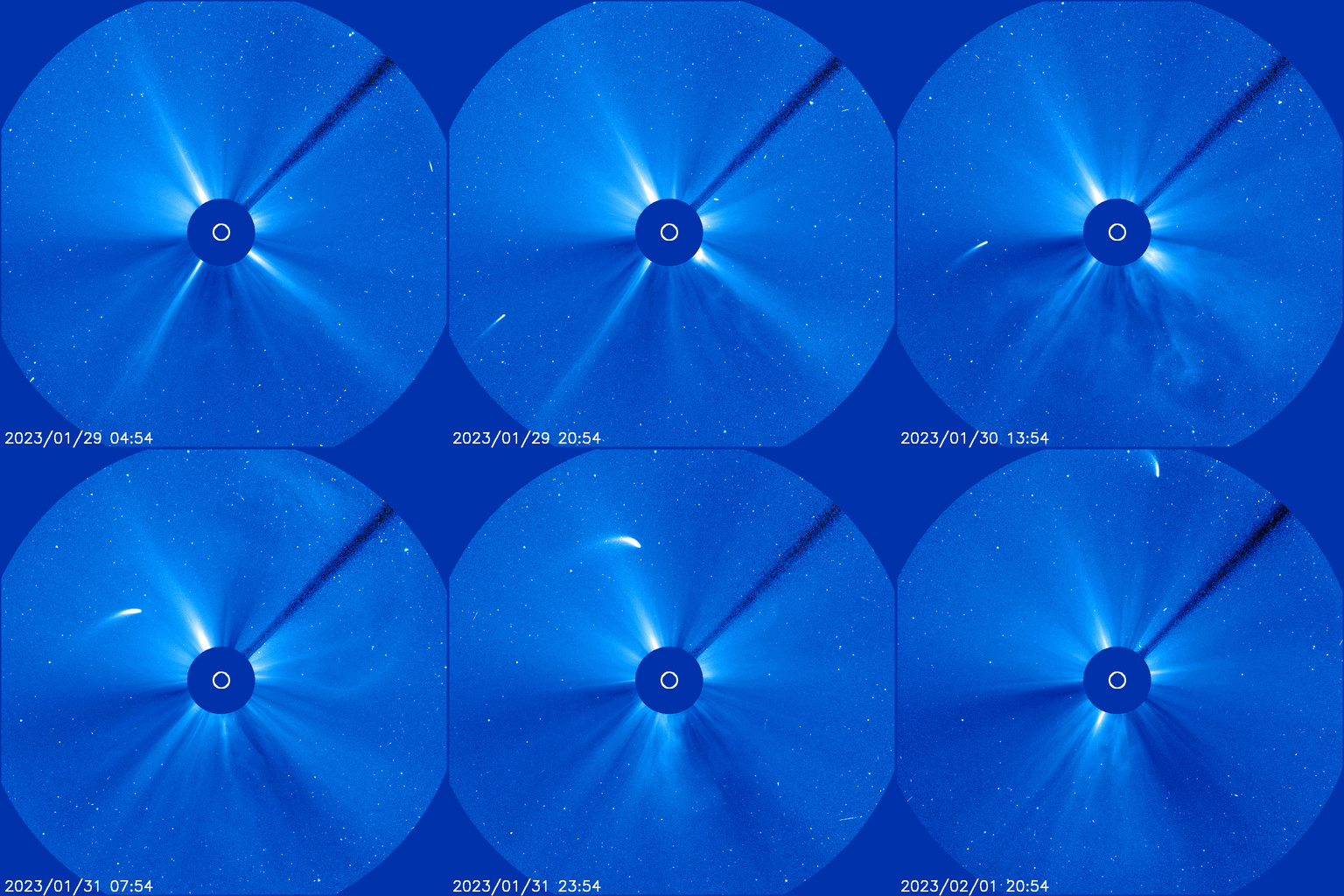
THE SOLAR FLYBY OF COMET 96P: Some comets like it hot--especially comet 96P/Machholz. The 6-km-wide dirty snowball just flew past the sun deep inside the orbit of Mercury and survived. Play this movie from the Solar and Heliospheric Observatory (SOHO) to see the entire flyby. Researchers working with the SOHO data say they may have a surprise to share in the days ahead. https://www.spaceweather.com/images2023/29jan23/lasco_comet_anim6.gif
❤12👍1
Solar wind
speed: 368.7 km/sec
density: 9.19 protons/cm3
Updated: Today at 0246 UT
X-ray Solar Flares
6-hr max: C1 0957 UT Feb03
24-hr: C3 0249 UT Feb03
Updated: Today at: 1450 UT
speed: 368.7 km/sec
density: 9.19 protons/cm3
Updated: Today at 0246 UT
X-ray Solar Flares
6-hr max: C1 0957 UT Feb03
24-hr: C3 0249 UT Feb03
Updated: Today at: 1450 UT
👍6
Space Weather Today pinned «Solar wind speed: 368.7 km/sec density: 9.19 protons/cm3 Updated: Today at 0246 UT X-ray Solar Flares 6-hr max: C1 0957 UT Feb03 24-hr: C3 0249 UT Feb03 Updated: Today at: 1450 UT»