Solar wind
speed: 392.7 km/sec
density: 1.37 protons/cm3
Updated: Today at 0217 UT
X-ray Solar Flares
6-hr max: C5 1407 UT Jan20
24-hr: C6 0152 UT Jan20
Updated: Today at: 1420 UT
speed: 392.7 km/sec
density: 1.37 protons/cm3
Updated: Today at 0217 UT
X-ray Solar Flares
6-hr max: C5 1407 UT Jan20
24-hr: C6 0152 UT Jan20
Updated: Today at: 1420 UT
👍7
CHANCE OF FLARES: NOAA forecasters say there is a 60% chance of M-class solar flares and a 15% chance of X-flares today. The most likely source is giant sunspot AR3190, which is directly facing Earth.
👍11🔥5
Solar wind
speed: 513.3 km/sec
density: 10.83 protons/cm3
Updated: Today at 0221 UT
X-ray Solar Flares
6-hr max: C6 0959 UT Jan23
24-hr: M1 1702 UT Jan22
Updated: Today at: 1425 UT
speed: 513.3 km/sec
density: 10.83 protons/cm3
Updated: Today at 0221 UT
X-ray Solar Flares
6-hr max: C6 0959 UT Jan23
24-hr: M1 1702 UT Jan22
Updated: Today at: 1425 UT
👍2
Space Weather Today pinned «Solar wind speed: 513.3 km/sec density: 10.83 protons/cm3 Updated: Today at 0221 UT X-ray Solar Flares 6-hr max: C6 0959 UT Jan23 24-hr: M1 1702 UT Jan22 Updated: Today at: 1425 UT»
CHANCE OF FLARES TODAY: NOAA forecasters say there is a 55% chance of M-class solar flares and a 10% chance of X-flares today, Jan. 23rd. The most likely flare-sites are sunspots AR3190 and AR3194, which have unstable 'delta-class' magnetic fields.
👍9🔥1
Extremely Close Flyby: New Asteroid 2023 BU Approaches Earth An asteroid, 2023 BU, will make a close flyby to Earth this Thursday, January 26th. The asteroid, measuring 5 meters wide, will pass by at a distance of 3500 km above South America and will not pose any threat of collision. The event will be live-streamed by Europe's Virtual Telescope Project at 21:17 UTC (16:17 EST).
https://www.virtualtelescope.eu/2023/01/23/near-earth-asteroid-2023-bu-extremely-close-encounter-online-observation-26-jan-2023/
https://www.virtualtelescope.eu/2023/01/23/near-earth-asteroid-2023-bu-extremely-close-encounter-online-observation-26-jan-2023/
🔥8
Solar wind
speed: 435.1 km/sec
density: 1.85 protons/cm3
Updated: Today at 0346 UT
X-ray Solar Flares
6-hr max: C9 1435 UT Jan24
24-hr: C9 1435 UT Jan24
Updated: Today at: 1550 UT
speed: 435.1 km/sec
density: 1.85 protons/cm3
Updated: Today at 0346 UT
X-ray Solar Flares
6-hr max: C9 1435 UT Jan24
24-hr: C9 1435 UT Jan24
Updated: Today at: 1550 UT
👍1
Solar wind
speed: 383.2 km/sec
density: 2.06 protons/cm3
Updated: Today at 0251 UT
X-ray Solar Flares
6-hr max: M4 1011 UT Jan25
24-hr: M4 1011 UT Jan25
Updated: Today at: 1455 UT
speed: 383.2 km/sec
density: 2.06 protons/cm3
Updated: Today at 0251 UT
X-ray Solar Flares
6-hr max: M4 1011 UT Jan25
24-hr: M4 1011 UT Jan25
Updated: Today at: 1455 UT
👍1
Solar wind
speed: 514.6 km/sec
density: 11.30 protons/cm3
Updated: Today at 0210 UT
X-ray Solar Flares
6-hr max: M2 1306 UT Jan26
24-hr: M2 1306 UT Jan26
Updated: Today at: 1415 UT
speed: 514.6 km/sec
density: 11.30 protons/cm3
Updated: Today at 0210 UT
X-ray Solar Flares
6-hr max: M2 1306 UT Jan26
24-hr: M2 1306 UT Jan26
Updated: Today at: 1415 UT
👍1
Space Weather Today pinned «Solar wind speed: 514.6 km/sec density: 11.30 protons/cm3 Updated: Today at 0210 UT X-ray Solar Flares 6-hr max: M2 1306 UT Jan26 24-hr: M2 1306 UT Jan26 Updated: Today at: 1415 UT»
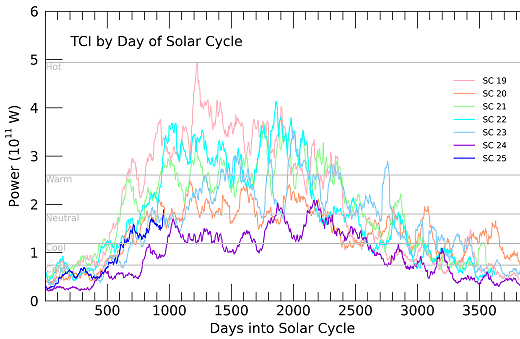
THE THERMOSPHERE IS WARMING UP: When solar activity is high, Earth's upper atmosphere puffs up like a marshmallow held over a campfire. That's happening now. Since Solar Cycle 25 began, the Thermosphere Climate Index (TCI) has increased nearly 10-fold:
https://www.spaceweather.com/images2023/26jan23/tci_sc_pctl_strip.jpg
TCI is a number published daily by NASA, which tells us how hot Earth’s upper atmosphere is. The thermosphere, the very highest layer of our atmosphere, literally touches space and is a sort of "first responder" to solar activity.
Linda Hunt of Science Systems and Applications, Inc. created the plot, above, which shows how TCI during Solar Cycle 25 compares to other solar cycles of the past. So far, the thermosphere is about twice as warm during Solar Cycle 25 as it was at the same point in the previous solar cycle: data.
"The sun is coming more alive now and looks ready to make a run at exceeding the max TCI of Solar Cycle 24," notes Dr. Marty Mlynczak of NASA.
As the thermosphere puffs up, it increases aerodynamic drag on Earth-orbiting satellites. Indeed, this is a key reason for the loss of dozens of Starlink satellites in Feb. 2022. If current trends continue, drag will increase even more as Solar Cycle 25 reaches its peak (Solar Maximum) in 2024 or 2025.
https://www.spaceweather.com/images2023/26jan23/tci_sc_pctl_strip.jpg
TCI is a number published daily by NASA, which tells us how hot Earth’s upper atmosphere is. The thermosphere, the very highest layer of our atmosphere, literally touches space and is a sort of "first responder" to solar activity.
Linda Hunt of Science Systems and Applications, Inc. created the plot, above, which shows how TCI during Solar Cycle 25 compares to other solar cycles of the past. So far, the thermosphere is about twice as warm during Solar Cycle 25 as it was at the same point in the previous solar cycle: data.
"The sun is coming more alive now and looks ready to make a run at exceeding the max TCI of Solar Cycle 24," notes Dr. Marty Mlynczak of NASA.
As the thermosphere puffs up, it increases aerodynamic drag on Earth-orbiting satellites. Indeed, this is a key reason for the loss of dozens of Starlink satellites in Feb. 2022. If current trends continue, drag will increase even more as Solar Cycle 25 reaches its peak (Solar Maximum) in 2024 or 2025.
👍11
Solar wind
speed: 395.7 km/sec
density: 10.91 protons/cm3
Updated: Today at 0226 UT
X-ray Solar Flares
6-hr max: C3 1207 UT Jan30
24-hr: C3 1207 UT Jan30
Updated: Today at: 1430 UT
speed: 395.7 km/sec
density: 10.91 protons/cm3
Updated: Today at 0226 UT
X-ray Solar Flares
6-hr max: C3 1207 UT Jan30
24-hr: C3 1207 UT Jan30
Updated: Today at: 1430 UT
🔥3👍1
Space Weather Today pinned «Solar wind speed: 395.7 km/sec density: 10.91 protons/cm3 Updated: Today at 0226 UT X-ray Solar Flares 6-hr max: C3 1207 UT Jan30 24-hr: C3 1207 UT Jan30 Updated: Today at: 1430 UT»
Moon to Occult Mars in Southern USA and Central America, Photo Op Alert!
Southern USA and Central America will witness the Moon passing in front of Mars tonight, Jan. 30-31, in a lunar occultation event. Mars will disappear for up to 2 hours with good photo opportunities when close to the Moon's edge. The event starts at around 8:30 PM PT.
https://spaceweathergallery2.com/submissions/pics/p/Peter-Zimnikoval-OnEarth_1674927792_lg.gif
Southern USA and Central America will witness the Moon passing in front of Mars tonight, Jan. 30-31, in a lunar occultation event. Mars will disappear for up to 2 hours with good photo opportunities when close to the Moon's edge. The event starts at around 8:30 PM PT.
https://spaceweathergallery2.com/submissions/pics/p/Peter-Zimnikoval-OnEarth_1674927792_lg.gif

❤6👍1🤔1
Solar wind
speed: 481.2 km/sec
density: 9.67 protons/cm3
Updated: Today at 0307 UT
X-ray Solar Flares
6-hr max: C4 1100 UT Jan31
24-hr: C4 1100 UT Jan31
Updated: Today at: 1510 UT
speed: 481.2 km/sec
density: 9.67 protons/cm3
Updated: Today at 0307 UT
X-ray Solar Flares
6-hr max: C4 1100 UT Jan31
24-hr: C4 1100 UT Jan31
Updated: Today at: 1510 UT
Space Weather Today pinned «Solar wind speed: 481.2 km/sec density: 9.67 protons/cm3 Updated: Today at 0307 UT X-ray Solar Flares 6-hr max: C4 1100 UT Jan31 24-hr: C4 1100 UT Jan31 Updated: Today at: 1510 UT»