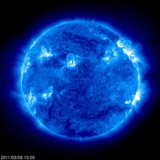
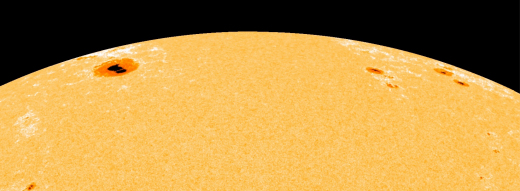
EMERGING SUNSPOT ALERT: A phalanx of large sunspots is emerging over the sun's eastern limb. NASA's Solar Dynamics Observatory recorded more than half a dozen dark cores during the early hours of Jan. 13th:
https://www.spaceweather.com/images2023/13jan23/heretheycome.jpg
We knew they were coming. Their approach was heralded by strong helioseismic echoes from the farside of the sun shown on Spaceweather.com a few days ago. Plumes of debris hurled over the edge of the sun yesterday and the day before suggest that these new regions are active and could soon pose a threat for geoeffective flares.
https://www.spaceweather.com/images2023/13jan23/heretheycome.jpg
We knew they were coming. Their approach was heralded by strong helioseismic echoes from the farside of the sun shown on Spaceweather.com a few days ago. Plumes of debris hurled over the edge of the sun yesterday and the day before suggest that these new regions are active and could soon pose a threat for geoeffective flares.
👍5🔥3
GEOMAGNETIC STORM WATCH: Minor G1-class geomagnetic storms are possible on Jan. 14-15 in response to glancing blows from one or more CMEs. The storm clouds were hurled into space by the collective activity of many flares earlier this week. None of the CMEs is squarely Earth directed and, in fact, all might miss. This is a low probability forecast.
👍8
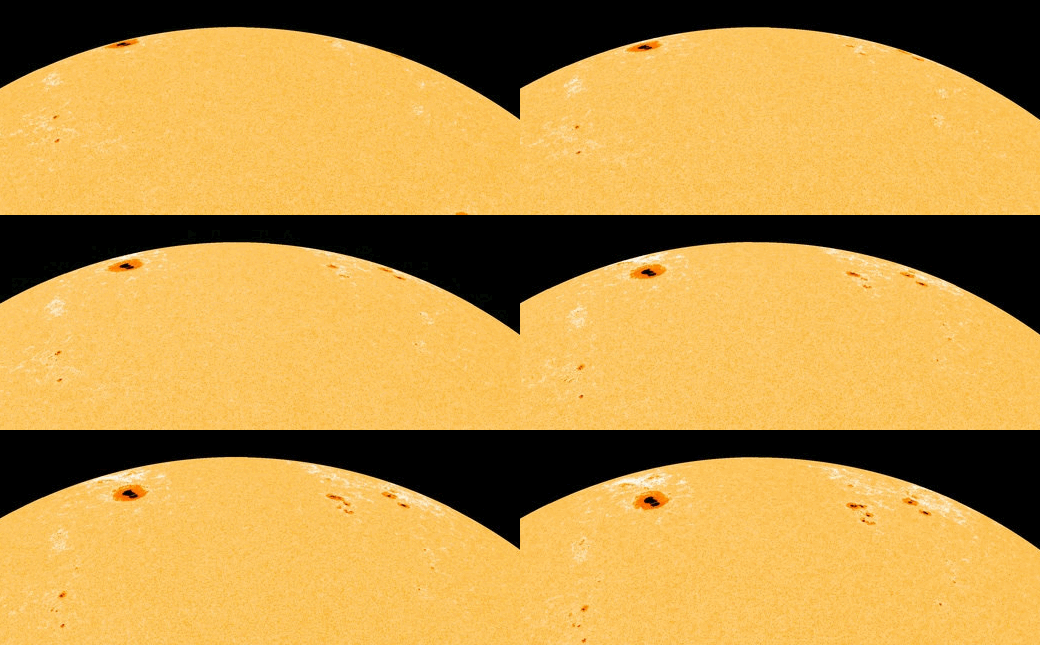
EMERGING SUNSPOTS (UPDATED): NASA's Solar Dynamics Observatory captured a group of large sunspots emerging over the sun's eastern limb and turning towards Earth on January 14th in this video.
https://www.spaceweather.com/images2023/14jan23/emerging_strip.gif
https://www.spaceweather.com/images2023/14jan23/emerging_strip.gif
👍6
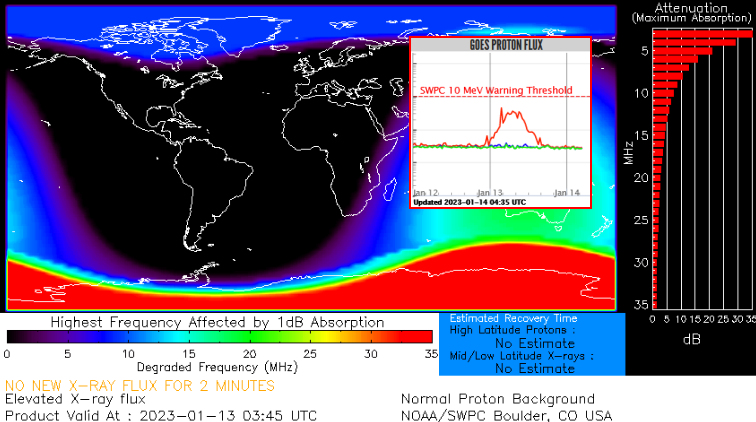
POLAR CAP ABSORPTION EVENT: Yesterday, Jan. 13th, Earth-orbiting satellites detected a pulse of energetic protons from the sun. When they hit Earth, a polar cap absorption event (PCA) occured:
https://www.spaceweather.com/images2023/14jan23/pca.jpg
Shortwave radio signals around the South Pole were abruptly attentuated. Why? Protons funneled by Earth's magnetic field into the Antarctic atmosphere ionized the D-layer of the ionosphere. This disrupted the normal propagation of radio signals at frequencies below ~30 MHz.
The PCA lasted for hours and would have blacked out radio communications for any airplanes flying over the South Pole. PCAs are a bigger problem when they occur over the North Pole where "great circle" air traffic is busier. The time for *that* is northern summer when the North Pole is tipped toward the sun. More PCAs are in the offing as Solar Cycle 25 intensifies.
https://www.spaceweather.com/images2023/14jan23/pca.jpg
Shortwave radio signals around the South Pole were abruptly attentuated. Why? Protons funneled by Earth's magnetic field into the Antarctic atmosphere ionized the D-layer of the ionosphere. This disrupted the normal propagation of radio signals at frequencies below ~30 MHz.
The PCA lasted for hours and would have blacked out radio communications for any airplanes flying over the South Pole. PCAs are a bigger problem when they occur over the North Pole where "great circle" air traffic is busier. The time for *that* is northern summer when the North Pole is tipped toward the sun. More PCAs are in the offing as Solar Cycle 25 intensifies.
👍6🔥2
GEOMAGNETIC STORM WATCH: Minor G1-class geomagnetic storms are possible on Jan. 14-15 in response to glancing blows from one or more CMEs. The storm clouds were hurled into space by the collective activity of many flares earlier this week. None of the CMEs is squarely Earth directed and, in fact, all might miss. This is a low probability forecast.
👍6
Solar wind
speed: 425.2 km/sec
density: 2.93 protons/cm3
Updated: Today at 0936 UT
X-ray Solar Flares
6-hr max: M4 2100 UT Jan14
24-hr: M4 2100 UT Jan14
Updated: Today at: 2140 UT
speed: 425.2 km/sec
density: 2.93 protons/cm3
Updated: Today at 0936 UT
X-ray Solar Flares
6-hr max: M4 2100 UT Jan14
24-hr: M4 2100 UT Jan14
Updated: Today at: 2140 UT
👍7
Space Weather Today pinned «Solar wind speed: 425.2 km/sec density: 2.93 protons/cm3 Updated: Today at 0936 UT X-ray Solar Flares 6-hr max: M4 2100 UT Jan14 24-hr: M4 2100 UT Jan14 Updated: Today at: 2140 UT»
Solar wind
speed: 428.2 km/sec
density: 5.45 protons/cm3
Updated: Today at 0247 UT
X-ray Solar Flares
6-hr max: M4 1431 UT Jan15
24-hr: M5 0342 UT Jan15
Updated: Today at: 1450 UT
speed: 428.2 km/sec
density: 5.45 protons/cm3
Updated: Today at 0247 UT
X-ray Solar Flares
6-hr max: M4 1431 UT Jan15
24-hr: M5 0342 UT Jan15
Updated: Today at: 1450 UT
❤2
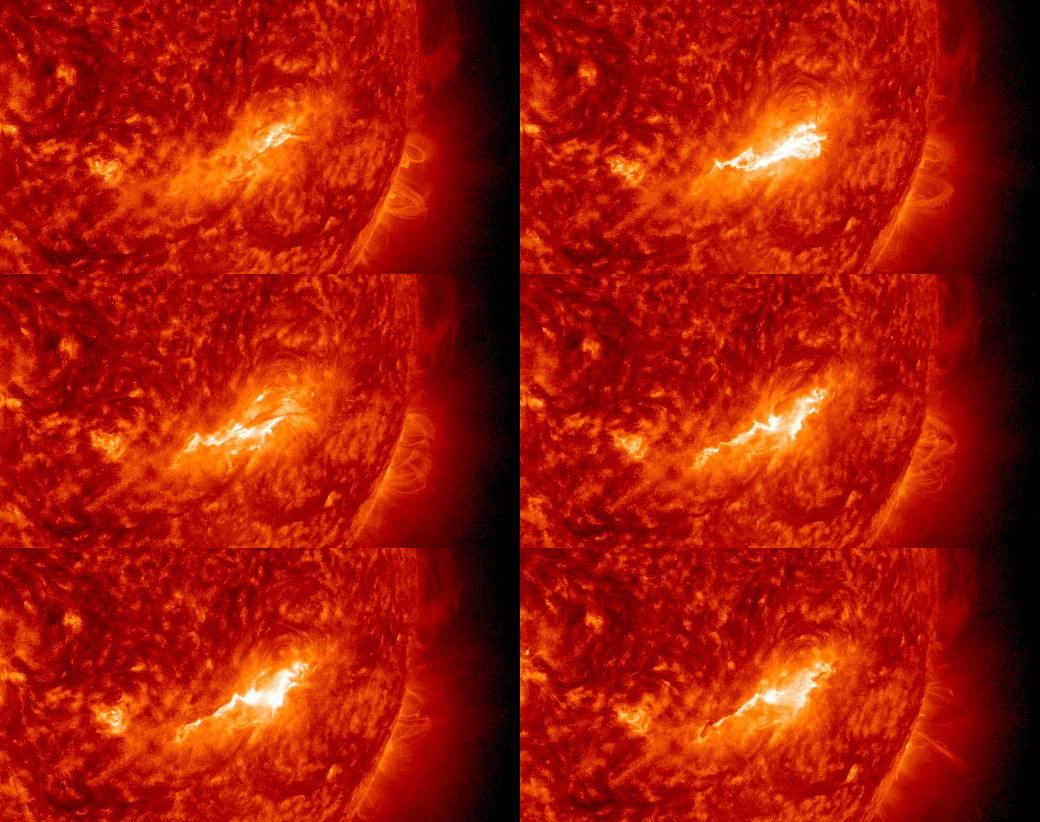
SOLAR FLARE AND CME: A twist of dark plasma left the sun on Jan. 14th, propelled by a double-dip M4-class solar flare in the magnetic canopy of sunspot AR3182:
https://www.spaceweather.com/images2023/14jan23/double_m_strip.gif
The debris carved a spiraling path through the sun's atmosphere, a blender-like process that hurled a coronal mass ejection (CME) into space. First-look images from the Solar and Heliospheric Observatory (SOHO) reveal a bright CME emerging from the sun's southwestern limb. Clearly, the CME is not heading directly for Earth, but a glancing blow might be possible early next week. NOAA analysts are evaluating the possibility now.
https://www.spaceweather.com/images2023/14jan23/double_m_strip.gif
The debris carved a spiraling path through the sun's atmosphere, a blender-like process that hurled a coronal mass ejection (CME) into space. First-look images from the Solar and Heliospheric Observatory (SOHO) reveal a bright CME emerging from the sun's southwestern limb. Clearly, the CME is not heading directly for Earth, but a glancing blow might be possible early next week. NOAA analysts are evaluating the possibility now.
❤6
INTERPLANETARY TRANSIENT SPARKS RED AURORAS: A solar wind stream washed over Earth on Jan. 13-14. Embedded inside was an 'interplanetary transient'--a minor but strongly magnetized shock wave from a CME, which left the sun 3 says earlier. Its impact sparked bright red auroras over Scotland and Norway.
⚡8❤3
Solar wind
speed: 471.9 km/sec
density: 11.57 protons/cm3
Updated: Today at 0312 UT
X-ray Solar Flares
6-hr max: C8 0923 UT Jan16
24-hr: M1 1515 UT Jan15
Updated: Today at: 1515 UT
speed: 471.9 km/sec
density: 11.57 protons/cm3
Updated: Today at 0312 UT
X-ray Solar Flares
6-hr max: C8 0923 UT Jan16
24-hr: M1 1515 UT Jan15
Updated: Today at: 1515 UT
❤5
Space Weather Today pinned «Solar wind speed: 471.9 km/sec density: 11.57 protons/cm3 Updated: Today at 0312 UT X-ray Solar Flares 6-hr max: C8 0923 UT Jan16 24-hr: M1 1515 UT Jan15 Updated: Today at: 1515 UT»
A CME IS COMING: Minor G1-class geomagnetic storms are possible on Jan. 19th when a CME is expected to graze Earth's magnetic field. The CME was hurled into space on Jan. 14th by a dramatic twisting eruption in the magnetic canopy of sunspot AR3182. High latitude sky watchers should be alert for auroras when the CME arrives.
❤15👍3
Solar wind
speed: 414.3 km/sec
density: 4.12 protons/cm3
Updated: Today at 0221 UT
X-ray Solar Flares
6-hr max: C2 1221 UT Jan17
24-hr: C9 0013 UT Jan17
Updated: Today at: 1425 UT
speed: 414.3 km/sec
density: 4.12 protons/cm3
Updated: Today at 0221 UT
X-ray Solar Flares
6-hr max: C2 1221 UT Jan17
24-hr: C9 0013 UT Jan17
Updated: Today at: 1425 UT
❤1
Space Weather Today pinned «Solar wind speed: 414.3 km/sec density: 4.12 protons/cm3 Updated: Today at 0221 UT X-ray Solar Flares 6-hr max: C2 1221 UT Jan17 24-hr: C9 0013 UT Jan17 Updated: Today at: 1425 UT»
Solar wind
speed: 434.4 km/sec
density: 8.05 protons/cm3
Updated: Today at 0222 UT
X-ray Solar Flares
6-hr max: M1 1035 UT Jan18
24-hr: M1 2329 UT Jan17
Updated: Today at: 1425 UT
speed: 434.4 km/sec
density: 8.05 protons/cm3
Updated: Today at 0222 UT
X-ray Solar Flares
6-hr max: M1 1035 UT Jan18
24-hr: M1 2329 UT Jan17
Updated: Today at: 1425 UT
🔥1
Space Weather Today pinned «Solar wind speed: 434.4 km/sec density: 8.05 protons/cm3 Updated: Today at 0222 UT X-ray Solar Flares 6-hr max: M1 1035 UT Jan18 24-hr: M1 2329 UT Jan17 Updated: Today at: 1425 UT»
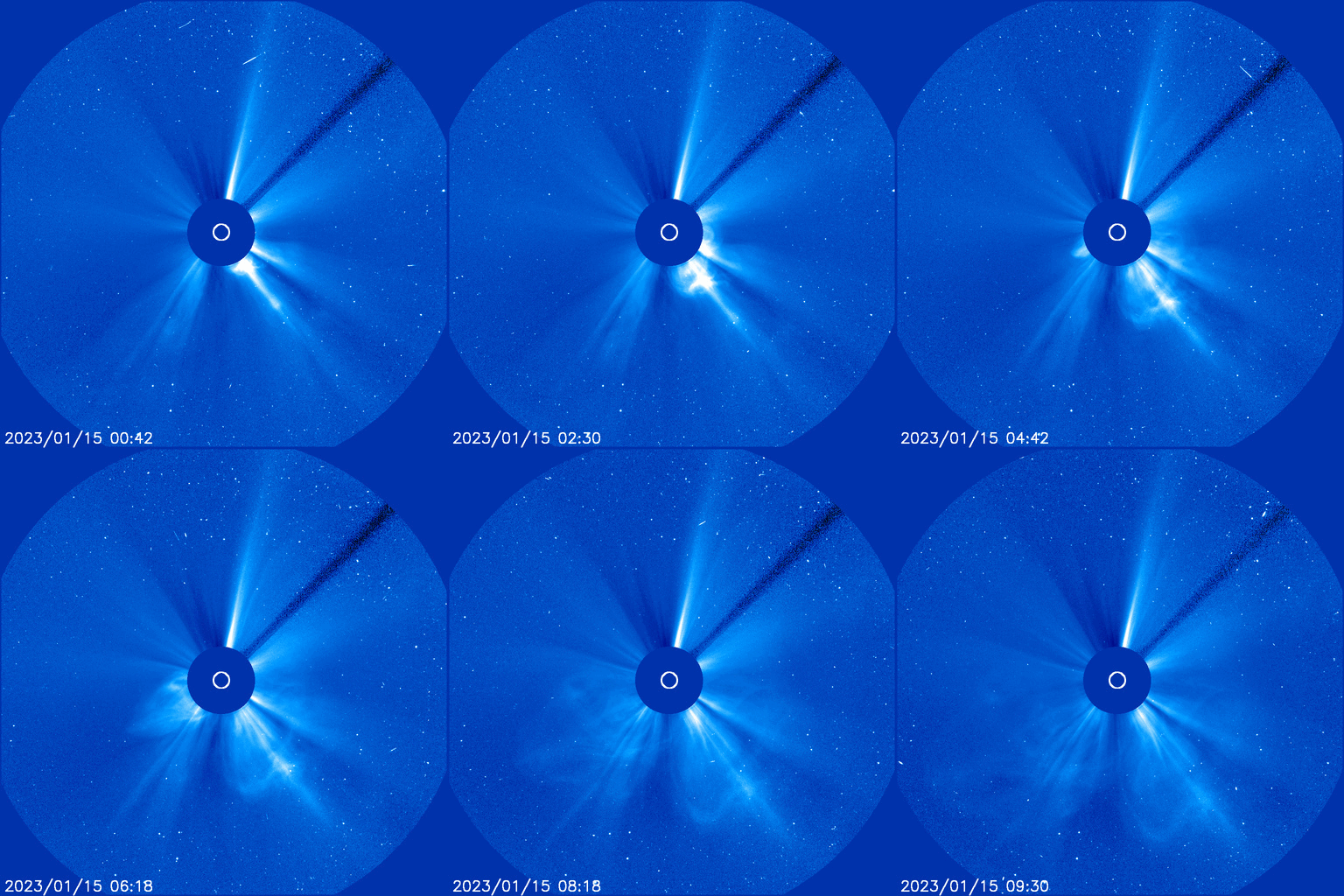
CME IMPACT SPARKS AURORAS: Arriving earlier than expected, a CME struck Earth's magnetic field on Jan. 17th around 2200 UT. Its arrival was signaled by an abrupt shift in the interplanetary magnetic field (IMF) near Earth. The impact sparked a brief outburst of Arctic auroras, which has since subsided. https://www.spaceweather.com/images2023/14jan23/two_cmes.gif
🔥2