Solar wind
speed: 389.0 km/sec
density: 5.50 protons/cm3
Updated: Today at 0257 UT
X-ray Solar Flares
6-hr max: M1 1108 UT Jan10
24-hr: X1 1850 UT Jan09
Updated: Today at: 1500 UT
speed: 389.0 km/sec
density: 5.50 protons/cm3
Updated: Today at 0257 UT
X-ray Solar Flares
6-hr max: M1 1108 UT Jan10
24-hr: X1 1850 UT Jan09
Updated: Today at: 1500 UT
👍4
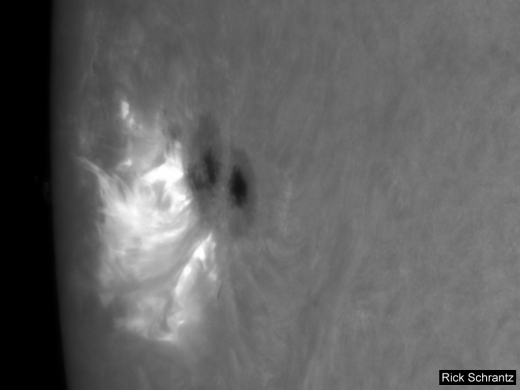
X-CLASS SOLAR FLARE: Yesterday in Kentucky, amateur astronomer Richard Schrantz was scanning the sun with his solar telescope when, almost finished, he decided to take one last look at sunspot AR3184. "What luck!" he says. "There was a big X1.9 solar flare in progress."
https://www.spaceweather.com/images2023/09jan23/Richard-N-Schrantz-Solar-Flare-1-9-23_1673304425_strip.jpg
"The flare is listed as happening at 18:50 UT, and my image is just a few minutes later at 18:55 UT," says Schrantz. "To capture the eruption I used a 127mm refracting telescope with a Daystar Quark Chromosphere filter."
https://www.spaceweather.com/images2023/09jan23/Richard-N-Schrantz-Solar-Flare-1-9-23_1673304425_strip.jpg
"The flare is listed as happening at 18:50 UT, and my image is just a few minutes later at 18:55 UT," says Schrantz. "To capture the eruption I used a 127mm refracting telescope with a Daystar Quark Chromosphere filter."
👍6🔥3
NO CME THIS TIME: Yesterday's X1.9-class solar flare did not hurl a CME toward Earth. Although it was intense, the blast was too brief to lift a CME out of the sun's atmosphere. Next time may be different. There are now three large sunspots (AR3181, 82 and 84) with unstable 'delta-class' magnetic fields capable of strong explosions. NOAA forecasters say there is a 35% chance of X-flares on Jan. 10th.
👍4🔥2
Space Weather Today pinned «Solar wind speed: 389.0 km/sec density: 5.50 protons/cm3 Updated: Today at 0257 UT X-ray Solar Flares 6-hr max: M1 1108 UT Jan10 24-hr: X1 1850 UT Jan09 Updated: Today at: 1500 UT»
Solar wind
speed: 410.7 km/sec
density: 5.99 protons/cm3
Updated: Today at 0226 UT
X-ray Solar Flares
6-hr max: M3 0833 UT Jan11
24-hr: X1 2247 UT Jan10
Updated: Today at: 1430 UT
speed: 410.7 km/sec
density: 5.99 protons/cm3
Updated: Today at 0226 UT
X-ray Solar Flares
6-hr max: M3 0833 UT Jan11
24-hr: X1 2247 UT Jan10
Updated: Today at: 1430 UT
👍5
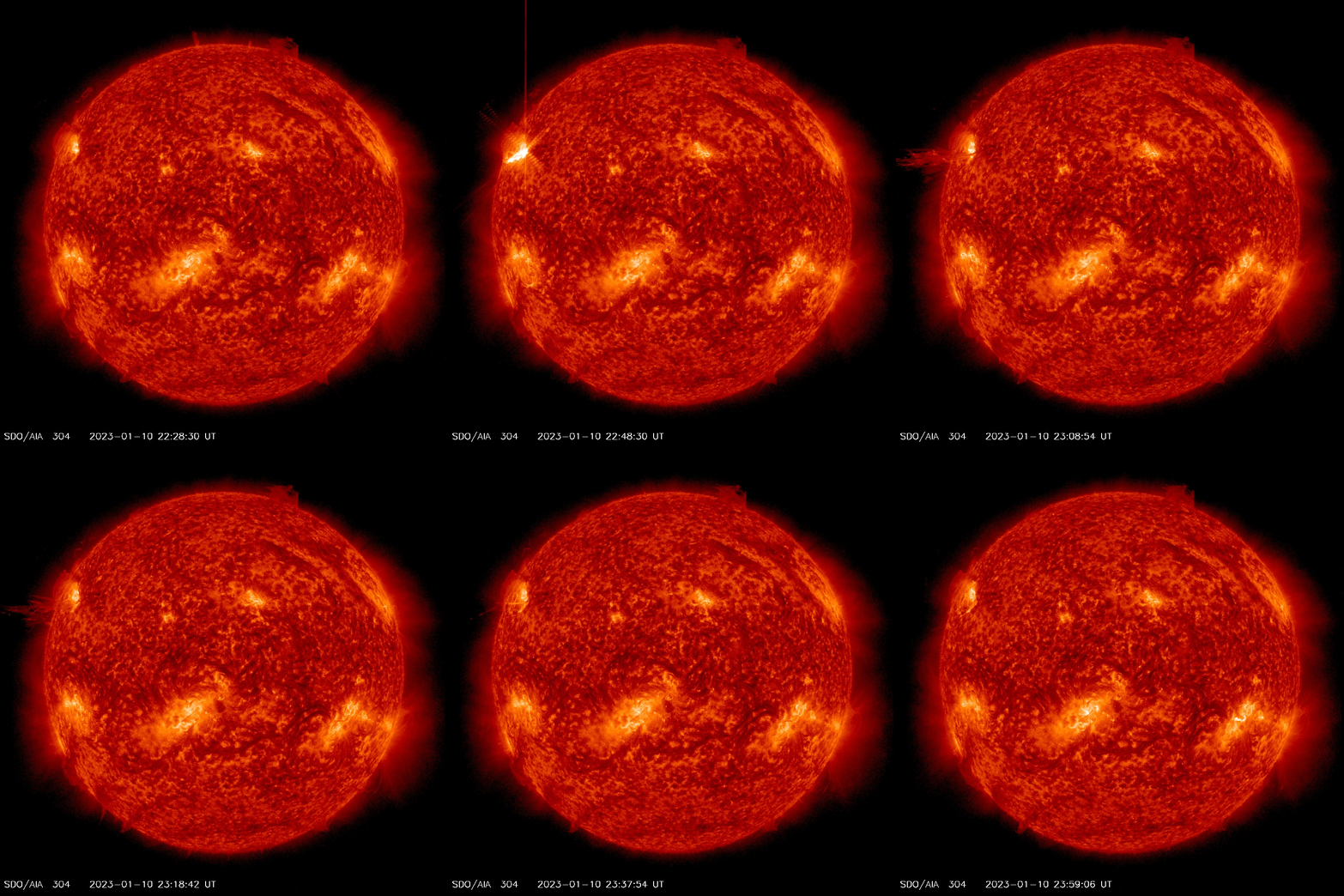
ANOTHER X-CLASS SOLAR FLARE: The sun produced another X-flare on Jan. 10th, this time from new sunspot AR3186. This movie from NASA's Solar Dynamics Observatory shows the X1-class explosion hurling a plume of debris into space:
https://www.spaceweather.com/images2023/10jan23/x1_red.gif
Radiation from the flare ionized the top of Earth's atmosphere, causing a shortwave radio blackout over the South Pacific: blackout map. Mariners and ham radio operators may have noticed fadeouts and other unusual propagation effects at frequencies below ~30 MHz.
This is the 3rd X-flare in a week, and each flare has come from a different sunspot. It's not just a single active region; the *whole sun* is becoming more active. NOAA forecasters say there is a 30% chance of another X-flare on Jan. 11th.
https://www.spaceweather.com/images2023/10jan23/x1_red.gif
Radiation from the flare ionized the top of Earth's atmosphere, causing a shortwave radio blackout over the South Pacific: blackout map. Mariners and ham radio operators may have noticed fadeouts and other unusual propagation effects at frequencies below ~30 MHz.
This is the 3rd X-flare in a week, and each flare has come from a different sunspot. It's not just a single active region; the *whole sun* is becoming more active. NOAA forecasters say there is a 30% chance of another X-flare on Jan. 11th.
👍6🔥2
Solar wind
speed: 401.7 km/sec
density: 7.02 protons/cm3
Updated: Today at 0741 UT
X-ray Solar Flares
6-hr max: M1 1913 UT Jan12
24-hr: M1 0650 UT Jan12
Updated: Today at: 1945 UT
speed: 401.7 km/sec
density: 7.02 protons/cm3
Updated: Today at 0741 UT
X-ray Solar Flares
6-hr max: M1 1913 UT Jan12
24-hr: M1 0650 UT Jan12
Updated: Today at: 1945 UT
❤2
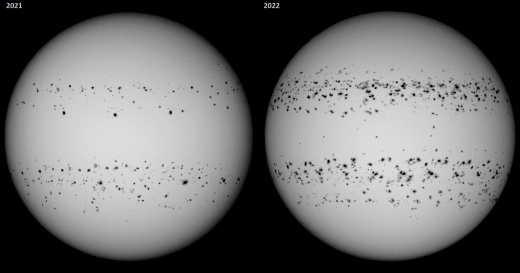
TWO YEARS OF SUNSPOTS: On almost every clear day in Santiago, Chile, Patricio Leon takes a picture of the sun. Lately, he's noticed a lot more sunspots. To illustrate the change, he stacked hundreds of images from 2021 and 2022:
https://www.spaceweather.com/images2023/12jan23/Patricio-Leon-Manchas-2021-22.anot_1673471080_strip.jpg
"This composite includes 110 solar images captured in 2021 and 159 in 2022," says Leon. "Nearly all days with major sunspots are present. Although this is not a scientific controlled study, variables such as cloudy days and holiday interruptions tend to even out in the large number of observations. The disparity between the two years agrees well with developing Solar Cycle 25."
https://www.spaceweather.com/images2023/12jan23/Patricio-Leon-Manchas-2021-22.anot_1673471080_strip.jpg
"This composite includes 110 solar images captured in 2021 and 159 in 2022," says Leon. "Nearly all days with major sunspots are present. Although this is not a scientific controlled study, variables such as cloudy days and holiday interruptions tend to even out in the large number of observations. The disparity between the two years agrees well with developing Solar Cycle 25."
👍2🔥2
EVERY SUNSPOT WANTS TO FLARE: It seems like every spot on the sun wants to flare. In the past week alone, three different sunspots have produced X-flares, and even more are crackling with M-class flares. With unstable sunspots scattered across the face of the sun, the chance of a geoeffective flare today is greater than 70%.
❤7🔥3
Space Weather Today pinned «Solar wind speed: 401.7 km/sec density: 7.02 protons/cm3 Updated: Today at 0741 UT X-ray Solar Flares 6-hr max: M1 1913 UT Jan12 24-hr: M1 0650 UT Jan12 Updated: Today at: 1945 UT»
Solar wind
speed: 412.0 km/sec
density: 3.36 protons/cm3
Updated: Today at 0420 UT
X-ray Solar Flares
6-hr max: C8 1508 UT Jan13
24-hr: M3 1015 UT Jan13
Updated: Today at: 1625 UT
speed: 412.0 km/sec
density: 3.36 protons/cm3
Updated: Today at 0420 UT
X-ray Solar Flares
6-hr max: C8 1508 UT Jan13
24-hr: M3 1015 UT Jan13
Updated: Today at: 1625 UT
👍2
Space Weather Today pinned «Solar wind speed: 412.0 km/sec density: 3.36 protons/cm3 Updated: Today at 0420 UT X-ray Solar Flares 6-hr max: C8 1508 UT Jan13 24-hr: M3 1015 UT Jan13 Updated: Today at: 1625 UT»
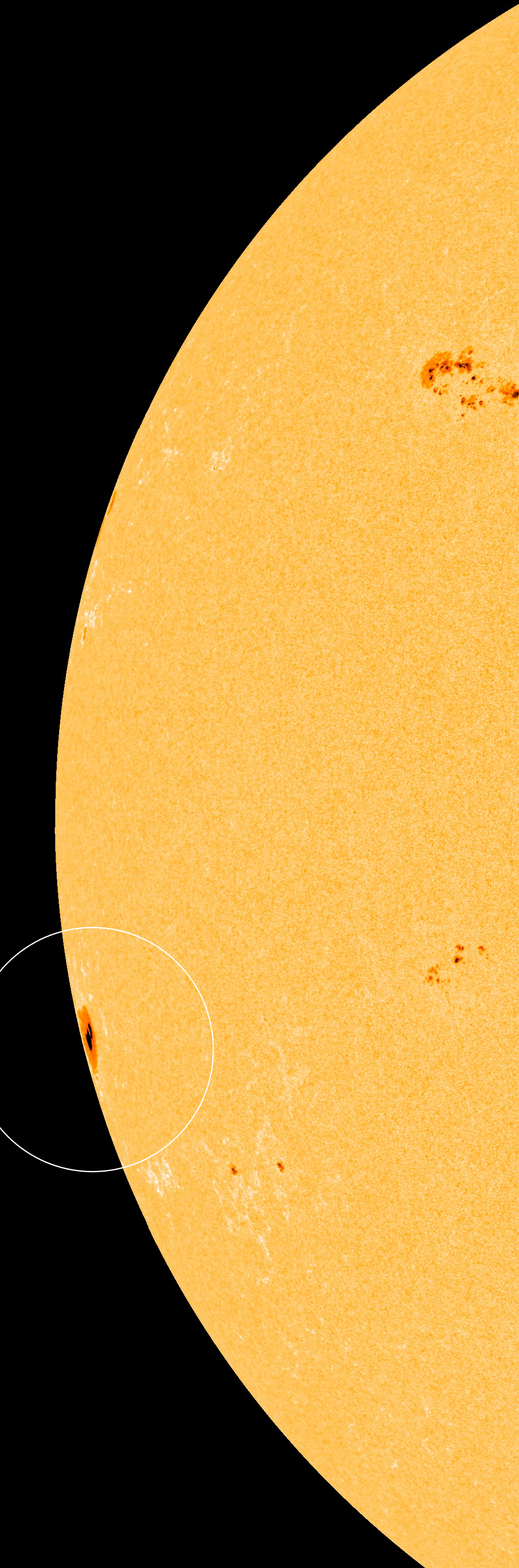
BIG SUNSPOT ALERT: A new sunspot is emerging over the sun's southeastern limb (right here). Its approach was heralded by strong helioseismic echoes from the farside of the sun. This suggests the sunspot is large, complex, and a possible source of strong flares.
https://www.spaceweather.com/images2023/13jan23/righthere.jpg
https://www.spaceweather.com/images2023/13jan23/righthere.jpg
🔥9👍5
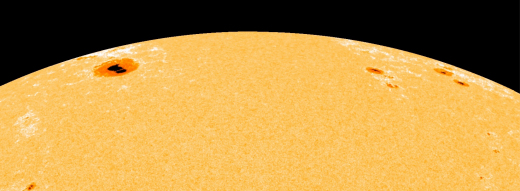
EMERGING SUNSPOT ALERT: A phalanx of large sunspots is emerging over the sun's eastern limb. NASA's Solar Dynamics Observatory recorded more than half a dozen dark cores during the early hours of Jan. 13th:
https://www.spaceweather.com/images2023/13jan23/heretheycome.jpg
We knew they were coming. Their approach was heralded by strong helioseismic echoes from the farside of the sun shown on Spaceweather.com a few days ago. Plumes of debris hurled over the edge of the sun yesterday and the day before suggest that these new regions are active and could soon pose a threat for geoeffective flares.
https://www.spaceweather.com/images2023/13jan23/heretheycome.jpg
We knew they were coming. Their approach was heralded by strong helioseismic echoes from the farside of the sun shown on Spaceweather.com a few days ago. Plumes of debris hurled over the edge of the sun yesterday and the day before suggest that these new regions are active and could soon pose a threat for geoeffective flares.
👍5🔥3
GEOMAGNETIC STORM WATCH: Minor G1-class geomagnetic storms are possible on Jan. 14-15 in response to glancing blows from one or more CMEs. The storm clouds were hurled into space by the collective activity of many flares earlier this week. None of the CMEs is squarely Earth directed and, in fact, all might miss. This is a low probability forecast.
👍8
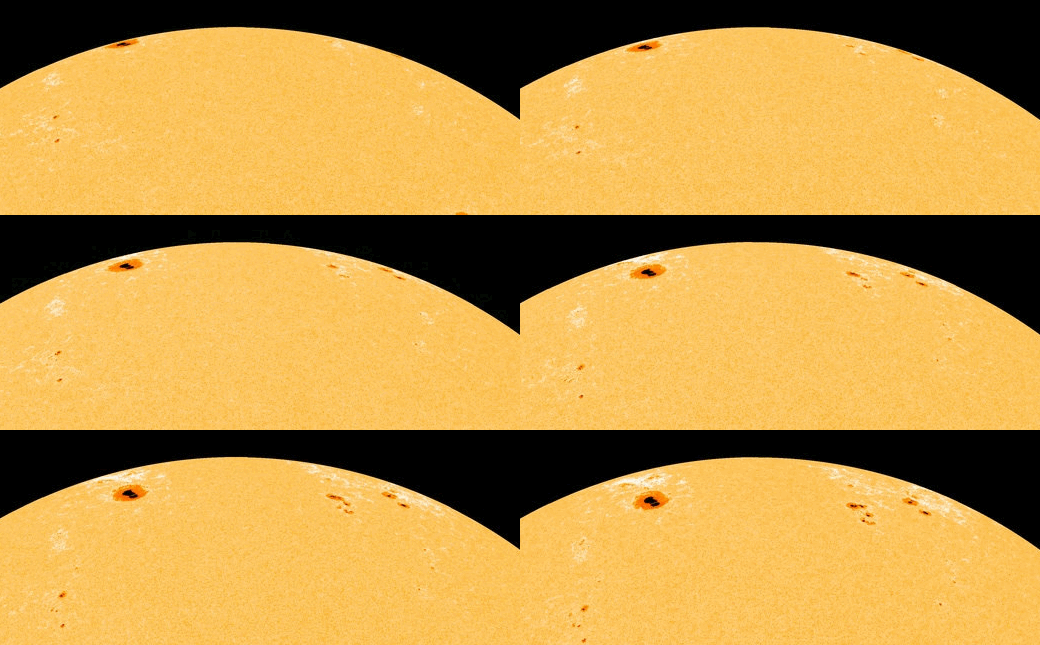
EMERGING SUNSPOTS (UPDATED): NASA's Solar Dynamics Observatory captured a group of large sunspots emerging over the sun's eastern limb and turning towards Earth on January 14th in this video.
https://www.spaceweather.com/images2023/14jan23/emerging_strip.gif
https://www.spaceweather.com/images2023/14jan23/emerging_strip.gif
👍6
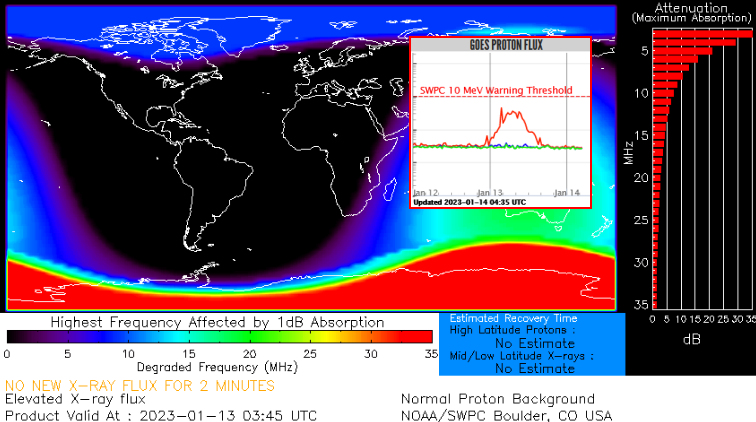
POLAR CAP ABSORPTION EVENT: Yesterday, Jan. 13th, Earth-orbiting satellites detected a pulse of energetic protons from the sun. When they hit Earth, a polar cap absorption event (PCA) occured:
https://www.spaceweather.com/images2023/14jan23/pca.jpg
Shortwave radio signals around the South Pole were abruptly attentuated. Why? Protons funneled by Earth's magnetic field into the Antarctic atmosphere ionized the D-layer of the ionosphere. This disrupted the normal propagation of radio signals at frequencies below ~30 MHz.
The PCA lasted for hours and would have blacked out radio communications for any airplanes flying over the South Pole. PCAs are a bigger problem when they occur over the North Pole where "great circle" air traffic is busier. The time for *that* is northern summer when the North Pole is tipped toward the sun. More PCAs are in the offing as Solar Cycle 25 intensifies.
https://www.spaceweather.com/images2023/14jan23/pca.jpg
Shortwave radio signals around the South Pole were abruptly attentuated. Why? Protons funneled by Earth's magnetic field into the Antarctic atmosphere ionized the D-layer of the ionosphere. This disrupted the normal propagation of radio signals at frequencies below ~30 MHz.
The PCA lasted for hours and would have blacked out radio communications for any airplanes flying over the South Pole. PCAs are a bigger problem when they occur over the North Pole where "great circle" air traffic is busier. The time for *that* is northern summer when the North Pole is tipped toward the sun. More PCAs are in the offing as Solar Cycle 25 intensifies.
👍6🔥2
GEOMAGNETIC STORM WATCH: Minor G1-class geomagnetic storms are possible on Jan. 14-15 in response to glancing blows from one or more CMEs. The storm clouds were hurled into space by the collective activity of many flares earlier this week. None of the CMEs is squarely Earth directed and, in fact, all might miss. This is a low probability forecast.
👍6
Solar wind
speed: 425.2 km/sec
density: 2.93 protons/cm3
Updated: Today at 0936 UT
X-ray Solar Flares
6-hr max: M4 2100 UT Jan14
24-hr: M4 2100 UT Jan14
Updated: Today at: 2140 UT
speed: 425.2 km/sec
density: 2.93 protons/cm3
Updated: Today at 0936 UT
X-ray Solar Flares
6-hr max: M4 2100 UT Jan14
24-hr: M4 2100 UT Jan14
Updated: Today at: 2140 UT
👍7