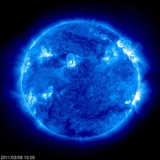
CHANCE OF FLARES TODAY: Following two days of non-stop flaring, active sunspot AR3165 is quieting. It could be gaining strength for a bigger flare. NOAA forecasters say there is a 50% chance of M-class flares and a 10% chance of X-flares on Dec. 17th.
🔥5
Solar wind
speed: 367.4 km/sec
density: 0.38 protons/cm3
more data: ACE, DSCOVR
Updated: Today at 0357 UT
X-ray Solar Flares
6-hr max: M1 1406 UT Dec20
24-hr: M1 1406 UT Dec20
explanation | more data
Updated: Today at: 1600 UT
speed: 367.4 km/sec
density: 0.38 protons/cm3
more data: ACE, DSCOVR
Updated: Today at 0357 UT
X-ray Solar Flares
6-hr max: M1 1406 UT Dec20
24-hr: M1 1406 UT Dec20
explanation | more data
Updated: Today at: 1600 UT
❤2
Solar wind
speed: 435.3 km/sec
density: 9.88 protons/cm3
Updated: Today at 0211 UT
X-ray Solar Flares
6-hr max: C1 1338 UT Dec22
24-hr: C6 2236 UT Dec21
Updated: Today at: 1415 UT
speed: 435.3 km/sec
density: 9.88 protons/cm3
Updated: Today at 0211 UT
X-ray Solar Flares
6-hr max: C1 1338 UT Dec22
24-hr: C6 2236 UT Dec21
Updated: Today at: 1415 UT
❤2
Space Weather Today pinned «Solar wind speed: 435.3 km/sec density: 9.88 protons/cm3 Updated: Today at 0211 UT X-ray Solar Flares 6-hr max: C1 1338 UT Dec22 24-hr: C6 2236 UT Dec21 Updated: Today at: 1415 UT»
ALL QUIET: Solar activity is low and it is likely to remain so through Christmas. All of the sunspots on the Earthside of the sun have relatively stable magnetic fields that pose a threat for, at most, minor C-class flares. The situation could change next week when one or more farside sunspots come over the horizon.
👍3❤1
Solar wind
speed: 441.8 km/sec
density: 5.36 protons/cm3
more data: ACE, DSCOVR
Updated: Today at 0242 UT
X-ray Solar Flares
6-hr max: C3 1152 UT Jan02
24-hr: C9 0621 UT Jan02
explanation | more data
Updated: Today at: 1445 UT
speed: 441.8 km/sec
density: 5.36 protons/cm3
more data: ACE, DSCOVR
Updated: Today at 0242 UT
X-ray Solar Flares
6-hr max: C3 1152 UT Jan02
24-hr: C9 0621 UT Jan02
explanation | more data
Updated: Today at: 1445 UT
❤1
GEOMAGNETIC STORM WATCH: Minor G1-class geomagnetic storms are possible on Jan. 4th when a slow-moving CME is expected to hit Earth's magnetic field. It was hurled in our direction by an M3.7-class solar flare (movie) in the magnetic canopy of sunspot AR3176 on Dec. 30th.
❤2
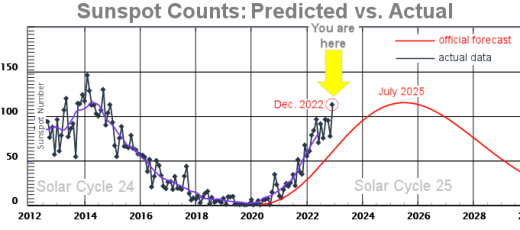
SUNSPOT COUNTS HIT 7 YEAR HIGH: 2022 ended with the highest monthly sunspot number in 7 years. This plot from NOAA shows the ascending progression of Solar Cycle 25:
https://www.spaceweather.com/images2023/02jan23/sunspotcycle_strip.png
For the 35th month in a row, Solar Cycle 25 is outperforming the official forecast. Conclusion: Solar Maximum will either happen sooner or be stronger than expected--possibly both. The next few years should have plenty of sunspots, solar flares, and CMEs. Happy New Year!
https://www.spaceweather.com/images2023/02jan23/sunspotcycle_strip.png
For the 35th month in a row, Solar Cycle 25 is outperforming the official forecast. Conclusion: Solar Maximum will either happen sooner or be stronger than expected--possibly both. The next few years should have plenty of sunspots, solar flares, and CMEs. Happy New Year!
❤4
Solar wind
speed: 386.0 km/sec
density: 10.36 protons/cm3
more data: ACE, DSCOVR
Updated: Today at 0840 UT
X-ray Solar Flares
6-hr max: C8 1845 UT Jan04
24-hr: C8 1845 UT Jan04
explanation | more data
Updated: Today at: 2045 UT
speed: 386.0 km/sec
density: 10.36 protons/cm3
more data: ACE, DSCOVR
Updated: Today at 0840 UT
X-ray Solar Flares
6-hr max: C8 1845 UT Jan04
24-hr: C8 1845 UT Jan04
explanation | more data
Updated: Today at: 2045 UT
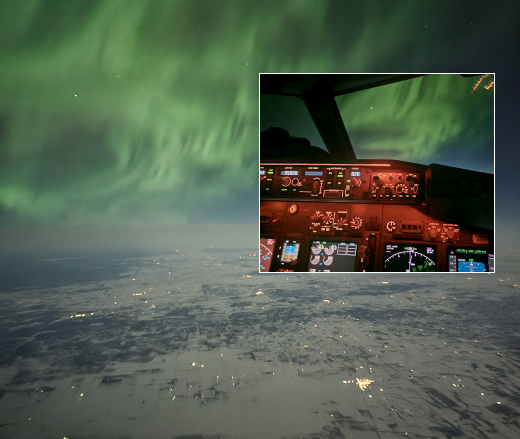
CME IMPACT JOLTS EARTH'S MAGNETIC FIELD: As predicted, a coronal mass ejection (CME) hit Earth's magnetic field on Jan. 4th (0254 UT). The impact jolted magnetometers around the world with the Canberra station in Australia registering a sudden impulse of 38 nT. It also ignited a G1-class geomagnetic storm. Pilot Matt Melnyk photographed the light show from 30,000 ft above Alberta, Canada:
https://www.spaceweather.com/images2023/04jan23/redeye_strip.jpg
https://www.spaceweather.com/images2023/04jan23/redeye_strip.jpg
👍3🔥3
Space Weather Today pinned «Solar wind speed: 386.0 km/sec density: 10.36 protons/cm3 more data: ACE, DSCOVR Updated: Today at 0840 UT X-ray Solar Flares 6-hr max: C8 1845 UT Jan04 24-hr: C8 1845 UT Jan04 explanation | more data Updated: Today at: 2045 UT»
Solar wind
speed: 350.6 km/sec
density: 7.46 protons/cm3
Updated: Today at 0409 UT
X-ray Solar Flares
6-hr max: C2 1015 UT Jan05
24-hr: C8 1845 UT Jan04
Updated: Today at: 1615 UT
speed: 350.6 km/sec
density: 7.46 protons/cm3
Updated: Today at 0409 UT
X-ray Solar Flares
6-hr max: C2 1015 UT Jan05
24-hr: C8 1845 UT Jan04
Updated: Today at: 1615 UT
❤2
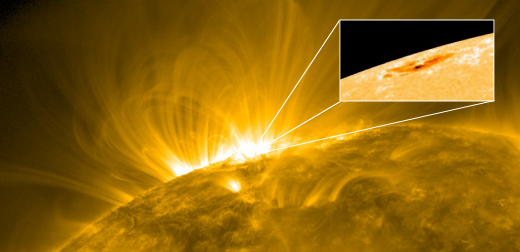
FARSIDE SUNSPOT EMERGES: A sunspot that produced a significant farside explosion on Jan. 3rd is emerging over the sun's southeastern limb. Its planet-sized dark core is inset in this image from NASA's Solar Dynamics Observatory:
https://www.spaceweather.com/images2023/05jan23/emerging_strip.jpg
Although the sunspot is severely foreshortened and, probably, still partially hidden behind the edge of the sun, we know a lot about it. The Jan. 3rd blast shows it is capable of very strong flares (circumstantially X-class) and CMEs. It may even be an old friend--sunspot AR3163, which produced a fusillade of solar flares when it crossed the Earthside of the sun in December.
https://www.spaceweather.com/images2023/05jan23/emerging_strip.jpg
Although the sunspot is severely foreshortened and, probably, still partially hidden behind the edge of the sun, we know a lot about it. The Jan. 3rd blast shows it is capable of very strong flares (circumstantially X-class) and CMEs. It may even be an old friend--sunspot AR3163, which produced a fusillade of solar flares when it crossed the Earthside of the sun in December.
❤6
Space Weather Today pinned «Solar wind speed: 350.6 km/sec density: 7.46 protons/cm3 Updated: Today at 0409 UT X-ray Solar Flares 6-hr max: C2 1015 UT Jan05 24-hr: C8 1845 UT Jan04 Updated: Today at: 1615 UT»
GEOMAGNETIC STORM WATCH: Minor G1-class geomagnetic storms are possible on Jan. 5th as Earth passes through the wake of a CME that struck our planet yesterday. Arctic sky watchers should remain alert for auroras.
❤5
Solar wind
speed: 470.8 km/sec
density: 9.91 protons/cm3
Updated: Today at 0126 UT
X-ray Solar Flares
6-hr max: C1 1226 UT Jan06
24-hr: X1 0057 UT Jan06
Updated: Today at: 1330 UT
speed: 470.8 km/sec
density: 9.91 protons/cm3
Updated: Today at 0126 UT
X-ray Solar Flares
6-hr max: C1 1226 UT Jan06
24-hr: X1 0057 UT Jan06
Updated: Today at: 1330 UT
❤2
Space Weather Today pinned «Solar wind speed: 470.8 km/sec density: 9.91 protons/cm3 Updated: Today at 0126 UT X-ray Solar Flares 6-hr max: C1 1226 UT Jan06 24-hr: X1 0057 UT Jan06 Updated: Today at: 1330 UT»