Solar wind
speed: 328.8 km/sec
density: 2.08 protons/cm3
more data: ACE, DSCOVR
Updated: Today at 0802 UT
X-ray Solar Flares
6-hr max: M2 1440 UT Dec16
24-hr: M5 2240 UT Dec15
explanation | more data
Updated: Today at: 2005 UT
speed: 328.8 km/sec
density: 2.08 protons/cm3
more data: ACE, DSCOVR
Updated: Today at 0802 UT
X-ray Solar Flares
6-hr max: M2 1440 UT Dec16
24-hr: M5 2240 UT Dec15
explanation | more data
Updated: Today at: 2005 UT
THE EXPLOSIONS CONTINUE: Sunspot AR3165 is crackling with M-class solar flares, more than 18 in the last two days. Pulses of extreme ultraviolet radiation are ionizing the top of Earth's atmosphere, causing frequent shortwave radio blackouts. The blackout events are regional, like this one, but they are rolling around the globe as Earth turns beneath the flaring sun. https://www.spaceweather.com/images2022/16dec22/fusillade.jpg

🔥3
Solar wind
speed: 298.1 km/sec
density: 1.97 protons/cm3
more data: ACE, DSCOVR
Updated: Today at 0637 UT
X-ray Solar Flares
6-hr max: C5 1736 UT Dec17
24-hr: C9 1911 UT Dec16
explanation | more data
Updated: Today at: 1840 UT
speed: 298.1 km/sec
density: 1.97 protons/cm3
more data: ACE, DSCOVR
Updated: Today at 0637 UT
X-ray Solar Flares
6-hr max: C5 1736 UT Dec17
24-hr: C9 1911 UT Dec16
explanation | more data
Updated: Today at: 1840 UT
👍2
CHANCE OF FLARES TODAY: Following two days of non-stop flaring, active sunspot AR3165 is quieting. It could be gaining strength for a bigger flare. NOAA forecasters say there is a 50% chance of M-class flares and a 10% chance of X-flares on Dec. 17th.
🔥5
Solar wind
speed: 367.4 km/sec
density: 0.38 protons/cm3
more data: ACE, DSCOVR
Updated: Today at 0357 UT
X-ray Solar Flares
6-hr max: M1 1406 UT Dec20
24-hr: M1 1406 UT Dec20
explanation | more data
Updated: Today at: 1600 UT
speed: 367.4 km/sec
density: 0.38 protons/cm3
more data: ACE, DSCOVR
Updated: Today at 0357 UT
X-ray Solar Flares
6-hr max: M1 1406 UT Dec20
24-hr: M1 1406 UT Dec20
explanation | more data
Updated: Today at: 1600 UT
❤2
Solar wind
speed: 435.3 km/sec
density: 9.88 protons/cm3
Updated: Today at 0211 UT
X-ray Solar Flares
6-hr max: C1 1338 UT Dec22
24-hr: C6 2236 UT Dec21
Updated: Today at: 1415 UT
speed: 435.3 km/sec
density: 9.88 protons/cm3
Updated: Today at 0211 UT
X-ray Solar Flares
6-hr max: C1 1338 UT Dec22
24-hr: C6 2236 UT Dec21
Updated: Today at: 1415 UT
❤2
Space Weather Today pinned «Solar wind speed: 435.3 km/sec density: 9.88 protons/cm3 Updated: Today at 0211 UT X-ray Solar Flares 6-hr max: C1 1338 UT Dec22 24-hr: C6 2236 UT Dec21 Updated: Today at: 1415 UT»
ALL QUIET: Solar activity is low and it is likely to remain so through Christmas. All of the sunspots on the Earthside of the sun have relatively stable magnetic fields that pose a threat for, at most, minor C-class flares. The situation could change next week when one or more farside sunspots come over the horizon.
👍3❤1
Solar wind
speed: 441.8 km/sec
density: 5.36 protons/cm3
more data: ACE, DSCOVR
Updated: Today at 0242 UT
X-ray Solar Flares
6-hr max: C3 1152 UT Jan02
24-hr: C9 0621 UT Jan02
explanation | more data
Updated: Today at: 1445 UT
speed: 441.8 km/sec
density: 5.36 protons/cm3
more data: ACE, DSCOVR
Updated: Today at 0242 UT
X-ray Solar Flares
6-hr max: C3 1152 UT Jan02
24-hr: C9 0621 UT Jan02
explanation | more data
Updated: Today at: 1445 UT
❤1
GEOMAGNETIC STORM WATCH: Minor G1-class geomagnetic storms are possible on Jan. 4th when a slow-moving CME is expected to hit Earth's magnetic field. It was hurled in our direction by an M3.7-class solar flare (movie) in the magnetic canopy of sunspot AR3176 on Dec. 30th.
❤2
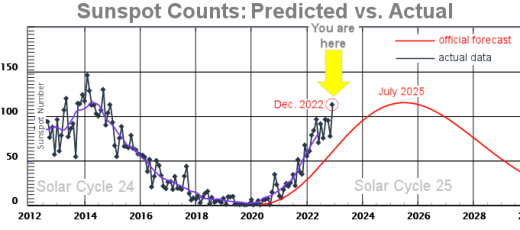
SUNSPOT COUNTS HIT 7 YEAR HIGH: 2022 ended with the highest monthly sunspot number in 7 years. This plot from NOAA shows the ascending progression of Solar Cycle 25:
https://www.spaceweather.com/images2023/02jan23/sunspotcycle_strip.png
For the 35th month in a row, Solar Cycle 25 is outperforming the official forecast. Conclusion: Solar Maximum will either happen sooner or be stronger than expected--possibly both. The next few years should have plenty of sunspots, solar flares, and CMEs. Happy New Year!
https://www.spaceweather.com/images2023/02jan23/sunspotcycle_strip.png
For the 35th month in a row, Solar Cycle 25 is outperforming the official forecast. Conclusion: Solar Maximum will either happen sooner or be stronger than expected--possibly both. The next few years should have plenty of sunspots, solar flares, and CMEs. Happy New Year!
❤4
Solar wind
speed: 386.0 km/sec
density: 10.36 protons/cm3
more data: ACE, DSCOVR
Updated: Today at 0840 UT
X-ray Solar Flares
6-hr max: C8 1845 UT Jan04
24-hr: C8 1845 UT Jan04
explanation | more data
Updated: Today at: 2045 UT
speed: 386.0 km/sec
density: 10.36 protons/cm3
more data: ACE, DSCOVR
Updated: Today at 0840 UT
X-ray Solar Flares
6-hr max: C8 1845 UT Jan04
24-hr: C8 1845 UT Jan04
explanation | more data
Updated: Today at: 2045 UT
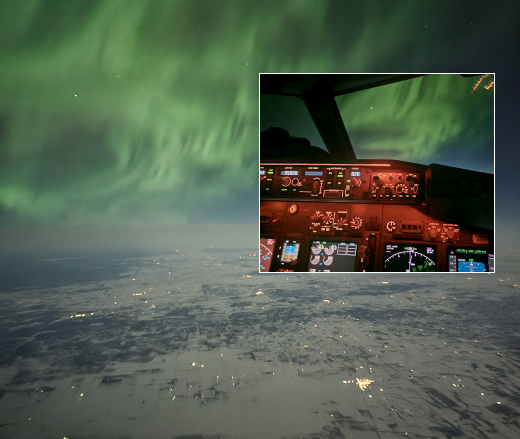
CME IMPACT JOLTS EARTH'S MAGNETIC FIELD: As predicted, a coronal mass ejection (CME) hit Earth's magnetic field on Jan. 4th (0254 UT). The impact jolted magnetometers around the world with the Canberra station in Australia registering a sudden impulse of 38 nT. It also ignited a G1-class geomagnetic storm. Pilot Matt Melnyk photographed the light show from 30,000 ft above Alberta, Canada:
https://www.spaceweather.com/images2023/04jan23/redeye_strip.jpg
https://www.spaceweather.com/images2023/04jan23/redeye_strip.jpg
👍3🔥3
Space Weather Today pinned «Solar wind speed: 386.0 km/sec density: 10.36 protons/cm3 more data: ACE, DSCOVR Updated: Today at 0840 UT X-ray Solar Flares 6-hr max: C8 1845 UT Jan04 24-hr: C8 1845 UT Jan04 explanation | more data Updated: Today at: 2045 UT»
Solar wind
speed: 350.6 km/sec
density: 7.46 protons/cm3
Updated: Today at 0409 UT
X-ray Solar Flares
6-hr max: C2 1015 UT Jan05
24-hr: C8 1845 UT Jan04
Updated: Today at: 1615 UT
speed: 350.6 km/sec
density: 7.46 protons/cm3
Updated: Today at 0409 UT
X-ray Solar Flares
6-hr max: C2 1015 UT Jan05
24-hr: C8 1845 UT Jan04
Updated: Today at: 1615 UT
❤2
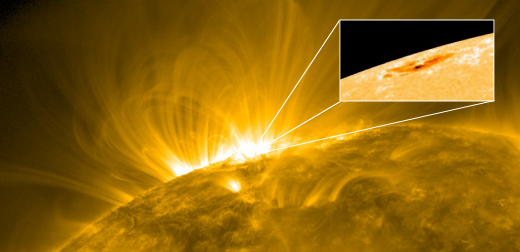
FARSIDE SUNSPOT EMERGES: A sunspot that produced a significant farside explosion on Jan. 3rd is emerging over the sun's southeastern limb. Its planet-sized dark core is inset in this image from NASA's Solar Dynamics Observatory:
https://www.spaceweather.com/images2023/05jan23/emerging_strip.jpg
Although the sunspot is severely foreshortened and, probably, still partially hidden behind the edge of the sun, we know a lot about it. The Jan. 3rd blast shows it is capable of very strong flares (circumstantially X-class) and CMEs. It may even be an old friend--sunspot AR3163, which produced a fusillade of solar flares when it crossed the Earthside of the sun in December.
https://www.spaceweather.com/images2023/05jan23/emerging_strip.jpg
Although the sunspot is severely foreshortened and, probably, still partially hidden behind the edge of the sun, we know a lot about it. The Jan. 3rd blast shows it is capable of very strong flares (circumstantially X-class) and CMEs. It may even be an old friend--sunspot AR3163, which produced a fusillade of solar flares when it crossed the Earthside of the sun in December.
❤6
Space Weather Today pinned «Solar wind speed: 350.6 km/sec density: 7.46 protons/cm3 Updated: Today at 0409 UT X-ray Solar Flares 6-hr max: C2 1015 UT Jan05 24-hr: C8 1845 UT Jan04 Updated: Today at: 1615 UT»