Solar wind
speed: 379.5 km/sec
density: 4.62 protons/cm3
Updated: Today at 0816 UT
X-ray Solar Flares
6-hr max: C7 0727 UT Nov22
24-hr: C7 0727 UT Nov22
Updated: Today at: 0820 UT
Planetary K-index
Now: Kp= 0.67 quiet
24-hr max: Kp= 2.00 quiet
Interplanetary Mag. Field
Btotal: 5.04 nT
Bz: 0.96 nT north
Updated: Today at 0816 UT
speed: 379.5 km/sec
density: 4.62 protons/cm3
Updated: Today at 0816 UT
X-ray Solar Flares
6-hr max: C7 0727 UT Nov22
24-hr: C7 0727 UT Nov22
Updated: Today at: 0820 UT
Planetary K-index
Now: Kp= 0.67 quiet
24-hr max: Kp= 2.00 quiet
Interplanetary Mag. Field
Btotal: 5.04 nT
Bz: 0.96 nT north
Updated: Today at 0816 UT
👍1
CHANCE OF MINOR STORMS TODAY: NOAA forecasters say there is a chance of minor G1-class geomagnetic storms on Nov. 22nd when a CME might sideswipe Earth's magnetic field. The faint CME was hurled into space on Nov. 19th by an erupting filament of magnetism in the sun's northern hemisphere. A glancing blow could spark bright auroras around the Arctic Circle.
ALL QUIET: There are four sunspot groups on the sun today. All of them have simple magnetic fields disinclined to explode. NOAA forecasters say there is a slight 10% chance of M-class solar flares and no more than a 1% chance of X-flares on Nov. 24th.
👍1
POSSIBLE CME IMPACT: A shock wave in the solar wind hit Earth's magnetic field today, Nov. 25th, at approximately 0230 UT. It might have been the belated arrival of a CME that left the sun on Nov. 19th, hurled in our direction by an erupting filament of magnetism. So far the weak impact has not caused a geomagnetic storm.
👍2
Solar wind
speed: 389.8 km/sec
density: 2.16 protons/cm3
more data: ACE, DSCOVR
Updated: Today at 1246 UT
X-ray Solar Flares
6-hr max: B7 0822 UT Dec06
24-hr: C2 1701 UT Dec05
explanation | more data
Updated: Today at: 1250 UT
speed: 389.8 km/sec
density: 2.16 protons/cm3
more data: ACE, DSCOVR
Updated: Today at 1246 UT
X-ray Solar Flares
6-hr max: B7 0822 UT Dec06
24-hr: C2 1701 UT Dec05
explanation | more data
Updated: Today at: 1250 UT
👍1
SOLAR WIND, INCOMING: A high speed stream of solar wind is approaching Earth. ETA: Dec. 8th or 9th. The gaseous material is flowing from a canyon-shaped hole in the sun's atmosphere. Minor G1-class geomagnetic storms are possible when the solar wind arrives.
👍1
Solar wind
speed: 544.0 km/sec
density: 11.08 protons/cm3
more data: ACE, DSCOVR
Updated: Today at 0235 UT
X-ray Solar Flares
6-hr max: B7 1314 UT Dec08
24-hr: C2 1904 UT Dec07
explanation | more data
Updated: Today at: 1440 UT
speed: 544.0 km/sec
density: 11.08 protons/cm3
more data: ACE, DSCOVR
Updated: Today at 0235 UT
X-ray Solar Flares
6-hr max: B7 1314 UT Dec08
24-hr: C2 1904 UT Dec07
explanation | more data
Updated: Today at: 1440 UT
❤2👍1
GEOMAGNETIC STORM WATCH: Minor G1-class geomagnetic storms are possible today, Dec. 8th, when a high-speed stream of solar wind is expected to hit Earth's magnetic field. The gaseous material is flowing from a canyon-shaped hole in the sun's atmosphere. High-latitude sky watchers should be alert for auroras mixed with the glare from a waning full Moon.
❤3👍1
Solar wind
speed: 527.2 km/sec
density: 9.74 protons/cm3
more data: ACE, DSCOVR
Updated: Today at 0406 UT
X-ray Solar Flares
6-hr max: C6 1413 UT Dec09
24-hr: C6 1413 UT Dec09
explanation | more data
Updated: Today at: 1610 UT
speed: 527.2 km/sec
density: 9.74 protons/cm3
more data: ACE, DSCOVR
Updated: Today at 0406 UT
X-ray Solar Flares
6-hr max: C6 1413 UT Dec09
24-hr: C6 1413 UT Dec09
explanation | more data
Updated: Today at: 1610 UT
👍5
ORION IS COMING IN HOT: NASA's Orion spacecraft is hurtling toward Earth for a nail-biting grand finale to its maiden 25-day space voyage. On Sunday, Dec. 11th, Orion will skip across the top of the atmosphere like a pebble on the surface of a pond, bleeding away some of its kinetic energy before it plunges toward the Pacific Ocean like a 5,000 degree Fahrenheit meteor. Will Orion's experimental heat shield work? Tune into NASA TV on Dec. 11th for live coverage.
https://www.nasa.gov/nasalive
https://www.nasa.gov/nasalive
NASA
NASA Live - NASA
NASA TV live: Watch live broadcasts from NASA Television and NASA's social media channels, and a schedule of upcoming live events including news briefings, launches and landings.
⚡6👍2
GEMINID METEOR SHOWER: Earth is enterng a stream of debris from "rock comet" 3200 Phaethon, source of the annual Geminid meteor shower. Forecasters expect the shower to peak tonight, Dec. 13/14, and/or tomorrow, Dec. 14/15, with ~30 meteors per hour visible in bright moonlight. Fun fact: The brightest Geminids are almost always green. Observing tips and a sky map are available from the International Meteor Organization.https://www.imo.net/viewing-the-geminid-meteor-shower-in-2022/
www.imo.net
Viewing the Geminid Meteor Shower in 2022 | IMO
Michel Deconinck drew this watercolor from Geminid meteors observed on the morning of December 14, 2021, from Artignosc-sur-Verdon, France. Notice how all of these Geminid meteors are parallel and shoot from one point in the sky. This is what one would see…
❤5
Solar wind
speed: 327.2 km/sec
density: 5.59 protons/cm3
more data: ACE, DSCOVR
Updated: Today at 0650 UT
X-ray Solar Flares
6-hr max: M6 1442 UT Dec14
24-hr: M6 1442 UT Dec14
explanation | more data
Updated: Today at: 1855 UT
speed: 327.2 km/sec
density: 5.59 protons/cm3
more data: ACE, DSCOVR
Updated: Today at 0650 UT
X-ray Solar Flares
6-hr max: M6 1442 UT Dec14
24-hr: M6 1442 UT Dec14
explanation | more data
Updated: Today at: 1855 UT
INTENSIFYING SOLAR FLARE ACTIVITY: New sunspot AR3165 is crackling with M-class solar flares. The strongest so far, an M6-class explosion (Dec. 14 @ 1442 UT) caused a shortwave radio blackout over the Atlantic Ocean. If current trends continue, the sunspot could produce an X-flare by the end of the day. https://sdowww.lmsal.com/sdomedia/ssw/media/ssw/ssw_client/data/ssw_service_221214_070102_29028/www/20221214_142842_20221214_151201.gif

👍4❤2
Solar wind
speed: 357.3 km/sec
density: 2.45 protons/cm3
more data: ACE, DSCOVR
Updated: Today at 0447 UT
X-ray Solar Flares
6-hr max: M1 1644 UT Dec15
24-hr: M4 2206 UT Dec14
explanation | more data
Updated: Today at: 1650 UT
speed: 357.3 km/sec
density: 2.45 protons/cm3
more data: ACE, DSCOVR
Updated: Today at 0447 UT
X-ray Solar Flares
6-hr max: M1 1644 UT Dec15
24-hr: M4 2206 UT Dec14
explanation | more data
Updated: Today at: 1650 UT
CHANCE OF FLARES TODAY: Don't be surprised if there is a solar flare today. NOAA forecasters say there is a 75% chance of M-flares and a 15% chance of X-flares on Dec. 15th. With 11 numbered sunspot groups crossing the face of the sun, odds are good that any eruption will be geoeffective.
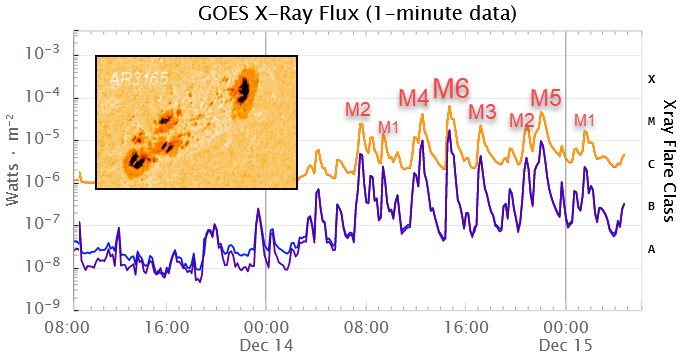
INCREASING SOLAR ACTIVITY: Yesterday, fast-growing sunspot AR3165 unleashed a remarkable series of M-class solar flares. All day long, no more than a few hours went by without a significant explosion:
https://www.spaceweather.com/images2022/15dec22/fusillade.jpg
During the fusillade, the sunspot strobed Earth with more than 10 pulses of extreme ultraviolet and X-radiation. The resulting ionization of Earth's upper atmosphere caused a series of shortwave radio blackouts rolling across all longitudes. Aviators and mariners may have noticed poor reception at frequencies below 15 MHz.
Many of the flares hurled CMEs into space. Preliminary coronagraph data from SOHO suggest that all of them will miss Earth, passing upstream of our planet. Maybe next time? Another large sunspot, AR3163, has an unstable 'beta-gamma' magnetic field that poses a threat for M-class flares--and it is directly facing Earth.
https://www.spaceweather.com/images2022/15dec22/fusillade.jpg
During the fusillade, the sunspot strobed Earth with more than 10 pulses of extreme ultraviolet and X-radiation. The resulting ionization of Earth's upper atmosphere caused a series of shortwave radio blackouts rolling across all longitudes. Aviators and mariners may have noticed poor reception at frequencies below 15 MHz.
Many of the flares hurled CMEs into space. Preliminary coronagraph data from SOHO suggest that all of them will miss Earth, passing upstream of our planet. Maybe next time? Another large sunspot, AR3163, has an unstable 'beta-gamma' magnetic field that poses a threat for M-class flares--and it is directly facing Earth.
👍3