Solar wind
speed: 421.1 km/sec
density: 8.54 protons/cm3
Updated: Today at 0750 UT
X-ray Solar Flares
6-hr max: C5 0326 UT Oct20
24-hr: C5 0326 UT Oct20
Updated: Today at: 0755 UT
Planetary K-index
Now: Kp= 1 quiet
24-hr max: Kp= 1 quiet
Interplanetary Mag. Field
Btotal: 4.79 nT
Bz: -2.33 nT south
Updated: Today at 0750 UT
speed: 421.1 km/sec
density: 8.54 protons/cm3
Updated: Today at 0750 UT
X-ray Solar Flares
6-hr max: C5 0326 UT Oct20
24-hr: C5 0326 UT Oct20
Updated: Today at: 0755 UT
Planetary K-index
Now: Kp= 1 quiet
24-hr max: Kp= 1 quiet
Interplanetary Mag. Field
Btotal: 4.79 nT
Bz: -2.33 nT south
Updated: Today at 0750 UT
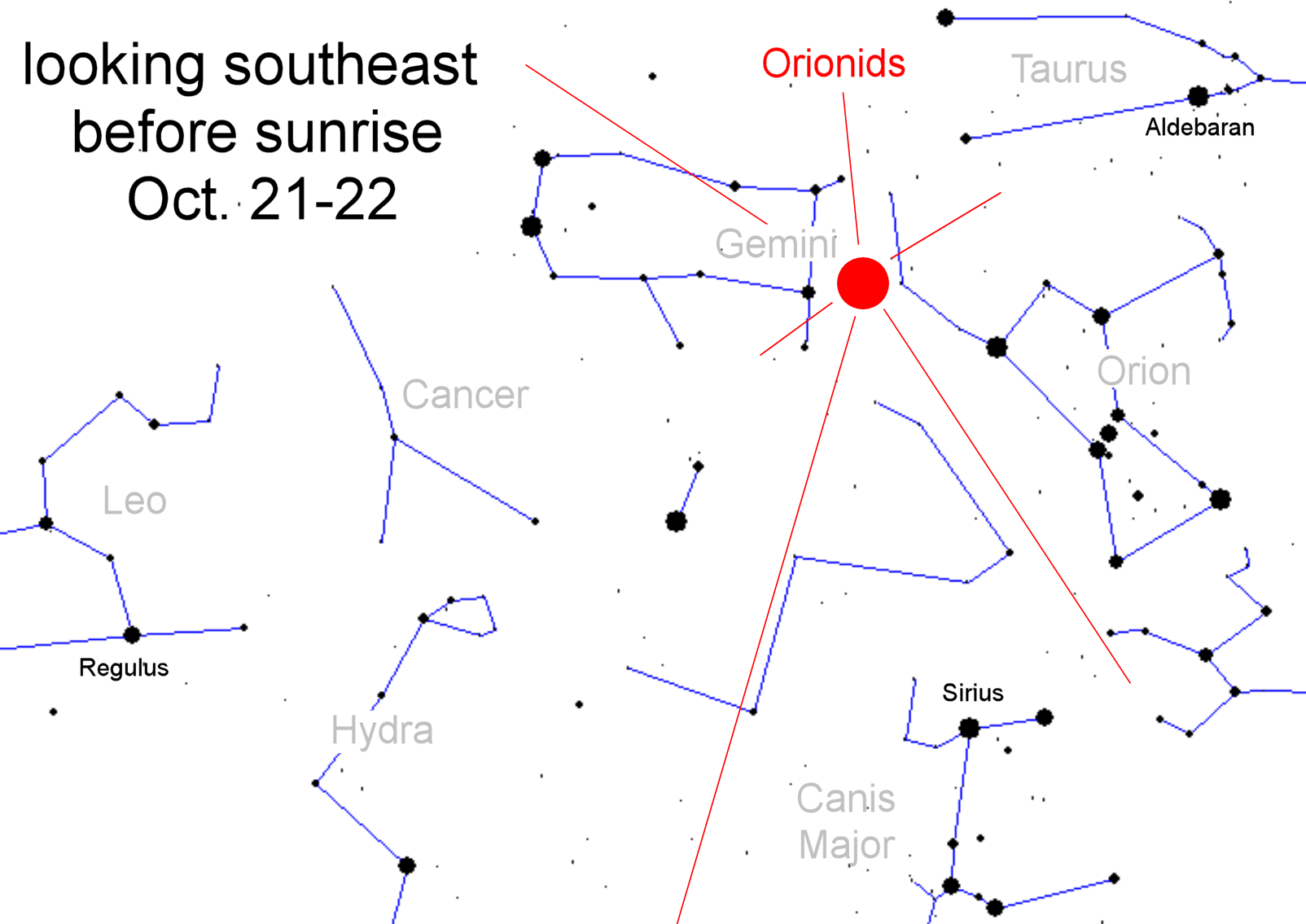
ORIONID METEOR SHOWER: Earth is entering a stream of debris from Halley's Comet, source of the annual Orionid meteor shower. Forecasters expect the shower to peak on Oct. 21st with as many as 20 meteors/hr. Orionids strike Earth's atmosphere traveling 148,000 mph. At that speed, they often leave glowing "trains" (incandescent bits of debris) that linger for minutes, swirling among the glittering stars of Orion, Gemini, and Taurus. The best time to look is between 1:00 am and sunrise. https://spaceweather.com/images2019/10oct19/skymap_orionids.png
👍3
Solar wind
speed: 550.7 km/sec
density: 7.64 protons/cm3
more data: ACE, DSCOVR
Updated: Today at 0956 UT
X-ray Solar Flares
6-hr max: C4 0802 UT Oct24
24-hr: C4 0802 UT Oct24
explanation | more data
Updated: Today at: 1000 UT
Planetary K-index
Now: Kp= 2 quiet
24-hr max: Kp= 4 unsettled
explanation | more data
Interplanetary Mag. Field
Btotal: 3.94 nT
Bz: -1.13 nT south
more data: ACE, DSCOVR
Updated: Today at 0956 UT
speed: 550.7 km/sec
density: 7.64 protons/cm3
more data: ACE, DSCOVR
Updated: Today at 0956 UT
X-ray Solar Flares
6-hr max: C4 0802 UT Oct24
24-hr: C4 0802 UT Oct24
explanation | more data
Updated: Today at: 1000 UT
Planetary K-index
Now: Kp= 2 quiet
24-hr max: Kp= 4 unsettled
explanation | more data
Interplanetary Mag. Field
Btotal: 3.94 nT
Bz: -1.13 nT south
more data: ACE, DSCOVR
Updated: Today at 0956 UT
ALL QUIET: There are five sunspot groups on the solar disk. None poses a threat for strong flares; they all have stable magnetic fields unlikely to explode. NOAA forecasters say there is a 5% chance of M-class solar flares and no more than a 1% chance of X-flares on Oct. 24th.
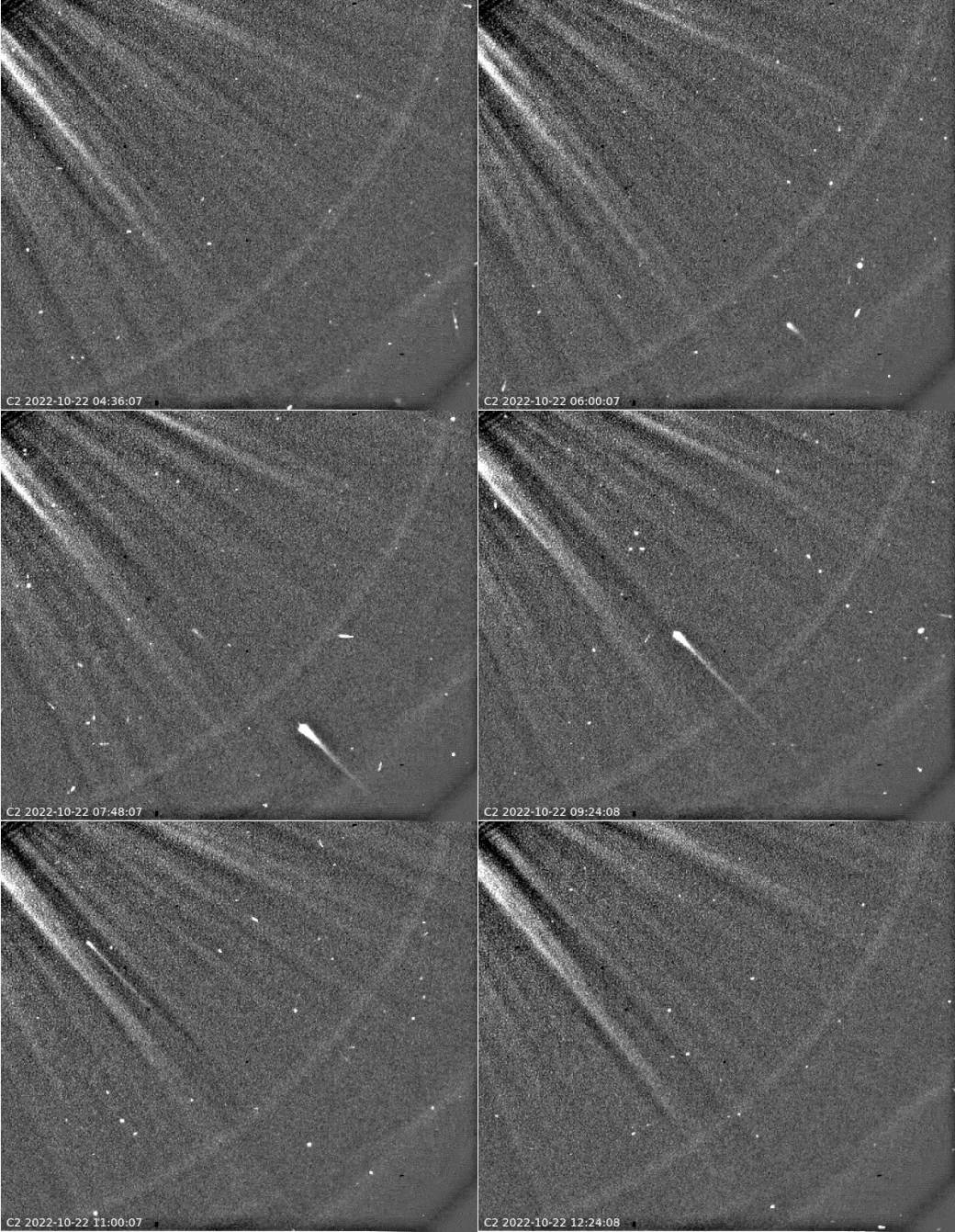
WATCH TWO COMETS DIVE INTO THE SUN: Over the weekend, the sun swallowed a comet. Correction: Make that two. Karl Battams of the US Naval Research Lab took a closer look at SOHO coronagraph images, and this is what he found:https://www.spaceweather.com/images2022/24oct22/doublegulp_slower_strip.gif
"Saturday's bright comet turned out to have a smaller, leading companion," says Battams. "This isn't particularly uncommon. I'd estimate that at least 30% of the really bright sungrazers we see in SOHO coronagraph images end up having a small leading or trailing companion."
Both comets in Battams' movie are Kreutz sungrazers. These are fragments from the breakup of a single giant comet many centuries ago. Since SOHO was launched in 1995, the observatory has watched more than 4000 Kreutz fragments fall into the sun. None have survived.
"Saturday's bright comet turned out to have a smaller, leading companion," says Battams. "This isn't particularly uncommon. I'd estimate that at least 30% of the really bright sungrazers we see in SOHO coronagraph images end up having a small leading or trailing companion."
Both comets in Battams' movie are Kreutz sungrazers. These are fragments from the breakup of a single giant comet many centuries ago. Since SOHO was launched in 1995, the observatory has watched more than 4000 Kreutz fragments fall into the sun. None have survived.
❤7😁1
Solar wind
speed: 395.8 km/sec
density: 9.42 protons/cm3
more data: ACE, DSCOVR
Updated: Today at 0656 UT
X-ray Solar Flares
6-hr max: B6 0338 UT Oct28
24-hr: C1 1003 UT Oct27
explanation | more data
Updated: Today at: 0700 UT
Planetary K-index
Now: Kp= 3 quiet
24-hr max: Kp= 3 quiet
explanation | more data
Interplanetary Mag. Field
Btotal: 3.23 nT
Bz: 0.20 nT north
more data: ACE, DSCOVR
Updated: Today at 0656 UT
speed: 395.8 km/sec
density: 9.42 protons/cm3
more data: ACE, DSCOVR
Updated: Today at 0656 UT
X-ray Solar Flares
6-hr max: B6 0338 UT Oct28
24-hr: C1 1003 UT Oct27
explanation | more data
Updated: Today at: 0700 UT
Planetary K-index
Now: Kp= 3 quiet
24-hr max: Kp= 3 quiet
explanation | more data
Interplanetary Mag. Field
Btotal: 3.23 nT
Bz: 0.20 nT north
more data: ACE, DSCOVR
Updated: Today at 0656 UT
👍1
GEOMAGNETIC STORM WATCH: NOAA forecasters say there is a chance of G1-class geomagnetic storms on Oct. 29th when a stream of solar wind is expected to hit Earth's magnetic field. The gaseous material is flowing from a cheerful hole in the sun's atmosphere. High latitude sky watchers should be alert for auroras this weekend.
👍1
Solar wind
speed: 551.8 km/sec
density: 11.17 protons/cm3
Updated: Today at 0736 UT
X-ray Solar Flares
6-hr max: C1 0618 UT Oct29
24-hr: C1 2222 UT Oct28
Updated: Today at: 0740 UT
Planetary K-index
Now: Kp= 4 unsettled
24-hr max: Kp= 4 unsettled
Interplanetary Mag. Field
Btotal: 8.81 nT
Bz: -4.95 nT south
Updated: Today at 0736 UT
speed: 551.8 km/sec
density: 11.17 protons/cm3
Updated: Today at 0736 UT
X-ray Solar Flares
6-hr max: C1 0618 UT Oct29
24-hr: C1 2222 UT Oct28
Updated: Today at: 0740 UT
Planetary K-index
Now: Kp= 4 unsettled
24-hr max: Kp= 4 unsettled
Interplanetary Mag. Field
Btotal: 8.81 nT
Bz: -4.95 nT south
Updated: Today at 0736 UT
GEOMAGNETIC STORM WATCH: NOAA forecasters say that minor G1-class geomagnetic storms are possible on Oct. 29th and 30th when a high-speed stream of solar wind is expected to hit Earth's magnetic field. The gaseous material is flowing from a cheerful hole in the sun's atmosphere. Arctic sky watchers should be alert for auroras this weekend.
Solar wind
speed: 457.5 km/sec
density: 5.52 protons/cm3
Updated: Today at 0810 UT
X-ray Solar Flares
6-hr max: C1 0248 UT Oct31
24-hr: C1 0248 UT Oct31
Updated: Today at: 0815 UT
Planetary K-index
Now: Kp= 3 quiet
24-hr max: Kp= 4 unsettled
explanation | more data
Interplanetary Mag. Field
Btotal: 5.22 nT
Bz: -2.74 nT south
Updated: Today at 0810 UT
speed: 457.5 km/sec
density: 5.52 protons/cm3
Updated: Today at 0810 UT
X-ray Solar Flares
6-hr max: C1 0248 UT Oct31
24-hr: C1 0248 UT Oct31
Updated: Today at: 0815 UT
Planetary K-index
Now: Kp= 3 quiet
24-hr max: Kp= 4 unsettled
explanation | more data
Interplanetary Mag. Field
Btotal: 5.22 nT
Bz: -2.74 nT south
Updated: Today at 0810 UT