Solar wind
speed: 580.9 km/sec
density: 10.46 protons/cm3
Updated: Today at 0805 UT
X-ray Solar Flares
6-hr max: C1 0225 UT Oct17
24-hr: C1 1606 UT Oct16
Updated: Today at: 0810 UT
Daily Sun: 17 Oct 22
Planetary K-index
Now: Kp= 1 quiet
24-hr max: Kp= 4 unsettled
Interplanetary Mag. Field
Btotal: 4.89 nT
Bz: 3.37 nT north
Updated: Today at 0805 UT
speed: 580.9 km/sec
density: 10.46 protons/cm3
Updated: Today at 0805 UT
X-ray Solar Flares
6-hr max: C1 0225 UT Oct17
24-hr: C1 1606 UT Oct16
Updated: Today at: 0810 UT
Daily Sun: 17 Oct 22
Planetary K-index
Now: Kp= 1 quiet
24-hr max: Kp= 4 unsettled
Interplanetary Mag. Field
Btotal: 4.89 nT
Bz: 3.37 nT north
Updated: Today at 0805 UT
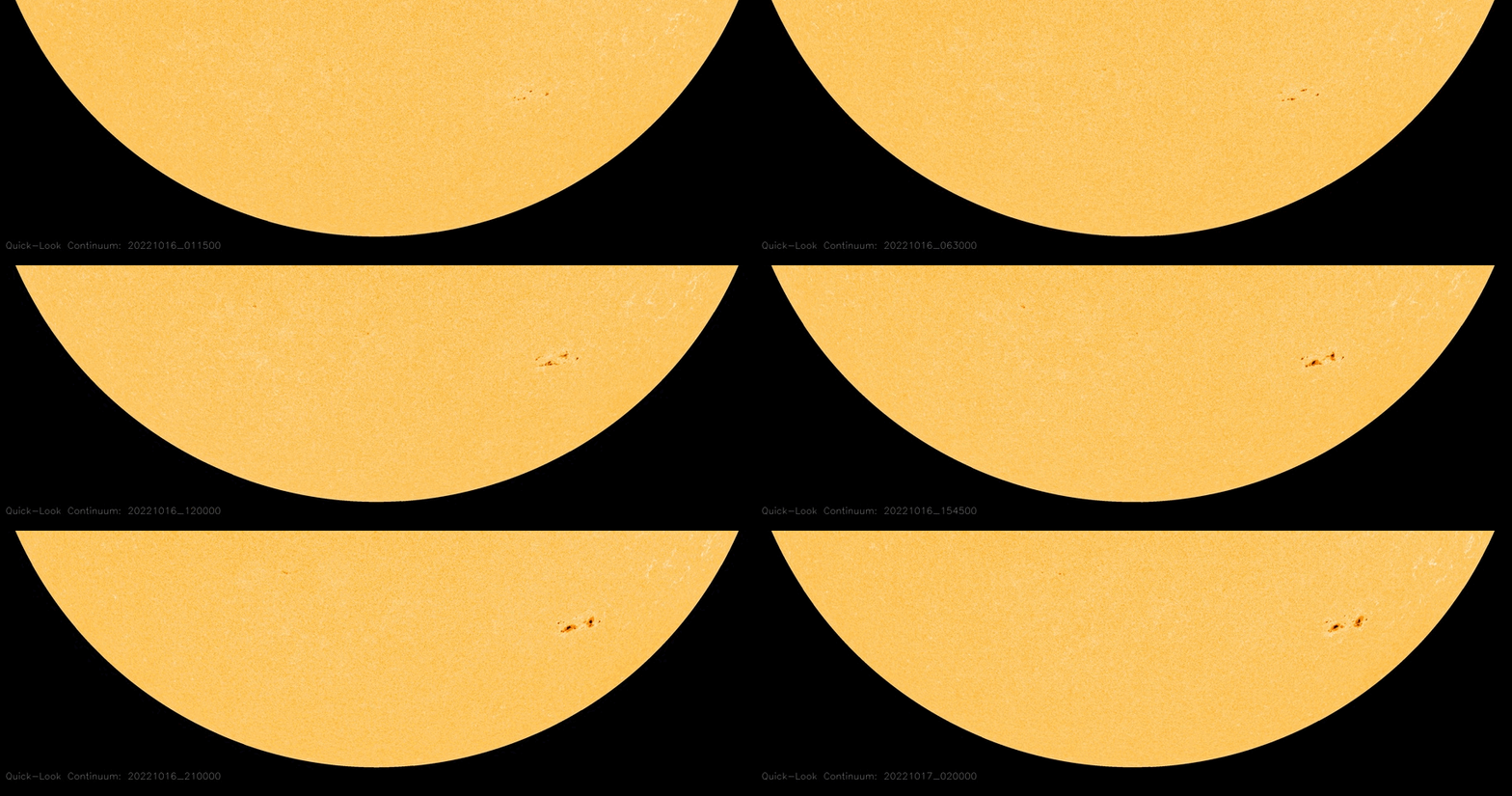
ALL QUIET: Despite yesterday's rapid growth of a sunspot in the sun's southern hemisphere, solar activity remains low. All of the sunspots on the solar disk have simple magnetic fields that pose no threat for strong solar flares. NOAA forecasters say the chance of an X-flare today is no more than 1%. https://www.spaceweather.com/images2022/17oct22/rapidgrowth.gif
Solar wind
speed: 450.6 km/sec
density: 4.17 protons/cm3
Updated: Today at 0750 UT
X-ray Solar Flares
6-hr max: C1 0737 UT Oct19
24-hr: C1 1413 UT Oct18
Updated: Today at: 0755 UT
Planetary K-index
Now: Kp= 2 quiet
24-hr max: Kp= 2 quiet
Interplanetary Mag. Field
Btotal: 5.18 nT
Bz: -0.42 nT south
Updated: Today at 0750 UT
speed: 450.6 km/sec
density: 4.17 protons/cm3
Updated: Today at 0750 UT
X-ray Solar Flares
6-hr max: C1 0737 UT Oct19
24-hr: C1 1413 UT Oct18
Updated: Today at: 0755 UT
Planetary K-index
Now: Kp= 2 quiet
24-hr max: Kp= 2 quiet
Interplanetary Mag. Field
Btotal: 5.18 nT
Bz: -0.42 nT south
Updated: Today at 0750 UT
Solar wind
speed: 421.1 km/sec
density: 8.54 protons/cm3
Updated: Today at 0750 UT
X-ray Solar Flares
6-hr max: C5 0326 UT Oct20
24-hr: C5 0326 UT Oct20
Updated: Today at: 0755 UT
Planetary K-index
Now: Kp= 1 quiet
24-hr max: Kp= 1 quiet
Interplanetary Mag. Field
Btotal: 4.79 nT
Bz: -2.33 nT south
Updated: Today at 0750 UT
speed: 421.1 km/sec
density: 8.54 protons/cm3
Updated: Today at 0750 UT
X-ray Solar Flares
6-hr max: C5 0326 UT Oct20
24-hr: C5 0326 UT Oct20
Updated: Today at: 0755 UT
Planetary K-index
Now: Kp= 1 quiet
24-hr max: Kp= 1 quiet
Interplanetary Mag. Field
Btotal: 4.79 nT
Bz: -2.33 nT south
Updated: Today at 0750 UT
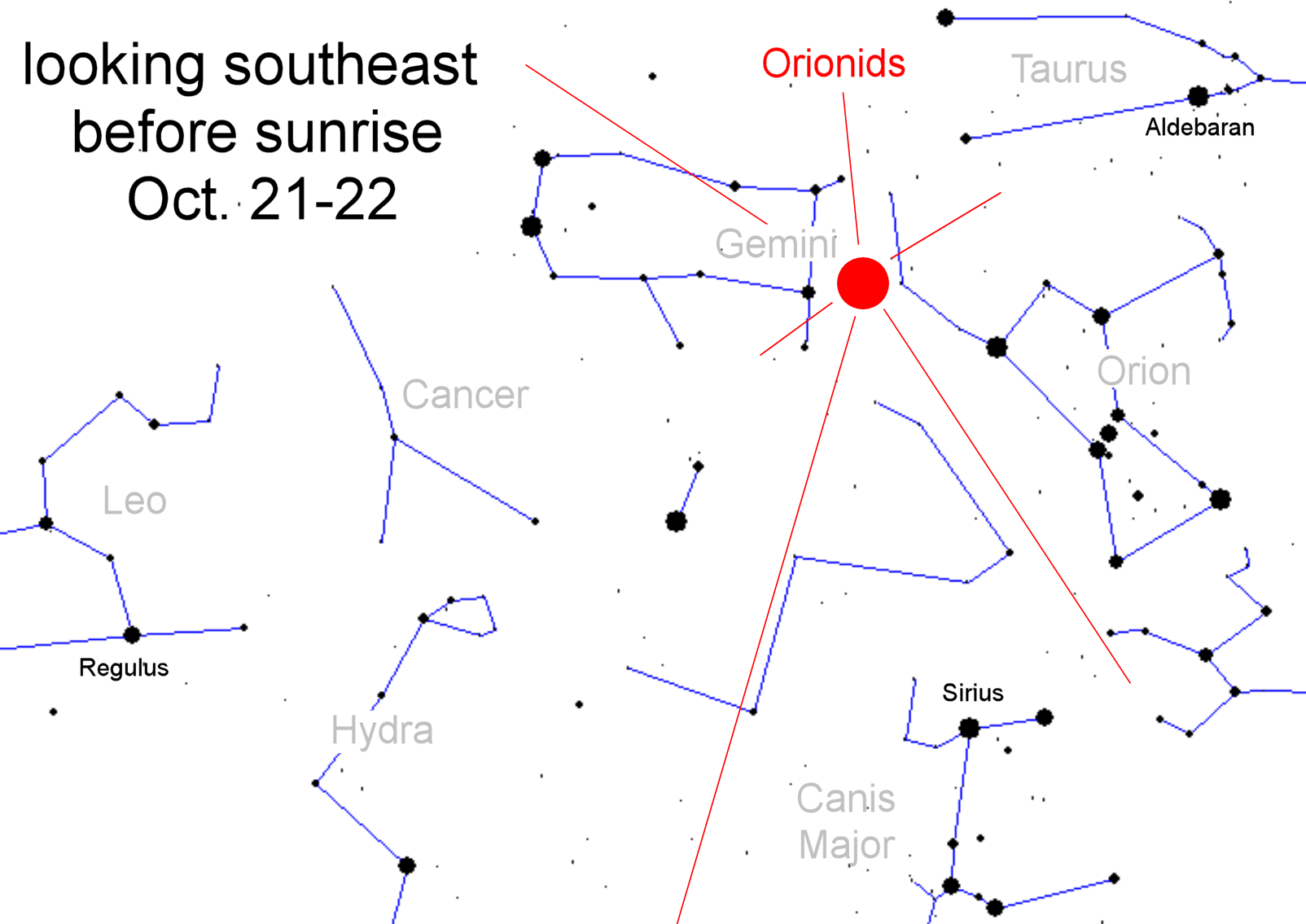
ORIONID METEOR SHOWER: Earth is entering a stream of debris from Halley's Comet, source of the annual Orionid meteor shower. Forecasters expect the shower to peak on Oct. 21st with as many as 20 meteors/hr. Orionids strike Earth's atmosphere traveling 148,000 mph. At that speed, they often leave glowing "trains" (incandescent bits of debris) that linger for minutes, swirling among the glittering stars of Orion, Gemini, and Taurus. The best time to look is between 1:00 am and sunrise. https://spaceweather.com/images2019/10oct19/skymap_orionids.png
👍3
Solar wind
speed: 550.7 km/sec
density: 7.64 protons/cm3
more data: ACE, DSCOVR
Updated: Today at 0956 UT
X-ray Solar Flares
6-hr max: C4 0802 UT Oct24
24-hr: C4 0802 UT Oct24
explanation | more data
Updated: Today at: 1000 UT
Planetary K-index
Now: Kp= 2 quiet
24-hr max: Kp= 4 unsettled
explanation | more data
Interplanetary Mag. Field
Btotal: 3.94 nT
Bz: -1.13 nT south
more data: ACE, DSCOVR
Updated: Today at 0956 UT
speed: 550.7 km/sec
density: 7.64 protons/cm3
more data: ACE, DSCOVR
Updated: Today at 0956 UT
X-ray Solar Flares
6-hr max: C4 0802 UT Oct24
24-hr: C4 0802 UT Oct24
explanation | more data
Updated: Today at: 1000 UT
Planetary K-index
Now: Kp= 2 quiet
24-hr max: Kp= 4 unsettled
explanation | more data
Interplanetary Mag. Field
Btotal: 3.94 nT
Bz: -1.13 nT south
more data: ACE, DSCOVR
Updated: Today at 0956 UT
ALL QUIET: There are five sunspot groups on the solar disk. None poses a threat for strong flares; they all have stable magnetic fields unlikely to explode. NOAA forecasters say there is a 5% chance of M-class solar flares and no more than a 1% chance of X-flares on Oct. 24th.