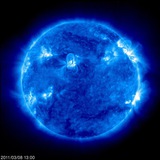
POSSIBLE CLOSE ENCOUNTER WITH A CME: NOAA forecasters say that a slow-moving CME might pass close to Earth today (Oct. 12th). It left the sun five days ago. The near miss could shove solar wind plasma onto Earth's magnetic field, sparking auroras around the Arctic Circle.
Solar wind
speed: 312.7 km/sec
density: 0.53 protons/cm3
Updated: Today at 0557 UT
X-ray Solar Flares
6-hr max: M1 0019 UT Oct13
24-hr: M1 0019 UT Oct13
Updated: Today at: 0600 UT
Planetary K-index
Now: Kp= 2 quiet
24-hr max: Kp= 2 quiet
Interplanetary Mag. Field
Btotal: 3.79 nT
Bz: -2.05 nT south
Updated: Today at 0557 UT
speed: 312.7 km/sec
density: 0.53 protons/cm3
Updated: Today at 0557 UT
X-ray Solar Flares
6-hr max: M1 0019 UT Oct13
24-hr: M1 0019 UT Oct13
Updated: Today at: 0600 UT
Planetary K-index
Now: Kp= 2 quiet
24-hr max: Kp= 2 quiet
Interplanetary Mag. Field
Btotal: 3.79 nT
Bz: -2.05 nT south
Updated: Today at 0557 UT
CHANCE OF FLARES TODAY: Departing sunspot AR3112 poses a continued threat for solar flares. NOAA forecasters estimate a 45% chance of M-class flares and a 10% chance of X-flares on Oct. 13th.
👍1
Solar wind
speed: 337.1 km/sec
density: 21.92 protons/cm3
Updated: Today at 0720 UT
X-ray Solar Flares
6-hr max: B9 0132 UT Oct14
24-hr: C4 0917 UT Oct13
Updated: Today at: 0725 UT
Planetary K-index
Now: Kp= 3 quiet
24-hr max: Kp= 3 quiet
Interplanetary Mag. Field
Btotal: 12.56 nT
Bz: -12.34 nT south
Updated: Today at 0721 UT
speed: 337.1 km/sec
density: 21.92 protons/cm3
Updated: Today at 0720 UT
X-ray Solar Flares
6-hr max: B9 0132 UT Oct14
24-hr: C4 0917 UT Oct13
Updated: Today at: 0725 UT
Planetary K-index
Now: Kp= 3 quiet
24-hr max: Kp= 3 quiet
Interplanetary Mag. Field
Btotal: 12.56 nT
Bz: -12.34 nT south
Updated: Today at 0721 UT
GEOMAGNETIC ACTIVITY: A CME may have just passed Earth, not hitting, but nevertheless unsettling our planet's magnetic field. Solar wind data from NOAA's DSCOVR spacecraft show an unexpected upsurge in dense magnetized plasma around UT midnight on Oct. 13-14. This event has triggered some bright auroras around the Arctic Circle.
Solar wind
speed: 580.9 km/sec
density: 10.46 protons/cm3
Updated: Today at 0805 UT
X-ray Solar Flares
6-hr max: C1 0225 UT Oct17
24-hr: C1 1606 UT Oct16
Updated: Today at: 0810 UT
Daily Sun: 17 Oct 22
Planetary K-index
Now: Kp= 1 quiet
24-hr max: Kp= 4 unsettled
Interplanetary Mag. Field
Btotal: 4.89 nT
Bz: 3.37 nT north
Updated: Today at 0805 UT
speed: 580.9 km/sec
density: 10.46 protons/cm3
Updated: Today at 0805 UT
X-ray Solar Flares
6-hr max: C1 0225 UT Oct17
24-hr: C1 1606 UT Oct16
Updated: Today at: 0810 UT
Daily Sun: 17 Oct 22
Planetary K-index
Now: Kp= 1 quiet
24-hr max: Kp= 4 unsettled
Interplanetary Mag. Field
Btotal: 4.89 nT
Bz: 3.37 nT north
Updated: Today at 0805 UT
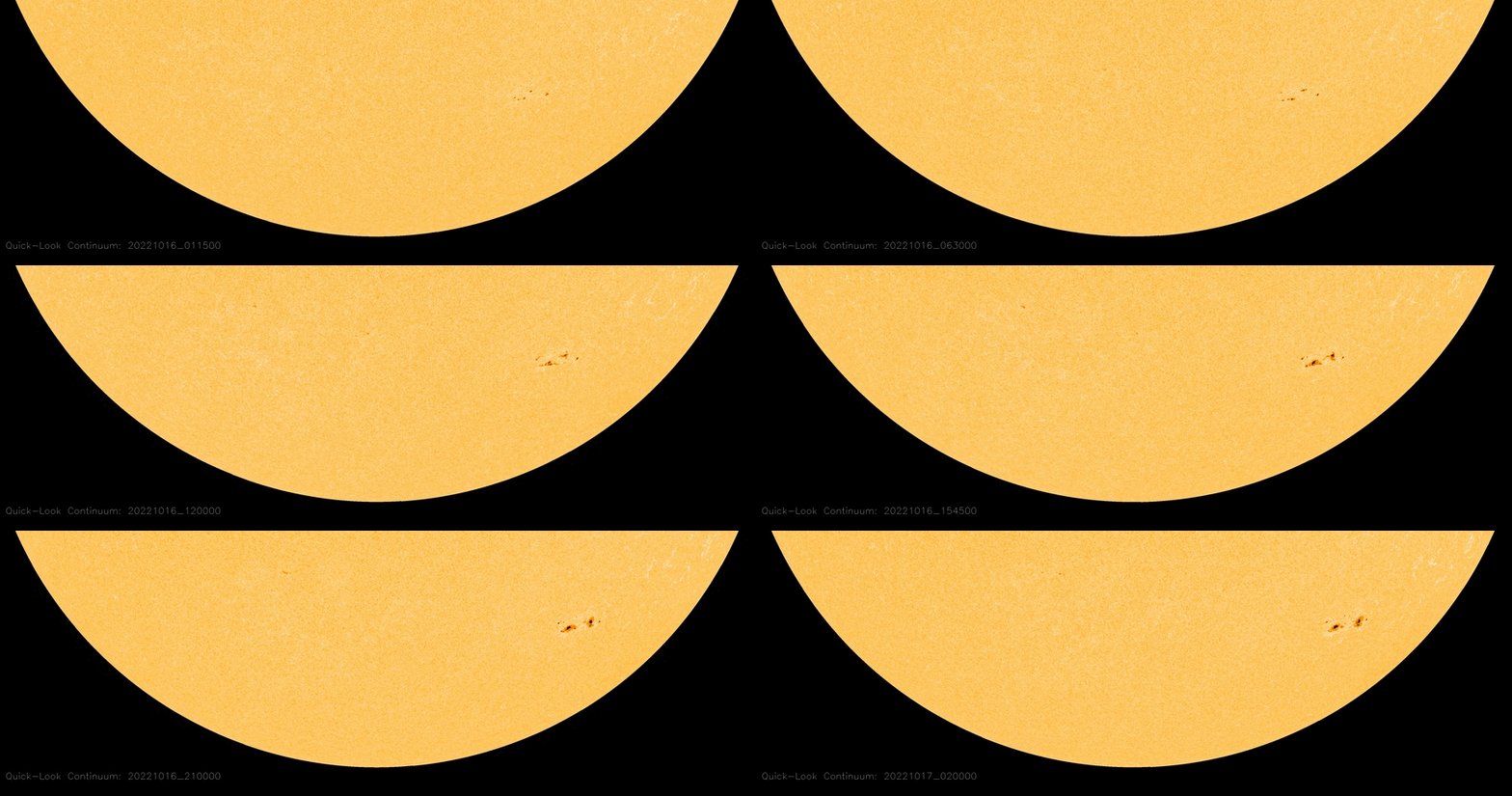
ALL QUIET: Despite yesterday's rapid growth of a sunspot in the sun's southern hemisphere, solar activity remains low. All of the sunspots on the solar disk have simple magnetic fields that pose no threat for strong solar flares. NOAA forecasters say the chance of an X-flare today is no more than 1%. https://www.spaceweather.com/images2022/17oct22/rapidgrowth.gif
Solar wind
speed: 450.6 km/sec
density: 4.17 protons/cm3
Updated: Today at 0750 UT
X-ray Solar Flares
6-hr max: C1 0737 UT Oct19
24-hr: C1 1413 UT Oct18
Updated: Today at: 0755 UT
Planetary K-index
Now: Kp= 2 quiet
24-hr max: Kp= 2 quiet
Interplanetary Mag. Field
Btotal: 5.18 nT
Bz: -0.42 nT south
Updated: Today at 0750 UT
speed: 450.6 km/sec
density: 4.17 protons/cm3
Updated: Today at 0750 UT
X-ray Solar Flares
6-hr max: C1 0737 UT Oct19
24-hr: C1 1413 UT Oct18
Updated: Today at: 0755 UT
Planetary K-index
Now: Kp= 2 quiet
24-hr max: Kp= 2 quiet
Interplanetary Mag. Field
Btotal: 5.18 nT
Bz: -0.42 nT south
Updated: Today at 0750 UT