Solar wind
speed: 572.4 km/sec
density: 10.95 protons/cm3
Updated: Today at 0831 UT
X-ray Solar Flares
6-hr max: C2 0814 UT Oct04
24-hr: M4 1011 UT Oct03
Updated: Today at: 0835 UT
Daily Sun: 04 Oct 22
Oulu Neutron Counts
Percentages of the Space Age average:
today: +1.1% Elevated
48-hr change: +0.0%
Max: +11.7% Very High (12/2009)
Min: -32.1% Very Low (06/1991)
Planetary K-index
Now: Kp= 4 unsettled
24-hr max: Kp= 5 storm
explanation | more data
Interplanetary Mag. Field
Btotal: 7.75 nT
Bz: -1.13 nT south
Updated: Today at 0831 UT
speed: 572.4 km/sec
density: 10.95 protons/cm3
Updated: Today at 0831 UT
X-ray Solar Flares
6-hr max: C2 0814 UT Oct04
24-hr: M4 1011 UT Oct03
Updated: Today at: 0835 UT
Daily Sun: 04 Oct 22
Oulu Neutron Counts
Percentages of the Space Age average:
today: +1.1% Elevated
48-hr change: +0.0%
Max: +11.7% Very High (12/2009)
Min: -32.1% Very Low (06/1991)
Planetary K-index
Now: Kp= 4 unsettled
24-hr max: Kp= 5 storm
explanation | more data
Interplanetary Mag. Field
Btotal: 7.75 nT
Bz: -1.13 nT south
Updated: Today at 0831 UT
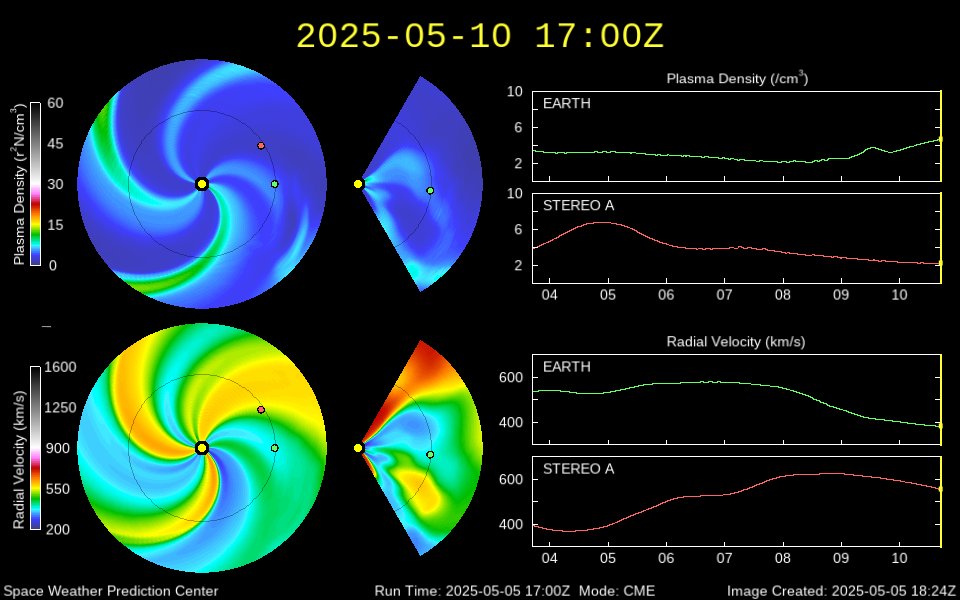
POSSIBLE CANNIBAL CME EVENT: According to NOAA forecasters, multiple CMEs are heading for Earth. ETA: Oct. 4th. This could be a "Cannibal CME" event. Take a look at this NOAA model. Cannibal CMEs form when a fast-moving CME devours one or more slower CMEs ahead of it. The combined cloud contains tangled magnetic fields that can do a good job sparking auroras. Storm levels could reach category G2 if/when the Cannibal arrives. https://services.swpc.noaa.gov/images/animations/enlil/latest.jpg
https://www.swpc.noaa.gov/products/wsa-enlil-solar-wind-prediction
https://www.swpc.noaa.gov/products/wsa-enlil-solar-wind-prediction
👍8🤩1
Solar wind
speed: 531.5 km/sec
density: 10.29 protons/cm3
Updated: Today at 0656 UT
X-ray Solar Flares
6-hr max: C2 0336 UT Oct06
24-hr: C2 2119 UT Oct05
Updated: Today at: 0700 UT
Daily Sun: 06 Oct 22
Planetary K-index
Now: Kp= 3 quiet
24-hr max: Kp= 4 unsettled
Interplanetary Mag. Field
Btotal: 6.08 nT
Bz: -5.24 nT south
Updated: Today at 0656 UT
Coronal Holes: 06 Oct 22
There are no large coronal holes on the Earthside of the sun. Credit: SDO/AIA
speed: 531.5 km/sec
density: 10.29 protons/cm3
Updated: Today at 0656 UT
X-ray Solar Flares
6-hr max: C2 0336 UT Oct06
24-hr: C2 2119 UT Oct05
Updated: Today at: 0700 UT
Daily Sun: 06 Oct 22
Planetary K-index
Now: Kp= 3 quiet
24-hr max: Kp= 4 unsettled
Interplanetary Mag. Field
Btotal: 6.08 nT
Bz: -5.24 nT south
Updated: Today at 0656 UT
Coronal Holes: 06 Oct 22
There are no large coronal holes on the Earthside of the sun. Credit: SDO/AIA
👍1
WHEN WILL THE NEXT CME ARRIVE? A magnetic filament in the sun's southrn hemisphere erupted on Oct. 4th, hurling part of itself into space. The emerging CME will pass mostly to the south of our planet, but a fraction could graze Earth's magnetic field on Oct. 8th. High-latitude sky watchers should be alert for minor geomagnetic storms and auroras on that date.
Solar wind
speed: 538.6 km/sec
density: 11.77 protons/cm3
Updated: Today at 0710 UT
X-ray Solar Flares
6-hr max: C5 0114 UT Oct10
24-hr: M1 0047 UT Oct10
Updated: Today at: 0715 UT
Planetary K-index
Now: Kp= 3 quiet
24-hr max: Kp= 4 unsettled
Interplanetary Mag. Field
Btotal: 4.75 nT
Bz: 0.25 nT north
Updated: Today at 0710 UT
speed: 538.6 km/sec
density: 11.77 protons/cm3
Updated: Today at 0710 UT
X-ray Solar Flares
6-hr max: C5 0114 UT Oct10
24-hr: M1 0047 UT Oct10
Updated: Today at: 0715 UT
Planetary K-index
Now: Kp= 3 quiet
24-hr max: Kp= 4 unsettled
Interplanetary Mag. Field
Btotal: 4.75 nT
Bz: 0.25 nT north
Updated: Today at 0710 UT
GEOMAGNETIC STORM WATCH: NOAA forecasters say there is a chance of minor G1-class geomagnetic storms today, Oct. 10th, in response to sustained pressure from a high-speed stream of solar wind. High-latitude sky watchers should be alert for auroras. https://www.spaceweather.com/glossary/g1.jpg

👍1