Solar wind
speed: 412.2 km/sec
density: 6.22 protons/cm3
more data: ACE, DSCOVR
Updated: Today at 0946 UT
X-ray Solar Flares
6-hr max: C5 0510 UT Sep23
24-hr: C7 1134 UT Sep22
explanation | more data
Updated: Today at: 0950 UT
Planetary K-index
Now: Kp= 3 quiet
24-hr max: Kp= 3 quiet
explanation | more data
Interplanetary Mag. Field
Btotal: 4.91 nT
Bz: -4.73 nT south
more data: ACE, DSCOVR
Updated: Today at 0945 UT
speed: 412.2 km/sec
density: 6.22 protons/cm3
more data: ACE, DSCOVR
Updated: Today at 0946 UT
X-ray Solar Flares
6-hr max: C5 0510 UT Sep23
24-hr: C7 1134 UT Sep22
explanation | more data
Updated: Today at: 0950 UT
Planetary K-index
Now: Kp= 3 quiet
24-hr max: Kp= 3 quiet
explanation | more data
Interplanetary Mag. Field
Btotal: 4.91 nT
Bz: -4.73 nT south
more data: ACE, DSCOVR
Updated: Today at 0945 UT
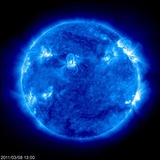
CHANCE OF STORMS TODAY: NOAA forecasters say that a minor G1-class geomagnetic storm is possible on Sept. 23rd when a high-speed stream of solar wind is expected to hit Earth's magnetic field. The gaseous material is flowing from an equatorial hole in the sun's atmosphere. High-latitude auroras are possible when the windy stream arrives.
👍7
Space Weather Today pinned «Solar wind speed: 412.2 km/sec density: 6.22 protons/cm3 more data: ACE, DSCOVR Updated: Today at 0946 UT X-ray Solar Flares 6-hr max: C5 0510 UT Sep23 24-hr: C7 1134 UT Sep22 explanation | more data Updated: Today at: 0950 UT Planetary K-index Now: Kp=…»
Solar wind
speed: 303.5 km/sec
density: 11.22 protons/cm3
Updated: Today at 0636 UT
X-ray Solar Flares
6-hr max: B9 0515 UT Sep26
24-hr: C6 0706 UT Sep25
Updated: Today at: 0640 UT
Planetary K-index
Now: Kp= 1 quiet
24-hr max: Kp= 2 quiet
explanation | more data
Interplanetary Mag. Field
Btotal: 4.73 nT
Bz: 0.85 nT north
Updated: Today at 0636 UT
speed: 303.5 km/sec
density: 11.22 protons/cm3
Updated: Today at 0636 UT
X-ray Solar Flares
6-hr max: B9 0515 UT Sep26
24-hr: C6 0706 UT Sep25
Updated: Today at: 0640 UT
Planetary K-index
Now: Kp= 1 quiet
24-hr max: Kp= 2 quiet
explanation | more data
Interplanetary Mag. Field
Btotal: 4.73 nT
Bz: 0.85 nT north
Updated: Today at 0636 UT
Daily Sun: 28 Sep 22
Solar wind
speed: 547.8 km/sec
density: 8.78 protons/cm3
Updated: Today at 0645 UT
X-ray Solar Flares
6-hr max: C2 0050 UT Sep28
24-hr: C5 1957 UT Sep27
Updated: Today at: 0650 UT
Solar wind
speed: 547.8 km/sec
density: 8.78 protons/cm3
Updated: Today at 0645 UT
X-ray Solar Flares
6-hr max: C2 0050 UT Sep28
24-hr: C5 1957 UT Sep27
Updated: Today at: 0650 UT
GEOMAGNETIC STORM WATCH: A solar wind stream is approaching Earth, and it could spark a G1-class geomagnetic storm when it arrives on Sept. 30th or Oct. 1st. The gaseous material is flowing from a double equatorial hole in the sun's atmosphere. High-latitude sky watchers should be alert for auroras on those dates.
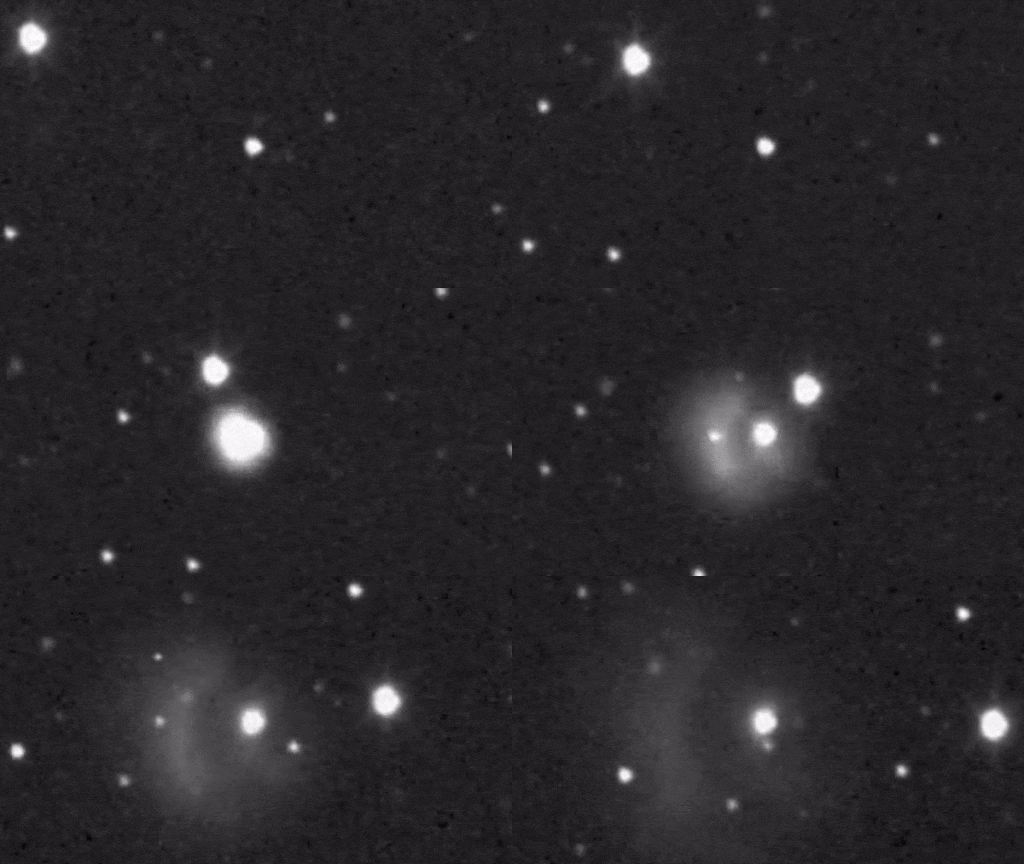
DRAMATIC GROUND-BASED IMAGES OF ASTEROID STRIKE: On Monday, Sept. 26th, NASA's DART spacecraft hit asteroid Dimorphos. Surprising even NASA, ground-based telescopes had no trouble seeing the impact. Astronomers with the Asteroid Terrestrial-impact Last Alert System (ATLAS) in Hawaii recorded a bright cloud of debris: https://www.spaceweather.com/images2022/27sep22/dart_strip_opt.gif
This was the result of the 1,340-pound spacecraft plunging into Dimorphos at 14,000 mph. Most of the debris is probably asteroid dust, but some of DART may be in there, too. A similar video was recorded by the 1-meter Lesedi telescope in South Africa.
Mission scientsts say DART hit the asteroid less than 17 meters off center. Think about that: 17 meters off at a distance of 11 million kilometers. NASA still has the right stuff.
Now that the dust has cleared, astronomers are monitoring Dimorphos's orbit to find out whether or not it has changed in response to the strike. Even a slight shift would prove that human tech can alter an asteroid's trajectory--a possible strategy for future Planetary Defense.
This was the result of the 1,340-pound spacecraft plunging into Dimorphos at 14,000 mph. Most of the debris is probably asteroid dust, but some of DART may be in there, too. A similar video was recorded by the 1-meter Lesedi telescope in South Africa.
Mission scientsts say DART hit the asteroid less than 17 meters off center. Think about that: 17 meters off at a distance of 11 million kilometers. NASA still has the right stuff.
Now that the dust has cleared, astronomers are monitoring Dimorphos's orbit to find out whether or not it has changed in response to the strike. Even a slight shift would prove that human tech can alter an asteroid's trajectory--a possible strategy for future Planetary Defense.
👍2❤1
Daily Sun: 29 Sep 22
Solar wind
speed: 490.3 km/sec
density: 9.49 protons/cm3
Updated: Today at 0651 UT
X-ray Solar Flares
6-hr max: C5 0530 UT Sep29
24-hr: C5 0530 UT Sep29
Updated: Today at: 0655 UT
Solar wind
speed: 490.3 km/sec
density: 9.49 protons/cm3
Updated: Today at 0651 UT
X-ray Solar Flares
6-hr max: C5 0530 UT Sep29
24-hr: C5 0530 UT Sep29
Updated: Today at: 0655 UT