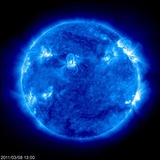
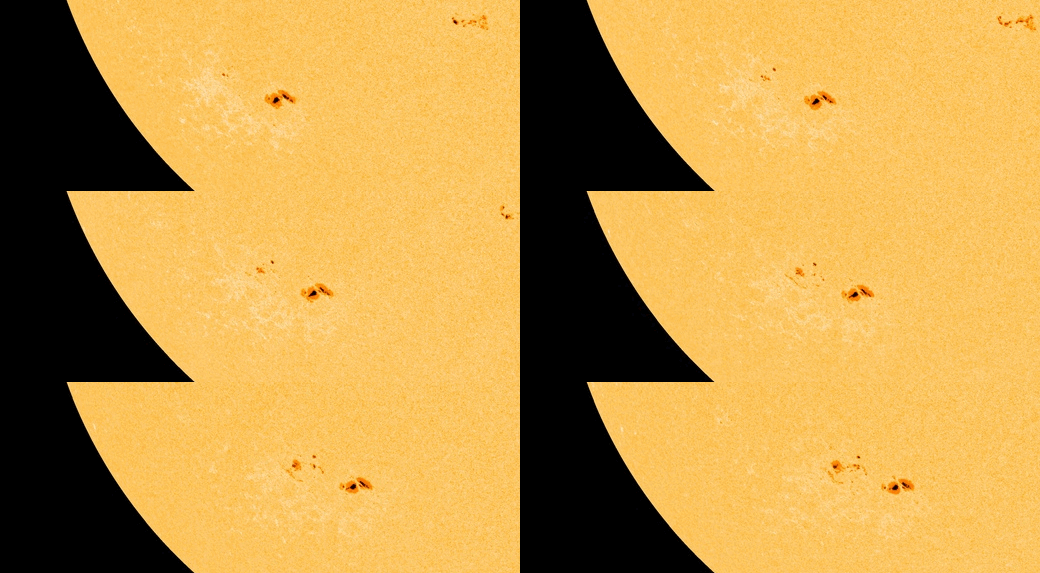
SUNSPOT RESURRECTION: Just when you thought old sunspot AR3088 was dead, it's back. The decaying sunspot is growing again, adding more than 50% to its area over the past 24 hours.
This is the sunspot's second time around the sun. The first time in August it peppered Earth with dozens of solar flares, and later hammered Venus with one of the strongest farside radiation storms in decades. The sunspot reappeared on the Earthside of the sun a few days ago and was renumbered AR3102. It appeared to be in decay. Not so fast? Stay tuned. https://www.spaceweather.com/images2022/17sep22/resurrection_strip.gif
This is the sunspot's second time around the sun. The first time in August it peppered Earth with dozens of solar flares, and later hammered Venus with one of the strongest farside radiation storms in decades. The sunspot reappeared on the Earthside of the sun a few days ago and was renumbered AR3102. It appeared to be in decay. Not so fast? Stay tuned. https://www.spaceweather.com/images2022/17sep22/resurrection_strip.gif
Solar wind
speed: 439.9 km/sec
density: 6.79 protons/cm3
Updated: Today at 0710 UT
X-ray Solar Flares
6-hr max: C7 0230 UT Sep19
24-hr: C7 0230 UT Sep19
Updated: Today at: 0715 UT
speed: 439.9 km/sec
density: 6.79 protons/cm3
Updated: Today at 0710 UT
X-ray Solar Flares
6-hr max: C7 0230 UT Sep19
24-hr: C7 0230 UT Sep19
Updated: Today at: 0715 UT
Solar wind
speed: 455.6 km/sec
density: 5.69 protons/cm3
Updated: Today at 0731 UT
X-ray Solar Flares
6-hr max: C5 0542 UT Sep20
24-hr: C5 0542 UT Sep20
Updated: Today at: 0735 UT
Planetary K-index
Now: Kp= 2 quiet
24-hr max: Kp= 3 quiet
explanation | more data
Interplanetary Mag. Field
Btotal: 5.00 nT
Bz: 1.76 nT north
more data: ACE, DSCOVR
Updated: Today at 0731 UT
speed: 455.6 km/sec
density: 5.69 protons/cm3
Updated: Today at 0731 UT
X-ray Solar Flares
6-hr max: C5 0542 UT Sep20
24-hr: C5 0542 UT Sep20
Updated: Today at: 0735 UT
Planetary K-index
Now: Kp= 2 quiet
24-hr max: Kp= 3 quiet
explanation | more data
Interplanetary Mag. Field
Btotal: 5.00 nT
Bz: 1.76 nT north
more data: ACE, DSCOVR
Updated: Today at 0731 UT
Space Weather Today pinned «Solar wind speed: 455.6 km/sec density: 5.69 protons/cm3 Updated: Today at 0731 UT X-ray Solar Flares 6-hr max: C5 0542 UT Sep20 24-hr: C5 0542 UT Sep20 Updated: Today at: 0735 UT Planetary K-index Now: Kp= 2 quiet 24-hr max: Kp= 3 quiet explanation | more…»
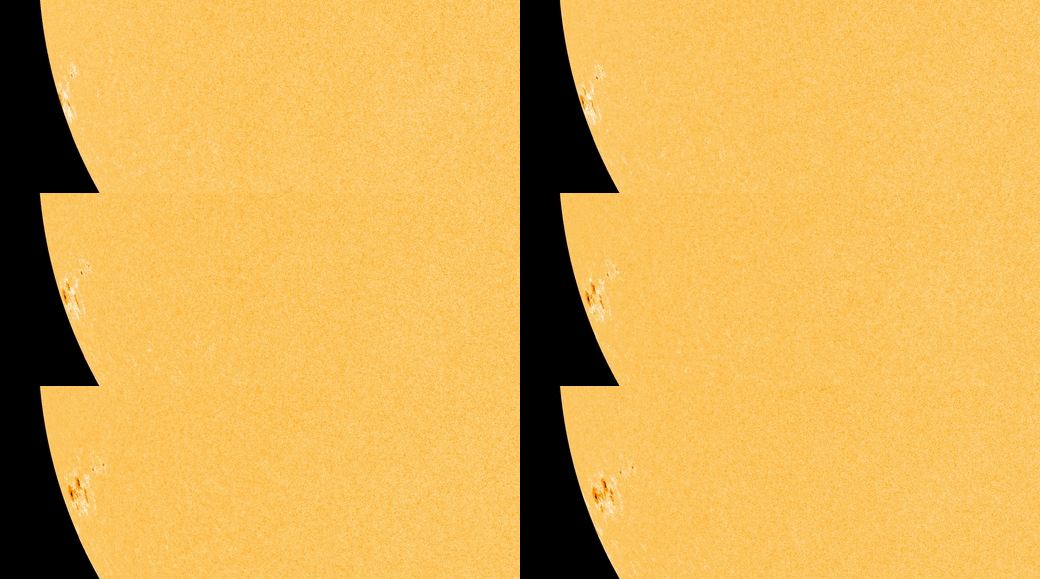
THAT SUNSPOT IS GETTING BIGGER: Sunspot AR3105 emerging over the sun's eastern limb is growing rapidly: movie. We've seen this sunspot before. It's AR3089 returning after a 2-week trip around the farside of the sun. Instead of decaying, the old sunspot seems to be growing again. If this continues, it could soon pose a threat for Earth-directed flares. https://www.spaceweather.com/images2022/20sep22/emerging_strip.gif
AN EXPLOSION OF AURORAS OVER NORWAY: Last night in Tromsø, Norway, there was an explosion of auroras so intense "it made my guests scream and laugh at the same time," says aurora tour guide Markus Varik. "We had no idea the night would turn out like this!"
Source: https://spaceweathergallery.com/indiv_upload.php?upload_id=188563
Source: https://spaceweathergallery.com/indiv_upload.php?upload_id=188563
🔥6❤3🤩3🤯1
Solar wind
speed: 412.2 km/sec
density: 6.22 protons/cm3
more data: ACE, DSCOVR
Updated: Today at 0946 UT
X-ray Solar Flares
6-hr max: C5 0510 UT Sep23
24-hr: C7 1134 UT Sep22
explanation | more data
Updated: Today at: 0950 UT
Planetary K-index
Now: Kp= 3 quiet
24-hr max: Kp= 3 quiet
explanation | more data
Interplanetary Mag. Field
Btotal: 4.91 nT
Bz: -4.73 nT south
more data: ACE, DSCOVR
Updated: Today at 0945 UT
speed: 412.2 km/sec
density: 6.22 protons/cm3
more data: ACE, DSCOVR
Updated: Today at 0946 UT
X-ray Solar Flares
6-hr max: C5 0510 UT Sep23
24-hr: C7 1134 UT Sep22
explanation | more data
Updated: Today at: 0950 UT
Planetary K-index
Now: Kp= 3 quiet
24-hr max: Kp= 3 quiet
explanation | more data
Interplanetary Mag. Field
Btotal: 4.91 nT
Bz: -4.73 nT south
more data: ACE, DSCOVR
Updated: Today at 0945 UT
CHANCE OF STORMS TODAY: NOAA forecasters say that a minor G1-class geomagnetic storm is possible on Sept. 23rd when a high-speed stream of solar wind is expected to hit Earth's magnetic field. The gaseous material is flowing from an equatorial hole in the sun's atmosphere. High-latitude auroras are possible when the windy stream arrives.
👍7