SUNSPOTS IN DECAY: With multiple sunspot groups in rapid decay, the sun is on the verge of producing a spotless day--a remarkable development more than 2 years after the start of Solar Cycle 25. The chance of strong solar flares today is close to zero.
RARE MORNING SKY SHOW: For the first time since Dec. 2004, five naked-eye planets have lined up at dawn in order of their distance from the sun. It's a rare morning sky show. Next week, the Moon will hop from planet to planet, producing a series of early morning conjunctions. Set your alarm for dawn and enjoy the show!
https://spaceweatherarchive.com/2022/06/12/rare-early-morning-sky-show/
https://spaceweatherarchive.com/2022/06/12/rare-early-morning-sky-show/
Spaceweather.com
Rare Early Morning Sky Show
June 12, 2022: How many planets can you see before breakfast? Tom Harradine of Brisbane, Australia, woke up early Thursday morning and found the entire solar system sprawled across the dawn sky: &#…
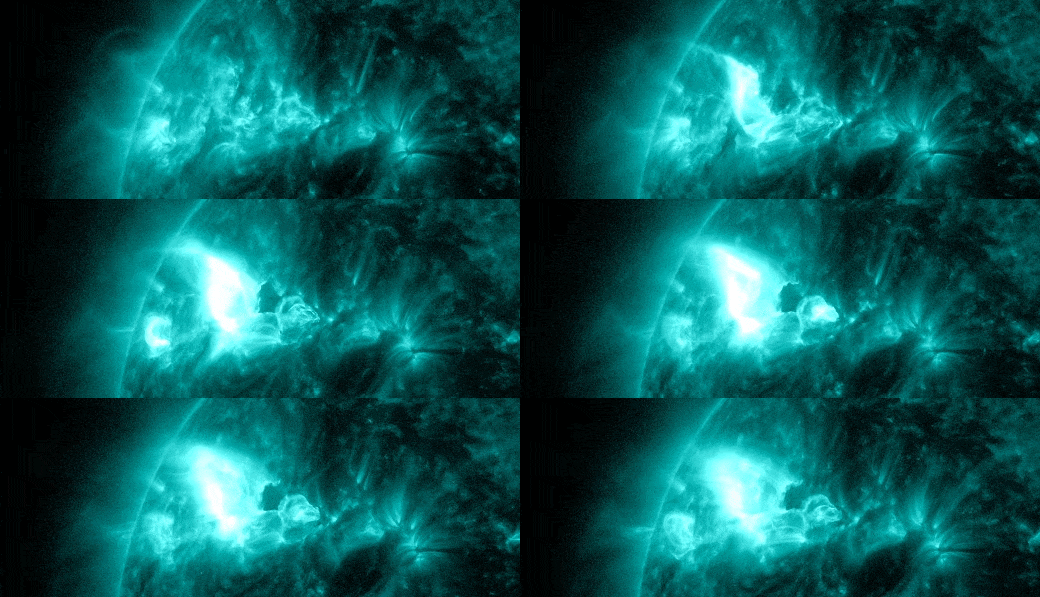
LONG-DURATION SOLAR FLARE: Growing sunspot AR3032 exploded on June 13th (0407 UT), producing an M3-class solar flare that lasted more than 3 hours. NASA's Solar Dynamics Observatory recorded the slow-motion blast.
https://www.spaceweather.com/images2022/13jun22/mflare_strip_opt.gif
Extreme ultraviolet radiation from the flare caused a shortwave radio blackout over Japan and southeast Asia, affecting frequencies below 30 MHz: blackout map. Also, the explosion probably hurled a CME into space. The US Air Force detected a Type II solar radio burst, which is usually caused by shock waves in the leading edge of a CME. Confirmation awaits fresh data from SOHO coronagraphs.
https://www.spaceweather.com/images2022/13jun22/mflare_strip_opt.gif
Extreme ultraviolet radiation from the flare caused a shortwave radio blackout over Japan and southeast Asia, affecting frequencies below 30 MHz: blackout map. Also, the explosion probably hurled a CME into space. The US Air Force detected a Type II solar radio burst, which is usually caused by shock waves in the leading edge of a CME. Confirmation awaits fresh data from SOHO coronagraphs.
❤3👍2
CHANCE OF STORMS THIS WEEK: A CME launched by yesterday's slow-motion solar flare (described below) is expected to pass near Earth on June 15th. Geomagnetic storms are possible if the CME makes contact. NOAA forecasters say minor G1-class storms are likely, with a chance for G2 (moderate) and a slight chance of G3 (strong) storms.