Space Weather Today
1.42K subscribers
1.39K photos
10 videos
1.8K links
Download Telegram
Current Auroral Oval:

Planetary K-index
Now: Kp= 2 quiet
24-hr max: Kp= 2 quiet
explanation | more data

Interplanetary Mag. Field
Btotal: 3.37 nT
Bz: -1.17 nT south
more data: ACE, DSCOVR
Updated: Today at 0822 UT
Coronal Holes: 06 Jun 22


There are no significant coronal holes on the Earthside of the sun. Credit: SDO/AIA
QUIET SUN: The sun is peppered with small sunspots. All of them have stable, quiet magnetic fields unlikely to explode. The chance of strong solar flares today is low.
👍3
Solar wind
speed: 323.2 km/sec
density: 10.86 protons/cm3
more data: ACE, DSCOVR
Updated: Today at 0911 UT

X-ray Solar Flares
6-hr max: B5 0329 UT Jun07
24-hr: B5 0329 UT Jun07
explanation | more data
Updated: Today at: 0915 UT
Daily Sun: 07 Jun 22

All of these sunspots are stable and quiet. The chance of flares today is low.Credit: SDO/HMI
Current Auroral Oval:

Planetary K-index
Now: Kp= 2 quiet
24-hr max: Kp= 3 quiet
explanation | more data

Interplanetary Mag. Field
Btotal: 6.71 nT
Bz: -4.75 nT south
more data: ACE, DSCOVR
Updated: Today at 0910 UT
Coronal Holes: 07 Jun 22


There are no significant coronal holes on the Earthside of the sun. Credit: SDO/AIA
THE SUN IS TAKING A BREAK: Following months of almost uninterrupted solar activity, the sun is taking a break. Today there are only a handful of small sunspots, and not one of them poses a threat for strong flares.
Solar wind
speed: 298.0 km/sec
density: 11.59 protons/cm3
more data: ACE, DSCOVR
Updated: Today at 0702 UT

X-ray Solar Flares
6-hr max: B3 0130 UT Jun08
24-hr: B6 2156 UT Jun07
explanation | more data
Updated: Today at: 0705 UT
Daily Sun: 08 Jun 22


The sun is on the verge of producing a spotless day--a remarkable development more than 2 years after the start of Solar Cycle 25. Credit: SDO/HMI
Current Auroral Oval:

Planetary K-index
Now: Kp= 1 quiet
24-hr max: Kp= 3 quiet
explanation | more data

Interplanetary Mag. Field
Btotal: 7.80 nT
Bz: -3.31 nT south
more data: ACE, DSCOVR
Updated: Today at 0701 UT
Coronal Holes: 08 Jun 22


There are no significant coronal holes on the Earthside of the sun. Credit: SDO/AIA
SUNSPOTS IN DECAY: With multiple sunspot groups in rapid decay, the sun is on the verge of producing a spotless day--a remarkable development more than 2 years after the start of Solar Cycle 25. The chance of strong solar flares today is close to zero.
Solar wind
speed: 521.9 km/sec
density: 9.68 protons/cm3
more data: ACE, DSCOVR
Updated: Today at 0247 UT

X-ray Solar Flares
6-hr max: C3 0849 UT Jun13
24-hr: M3 0407 UT Jun13
explanation | more data
Updated: Today at: 1450 UT
👍1
Daily Sun: 13 Jun 22


Sunspot group AR3032 (sandwiched between 3030 and 3033) poses an increasing threat for M-class solar flares. Credit: SDO/HMI
Current Auroral Oval:

Planetary K-index
Now: Kp= 2 quiet
24-hr max: Kp= 5 storm
explanation | more data

Interplanetary Mag. Field
Btotal: 10.00 nT
Bz: -2.99 nT south
more data: ACE, DSCOVR
Updated: Today at 0246 UT
Coronal Holes: 13 Jun 22


Solar wind flowing from the indicated coronal hole should reach Earth on June 16. Credit: SDO/AIA
RARE MORNING SKY SHOW: For the first time since Dec. 2004, five naked-eye planets have lined up at dawn in order of their distance from the sun. It's a rare morning sky show. Next week, the Moon will hop from planet to planet, producing a series of early morning conjunctions. Set your alarm for dawn and enjoy the show!

https://spaceweatherarchive.com/2022/06/12/rare-early-morning-sky-show/
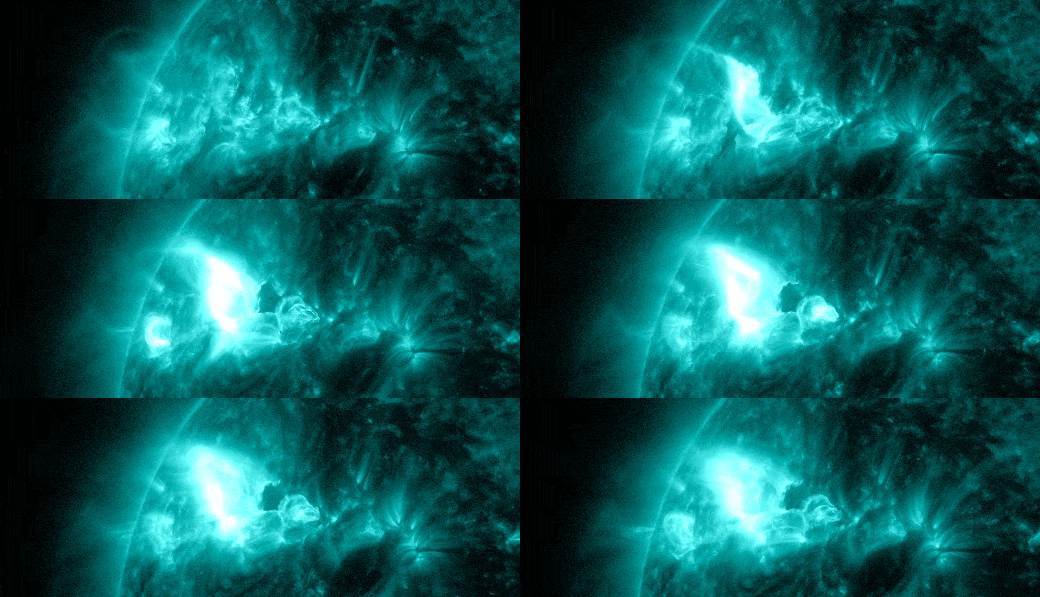
LONG-DURATION SOLAR FLARE: Growing sunspot AR3032 exploded on June 13th (0407 UT), producing an M3-class solar flare that lasted more than 3 hours. NASA's Solar Dynamics Observatory recorded the slow-motion blast.

https://www.spaceweather.com/images2022/13jun22/mflare_strip_opt.gif

Extreme ultraviolet radiation from the flare caused a shortwave radio blackout over Japan and southeast Asia, affecting frequencies below 30 MHz: blackout map. Also, the explosion probably hurled a CME into space. The US Air Force detected a Type II solar radio burst, which is usually caused by shock waves in the leading edge of a CME. Confirmation awaits fresh data from SOHO coronagraphs.
3👍2
Solar wind
speed: 476.6 km/sec
density: 6.81 protons/cm3
more data: ACE, DSCOVR
Updated: Today at 0816 UT

X-ray Solar Flares
6-hr max: C4 0540 UT Jun14
24-hr: C8 2124 UT Jun13
explanation | more data
Updated: Today at: 0820 UT
Daily Sun: 14 Jun 22


Sunspot group AR3032 (sandwiched between 3030 and 3033) has a 'beta-gamma' magnetic field that harbors energy for M-class solar flares. Credit: SDO/HMI