Space Weather Today
1.42K subscribers
1.39K photos
10 videos
1.8K links
Download Telegram
Daily Sun: 04 Jun 22


Sunspot AR3027 has a reversed magnetic polarity. Credit: SDO/HMI
Current Auroral Oval:

Planetary K-index
Now: Kp= 2 quiet
24-hr max: Kp= 2 quiet
explanation | more data

Interplanetary Mag. Field
Btotal: 3.73 nT
Bz: -1.04 nT south
more data: ACE, DSCOVR
Updated: Today at 1046 UT
Coronal Holes: 04 Jun 22


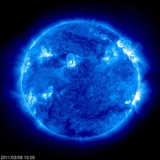
There are no significant coronal holes on the Earthside of the sun. Credit: SDO/AIA
SOLAR CYCLE 25 UPDATE: Once again, Solar Cycle 25 is exceeding predictions. Sunspot numbers in May 2022 more than doubled NOAA's forecast, setting the stage for a relatively strong Solar Maximum in early 2025.

Image credit: Helio4cast, a group of scientists based in Austria working on basic and applied space weather research.

The plot, above, compares actual sunspot numbers to a selection of benchmarks. The blue curve is the "official forecast" issued by NOAA's Solar Cycle Prediction Panel in 2019. Sunspot counts are tracing a curve significantly higher than that.

The green curve is the average of all solar cycles since 1750, and the red curve is a new prediction based on the Termination Event. Current sunspot counts match both. Even if Solar Cycle 25 turns out to be merely average, it will still far exceed previously low expectations.

Source: https://www.spaceweather.com/
Solar wind
speed: 288.6 km/sec
density: 10.53 protons/cm3
more data: ACE, DSCOVR
Updated: Today at 0422 UT

X-ray Solar Flares
6-hr max: C1 1225 UT Jun05
24-hr: C1 1225 UT Jun05
explanation | more data
Updated: Today at: 1625 UT
Daily Sun: 05 Jun 22


New sunspots AR3028 and AR3029 have stable magnetic fields that pose no threat for strong solar flares. Credit: SDO/HMI
Current Auroral Oval:

Planetary K-index
Now: Kp= 1 quiet
24-hr max: Kp= 1 quiet
explanation | more data

Interplanetary Mag. Field
Btotal: 6.43 nT
Bz: -0.72 nT south
more data: ACE, DSCOVR
Updated: Today at 0422 UT
Coronal Holes: 05 Jun 22


There are no significant coronal holes on the Earthside of the sun. Credit: SDO/AIA
CME NEAR-MISS POSSIBLE ON JUNE 5TH: A minor coronal mass ejection (CME) that left the sun on June 1st will pass close to Earth on June 5th, according to NOAA analysts. It might come close enough for a glancing blow. High latitude sky watchers should be alert for auroras when the CME arrives this weekend.
👍3
Solar wind
speed: 262.9 km/sec
density: 13.91 protons/cm3
more data: ACE, DSCOVR
Updated: Today at 0821 UT

X-ray Solar Flares
6-hr max: B2 0621 UT Jun06
24-hr: C1 1225 UT Jun05
explanation | more data
Updated: Today at: 0825 UT
Daily Sun: 06 Jun 22


All of these sunspots are stable and quiet. The chance of flares today is low.Credit: SDO/HMI
Current Auroral Oval:

Planetary K-index
Now: Kp= 2 quiet
24-hr max: Kp= 2 quiet
explanation | more data

Interplanetary Mag. Field
Btotal: 3.37 nT
Bz: -1.17 nT south
more data: ACE, DSCOVR
Updated: Today at 0822 UT
Coronal Holes: 06 Jun 22


There are no significant coronal holes on the Earthside of the sun. Credit: SDO/AIA
QUIET SUN: The sun is peppered with small sunspots. All of them have stable, quiet magnetic fields unlikely to explode. The chance of strong solar flares today is low.
👍3
Solar wind
speed: 323.2 km/sec
density: 10.86 protons/cm3
more data: ACE, DSCOVR
Updated: Today at 0911 UT

X-ray Solar Flares
6-hr max: B5 0329 UT Jun07
24-hr: B5 0329 UT Jun07
explanation | more data
Updated: Today at: 0915 UT
Daily Sun: 07 Jun 22

All of these sunspots are stable and quiet. The chance of flares today is low.Credit: SDO/HMI
Current Auroral Oval:

Planetary K-index
Now: Kp= 2 quiet
24-hr max: Kp= 3 quiet
explanation | more data

Interplanetary Mag. Field
Btotal: 6.71 nT
Bz: -4.75 nT south
more data: ACE, DSCOVR
Updated: Today at 0910 UT
Coronal Holes: 07 Jun 22


There are no significant coronal holes on the Earthside of the sun. Credit: SDO/AIA
THE SUN IS TAKING A BREAK: Following months of almost uninterrupted solar activity, the sun is taking a break. Today there are only a handful of small sunspots, and not one of them poses a threat for strong flares.
Solar wind
speed: 298.0 km/sec
density: 11.59 protons/cm3
more data: ACE, DSCOVR
Updated: Today at 0702 UT

X-ray Solar Flares
6-hr max: B3 0130 UT Jun08
24-hr: B6 2156 UT Jun07
explanation | more data
Updated: Today at: 0705 UT