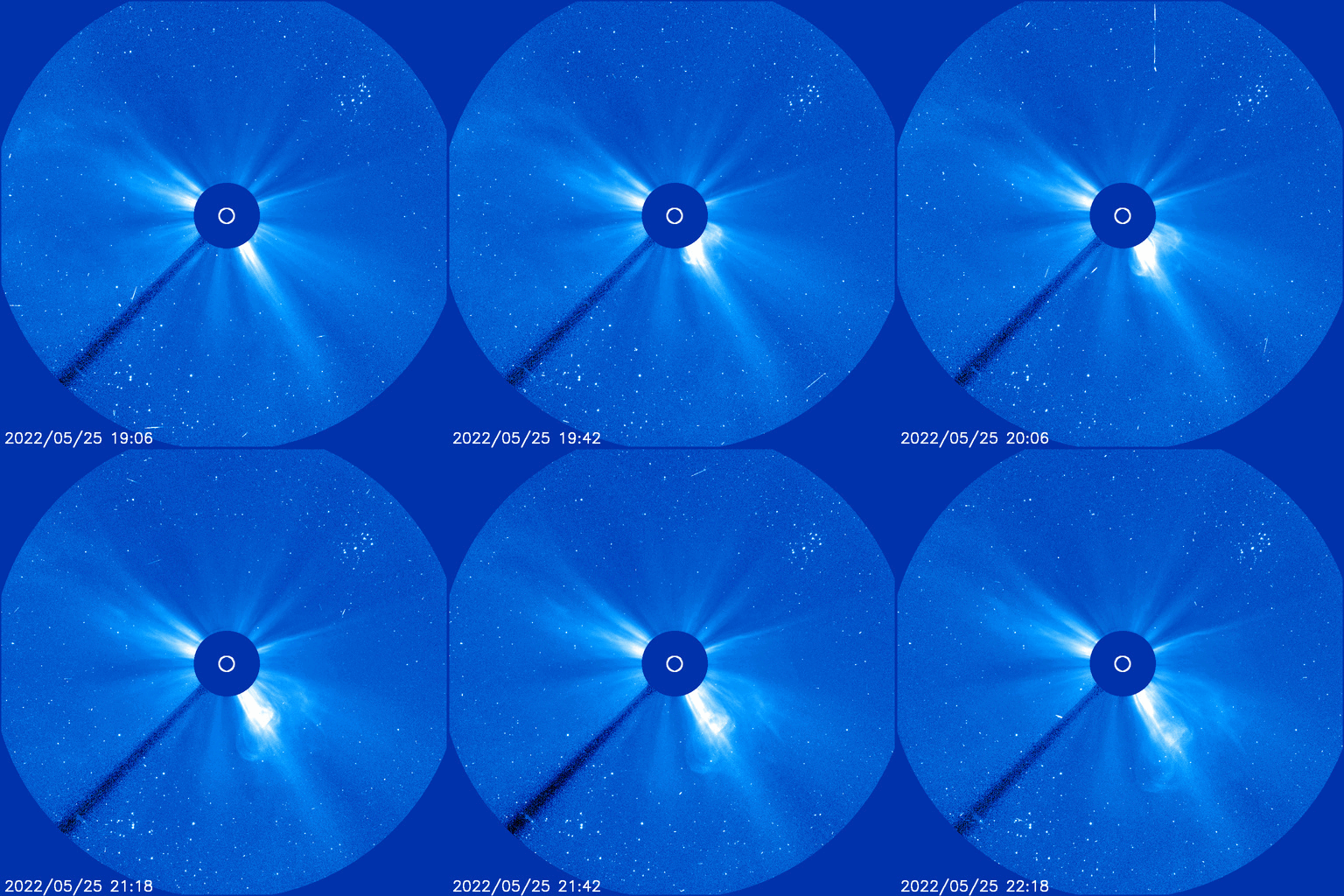
GEOMAGNETIC STORM WATCH: Minor G1-class geomagnetic storms are possible on May 28th when a CME is expected to sideswipe Earth's magnetic field. The solar storm cloud was hurled into space by an unstable magnetic filament, which erupted on May 25th. High-latitude auroras are possible this weekend. https://www.spaceweather.com/images2022/25may22/m1_cme.gif
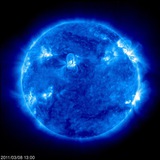
GEOMAGNETIC STORM WATCH: Minor G1-class geomagnetic storms are underway this weekend as Earth moves through a stream of high-speed (> 500 km/s) solar wind. The gaseous material is flowing from a hole in the sun's atmosphere. Storminess could increase later today, May 28th, when a CME is expected to sideswipe Earth's magnetic field.
LUNAR OCCULTATION OF VENUS: For almost 5 hours yesterday, the planet Venus disappeared. It was hiding behind the Moon. Quentin Gineys photographed the lunar occultation from Réunion Island in the Indian Ocean.
"To observe the occultation, I used an 11-inch Celestron telescope," says Gineys. "The phenomenon was very low, only 10 degrees above the horizon. I had to prepare my shooting location well, between roofs, a relay antenna and many palm trees."
"To observe the occultation, I used an 11-inch Celestron telescope," says Gineys. "The phenomenon was very low, only 10 degrees above the horizon. I had to prepare my shooting location well, between roofs, a relay antenna and many palm trees."
A METEOR OUTBURST MIGHT HAPPEN TONIGHT: Yes, debris from Comet 73P/Schwassmann-Wachmann 3 might actually be approaching Earth. Last Friday, a camera operated by the Spanish Meteor and Fireball Network caught a piece of the broken comet disintegrating over Europe. The fireball they saw could herald a larger cloud of debris following close behind. If it exists, the approaching cloud could cause a meteor outburst over North America on the night of May 30-31. That's tonight! Probably nothing will happen, but for enthusiasts it's worth a look.
https://twitter.com/i/status/1530619943322017794
https://twitter.com/i/status/1530619943322017794
Twitter
Red de Investigación Bólidos y Meteoritos (SPMN)
¡PRIMER BÓLIDO TAU HERCÚLIDA #SPMN270522H! Registrado ayer viernes sobre #Aragón por Antonio Lasala @AntonioLG1 a las 23h57m46s TUC. Ojalá sea el anuncio de muchos más fragmentos del cometa #73P #SW3 en las próximas noches. ¿Preparados para la campaña? 🤩…
EXPLODING COMET DEBRIS: Have you ever seen a piece of a comet explode? Francis Murphy did on Monday night in Thorndale, Pennsylvania:
https://spaceweathergallery.com/submissions/pics/f/Francis-Murphy-May_31st_2022_Meteor_Chart_1654037263.gif
The tau Herculid meteor shower was underway as debris from Comet 73P/Schwassmann-Wachmann 3 peppered the top of Earth's atmosphere. This piece of the broken comet disintegrated 90 km above above the ground, spreading its remains across the edge of space.
"The meteor's trail twisted and turned in high altitude winds," says Murphy. "It was the brightest of 10 to 15 tau Herculids we saw during a 3-hour observing session."
In Mormon Lake, Arizona, astronomer David Blanchard saw the same thing--twice. This video shows two tau Herculids disintegrating in a star field with satellites and airplanes whizzing by.
https://spaceweathergallery.com/submissions/pics/f/Francis-Murphy-May_31st_2022_Meteor_Chart_1654037263.gif
The tau Herculid meteor shower was underway as debris from Comet 73P/Schwassmann-Wachmann 3 peppered the top of Earth's atmosphere. This piece of the broken comet disintegrated 90 km above above the ground, spreading its remains across the edge of space.
"The meteor's trail twisted and turned in high altitude winds," says Murphy. "It was the brightest of 10 to 15 tau Herculids we saw during a 3-hour observing session."
In Mormon Lake, Arizona, astronomer David Blanchard saw the same thing--twice. This video shows two tau Herculids disintegrating in a star field with satellites and airplanes whizzing by.

👍1