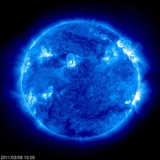
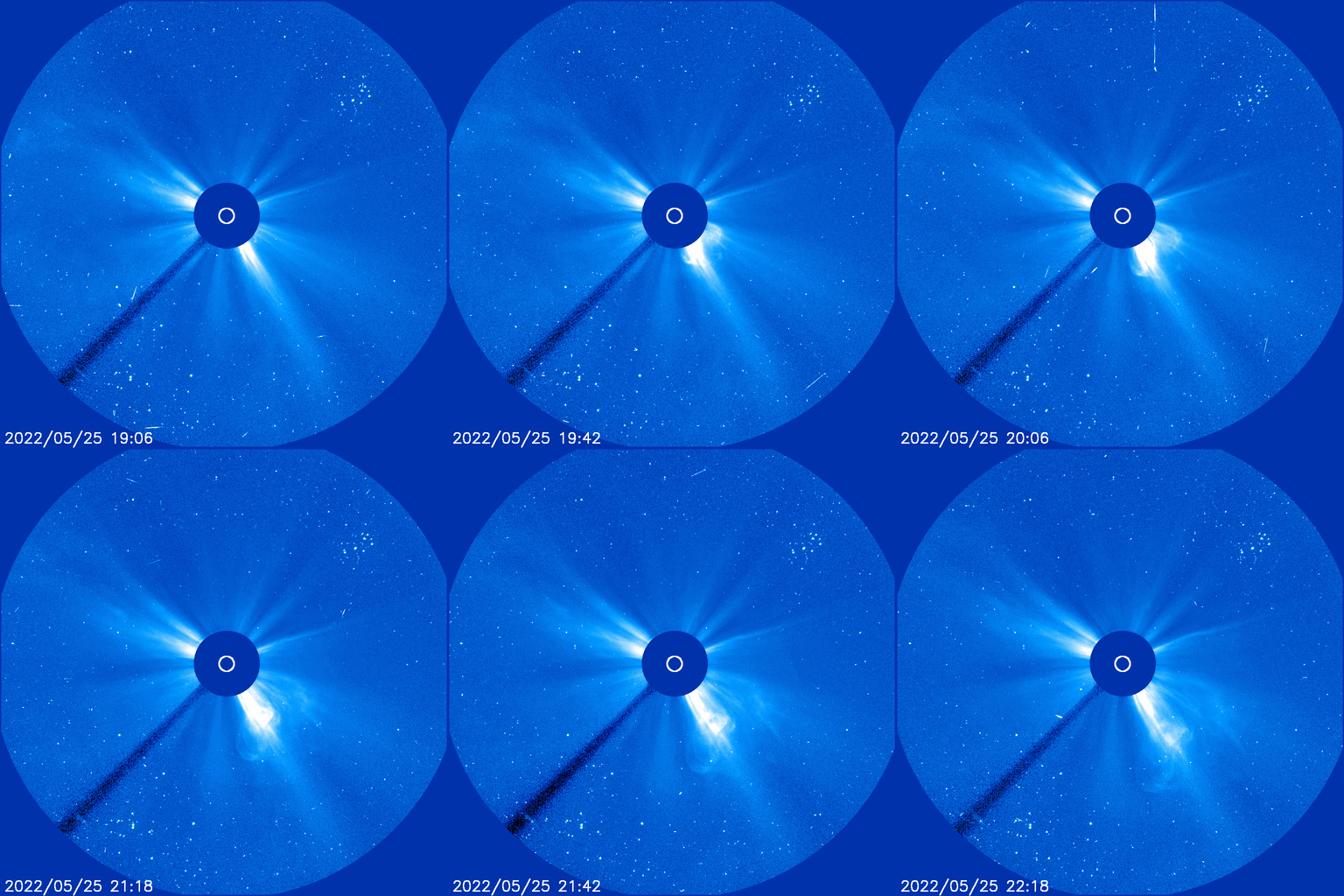
GEOMAGNETIC STORM WATCH: Minor G1-class geomagnetic storms are possible on May 28th when a CME is expected to sideswipe Earth's magnetic field. The solar storm cloud was hurled into space by an unstable magnetic filament, which erupted on May 25th. High-latitude auroras are possible this weekend. https://www.spaceweather.com/images2022/25may22/m1_cme.gif
GEOMAGNETIC STORM WATCH: Minor G1-class geomagnetic storms are underway this weekend as Earth moves through a stream of high-speed (> 500 km/s) solar wind. The gaseous material is flowing from a hole in the sun's atmosphere. Storminess could increase later today, May 28th, when a CME is expected to sideswipe Earth's magnetic field.
LUNAR OCCULTATION OF VENUS: For almost 5 hours yesterday, the planet Venus disappeared. It was hiding behind the Moon. Quentin Gineys photographed the lunar occultation from Réunion Island in the Indian Ocean.
"To observe the occultation, I used an 11-inch Celestron telescope," says Gineys. "The phenomenon was very low, only 10 degrees above the horizon. I had to prepare my shooting location well, between roofs, a relay antenna and many palm trees."
"To observe the occultation, I used an 11-inch Celestron telescope," says Gineys. "The phenomenon was very low, only 10 degrees above the horizon. I had to prepare my shooting location well, between roofs, a relay antenna and many palm trees."
A METEOR OUTBURST MIGHT HAPPEN TONIGHT: Yes, debris from Comet 73P/Schwassmann-Wachmann 3 might actually be approaching Earth. Last Friday, a camera operated by the Spanish Meteor and Fireball Network caught a piece of the broken comet disintegrating over Europe. The fireball they saw could herald a larger cloud of debris following close behind. If it exists, the approaching cloud could cause a meteor outburst over North America on the night of May 30-31. That's tonight! Probably nothing will happen, but for enthusiasts it's worth a look.
https://twitter.com/i/status/1530619943322017794
https://twitter.com/i/status/1530619943322017794
Twitter
Red de Investigación Bólidos y Meteoritos (SPMN)
¡PRIMER BÓLIDO TAU HERCÚLIDA #SPMN270522H! Registrado ayer viernes sobre #Aragón por Antonio Lasala @AntonioLG1 a las 23h57m46s TUC. Ojalá sea el anuncio de muchos más fragmentos del cometa #73P #SW3 en las próximas noches. ¿Preparados para la campaña? 🤩…