INCREASING CHANCE OF FLARES: Big sunspot AR3014 has an unstable 'beta-gamma-delta' magnetic field that harbors energy for strong explosions. NOAA forecasters estimate a 35% chance of M-class solar flares and a 15% chance of X-flares on May 19th. Any eruptions will be geoeffective because the sunspot is directly facing Earth.
OLD VENUS PROBE TO CRASH INTO EARTH: In March 1972, Russia launched a spacecraft to Venus. The Venera probe (since renamed "Kosmos 482") never made it out of Earth orbit. A new analysis by Dr. Marco Langbroek suggests that orbital decay is bringing the old probe back to Earth. "This is a lander built to withstand atmospheric reentry [on Venus]," notes Langbroek, so it "will make for an interesting reentry sometime between 2024 and 2026."
Read: https://www.thespacereview.com/article/4384/1
Read: https://www.thespacereview.com/article/4384/1
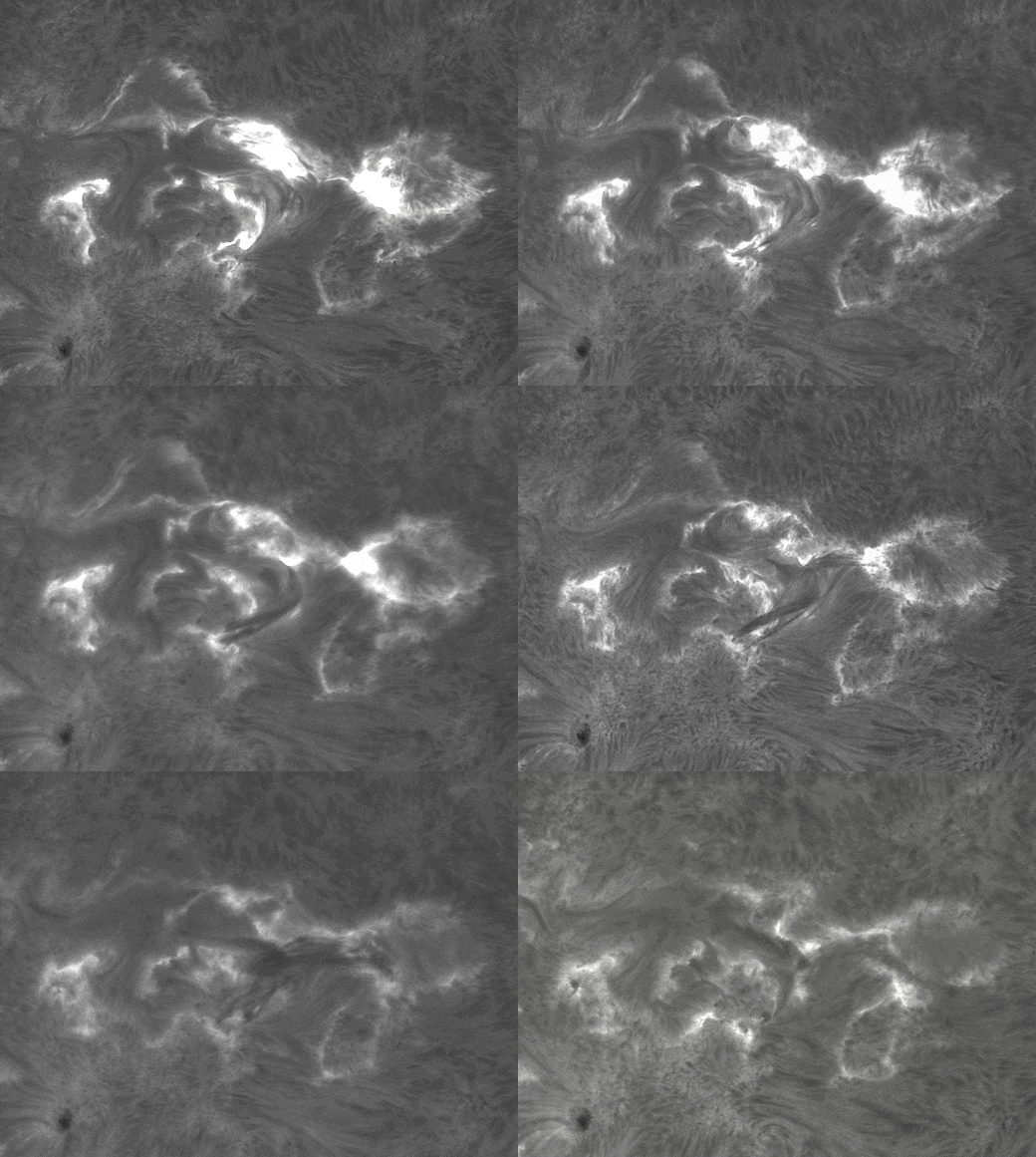
ACTIVE SUNSPOT: A storm is swirling around sunspot AR3014. This morning in Romania, astronomer Maximilian Teodorescu made a 45 minute movie of the sun's atmosphere above the huge sunspot. It is literally seething.
https://www.spaceweather.com/images2022/19may22/seething_strip_opt.gif
"I caught a pretty big M-class solar flare," says Teodorescu. In addition, dark filaments of magnetism can be seen snaking through the region as lesser flares illuminate the interstices. The tumult overlies of the biggest sunspots of Solar Cycle 25 with an unstable 'beta-gamma-delta' magnetic field that harbors energy for powerful X-flares.
https://www.spaceweather.com/images2022/19may22/seething_strip_opt.gif
"I caught a pretty big M-class solar flare," says Teodorescu. In addition, dark filaments of magnetism can be seen snaking through the region as lesser flares illuminate the interstices. The tumult overlies of the biggest sunspots of Solar Cycle 25 with an unstable 'beta-gamma-delta' magnetic field that harbors energy for powerful X-flares.
STARLINER REACHES THE ISS: Boeing's Starliner spacecraft has finally reached the International Space Station (ISS). Szabolcs Nagy of London, England, photographed the capsule just before docking on Friday, May 20th.https://spaceweathergallery.com/submissions/pics/s/Szabolcs-Nagy-For-Space-dot-com_1653121227_lg.gif
"Boeing's Starliner was only 200 meters from the ISS," says Nagy, who manually tracked the pair using a 10-inch dobsonian telescope. "Seeing them so close together was an incredible experience. Just wow!!"
"Boeing's Starliner was only 200 meters from the ISS," says Nagy, who manually tracked the pair using a 10-inch dobsonian telescope. "Seeing them so close together was an incredible experience. Just wow!!"

CALM BEFORE THE STORM? The sun has been quiet for two days. Could it be the calm before the storm? Big sunspot AR3014 has an unstable 'beta-gamma-delta' magnetic field that harbors energy for strong explosions. NOAA forecasters estimate a 40% chance of M-class flares and a 5% chance of X-flares on May 23rd.
DID A COLD INTERSTELLAR CLOUD HIT THE SOLAR SYSTEM? A new research paper by Merav Opher (Boston University) and Abraham Loeb (Harvard University) suggests that a cold interstellar cloud of gas hit the Solar System two million years ago. The impact compressed the heliosphere, making it much smaller than Earth's orbit. Our planet was completely exposed to interstellar space and a blizzard of galactic cosmic rays. If this really happened, it would have altered space weather, terrestrial climate, and possibly even human evolution.
Read more: https://arxiv.org/abs/2202.01813v2
Read more: https://arxiv.org/abs/2202.01813v2