Space Weather Today
1.42K subscribers
1.39K photos
10 videos
1.8K links
Download Telegram
Current Auroral Oval:

Planetary K-index
Now: Kp= 3 quiet
24-hr max: Kp= 3 quiet
explanation | more data

Interplanetary Mag. Field
Btotal: 9.86 nT
Bz: -1.16 nT south
more data: ACE, DSCOVR
Updated: Today at 0706 UT
Coronal Holes: 17 May 22


Solar wind flowing from this coronal hole should reach Earth on May 20-21. Credit: SDO/AIA
FARSIDE SUNSPOTS: Today, there are 8 sunspot groups on the solar disk--the most in years. Get ready for two more. NASA's STEREO-A spacecraft is monitoring a pair of extreme ultraviolet hotspots behind the sun's eastern limb. It is probably the glow of two more sunspot groups. The active regions will rotate into view by mid-week.
Solar wind
speed: 493.7 km/sec
density: 7.29 protons/cm3
more data: ACE, DSCOVR
Updated: Today at 0132 UT

X-ray Solar Flares
6-hr max: C2 0823 UT May18
24-hr: C4 1626 UT May17
explanation | more data
Updated: Today at: 1335 UT
Daily Sun: 18 May 22


Sunspot AR3014 has a 'beta-gamma' magnetic field that poses a threat for strong M-class solar flares. Credit: SDO/HMI
Current Auroral Oval:

Planetary K-index
Now: Kp= 2 quiet
24-hr max: Kp= 3 quiet
explanation | more data

Interplanetary Mag. Field
Btotal: 5.74 nT
Bz: -1.03 nT south
more data: ACE, DSCOVR
Updated: Today at 0132 UT
Coronal Holes: 18 May 22


Solar wind flowing from this coronal hole should reach Earth on May 20-21. Credit: SDO/AIA
👍2
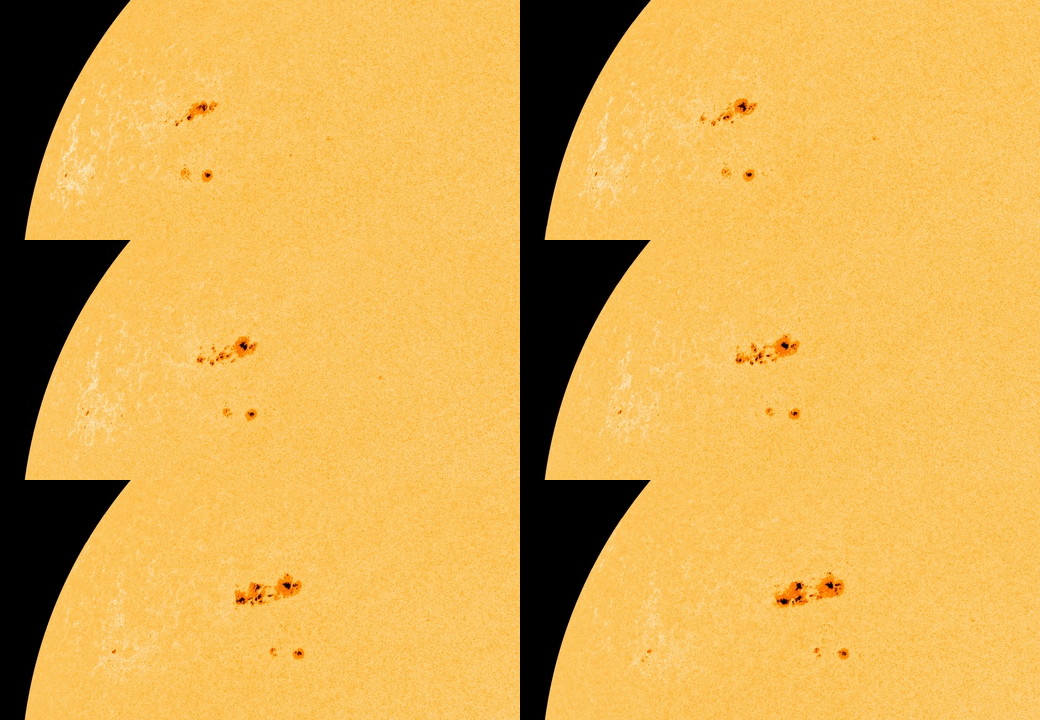
DOUBLE TROUBLE: Since yesterday, big sunspot AR3014 has doubled in size. This 24-hour movie from NASA's Solar Dynamics Observatory shows the sunspot's rapid growth. AR3014 has a 'beta-gamma' magnetic field that harbors energy for strong M-class solar flares. https://www.spaceweather.com/images2022/18may22/double_anim_strip.gif
👍1
TOTAL ECLIPSE OF THE MOON: There's something magic about the darkness that falls during a lunar eclipse. The nightscape should be flooded with moonlight. Instead, the stars pop out. On May 15th, Brad Goldpaint photographed the phenomenon from Farmington, New Mexico.

Source: https://spaceweathergallery.com/indiv_upload.php?upload_id=184898
👍1
Solar wind
speed: 551.3 km/sec
density: 1.80 protons/cm3
more data: ACE, DSCOVR
Updated: Today at 1122 UT

X-ray Solar Flares
6-hr max: M5 0719 UT May19
24-hr: M5 0719 UT May19
explanation | more data
Updated: Today at: 1125 UT
Daily Sun: 19 May 22


Sunspot AR3014 has a 'beta-gamma-delta' magnetic field that poses a threat for X-class solar flares. Credit: SDO/HMI
Current Auroral Oval:

Planetary K-index
Now: Kp= 3 quiet
24-hr max: Kp= 3 quiet
explanation | more data

Interplanetary Mag. Field
Btotal: 4.62 nT
Bz: 4.45 nT north
more data: ACE, DSCOVR
Updated: Today at 1122 UT
Coronal Holes: 19 May 22


Solar wind flowing from this coronal hole should reach Earth on May 21st. Credit: SDO/AIA
INCREASING CHANCE OF FLARES: Big sunspot AR3014 has an unstable 'beta-gamma-delta' magnetic field that harbors energy for strong explosions. NOAA forecasters estimate a 35% chance of M-class solar flares and a 15% chance of X-flares on May 19th. Any eruptions will be geoeffective because the sunspot is directly facing Earth.
Solar wind
speed: 540.4 km/sec
density: 9.96 protons/cm3
more data: ACE, DSCOVR
Updated: Today at 0635 UT

X-ray Solar Flares
6-hr max: C1 0043 UT May20
24-hr: M5 0719 UT May19
explanation | more data
Updated: Today at: 0640 UT
Daily Sun: 20 May 22

Sunspot AR3014 has a 'beta-gamma-delta' magnetic field that poses a threat for X-class solar flares. Credit: SDO/HMI
Current Auroral Oval:

Planetary K-index
Now: Kp= 3 quiet
24-hr max: Kp= 3 quiet
explanation | more data

Interplanetary Mag. Field
Btotal: 5.44 nT
Bz: 0.67 nT north
more data: ACE, DSCOVR
Updated: Today at 0635 UT
Coronal Holes: 20 May 22


Earth is entering a stream of solar wind flowing from the indicated coronal hole. Credit: SDO/AIA
OLD VENUS PROBE TO CRASH INTO EARTH: In March 1972, Russia launched a spacecraft to Venus. The Venera probe (since renamed "Kosmos 482") never made it out of Earth orbit. A new analysis by Dr. Marco Langbroek suggests that orbital decay is bringing the old probe back to Earth. "This is a lander built to withstand atmospheric reentry [on Venus]," notes Langbroek, so it "will make for an interesting reentry sometime between 2024 and 2026."

Read: https://www.thespacereview.com/article/4384/1