SLIGHT CHANCE OF STORMS TODAY: One of the many CMEs that appeared set to miss Earth this week might hit after all. NOAA analysts say that a glancing blow is possible today, potentially turning Friday the 13th into a lucky day for high-latitude aurora watchers. Minor G1-class geomagnetic storms are possible if the CME grazes Earth's magnetic field.
TOTAL ECLIPSE OF THE MOON: Last night, the full Moon passed through the shadow of Earth, producing a total lunar eclipse. Kevin R. Witman photographed totality from Cochranville, Pennsylvania.
Source: https://spaceweathergallery.com/indiv_upload.php?upload_id=184788
https://t.me/SpaceWeatherToday
#eclipse
Source: https://spaceweathergallery.com/indiv_upload.php?upload_id=184788
https://t.me/SpaceWeatherToday
#eclipse
FARSIDE SUNSPOTS: Today, there are 8 sunspot groups on the solar disk--the most in years. Get ready for two more. NASA's STEREO-A spacecraft is monitoring a pair of extreme ultraviolet hotspots behind the sun's eastern limb. It is probably the glow of two more sunspot groups. The active regions will rotate into view by mid-week.
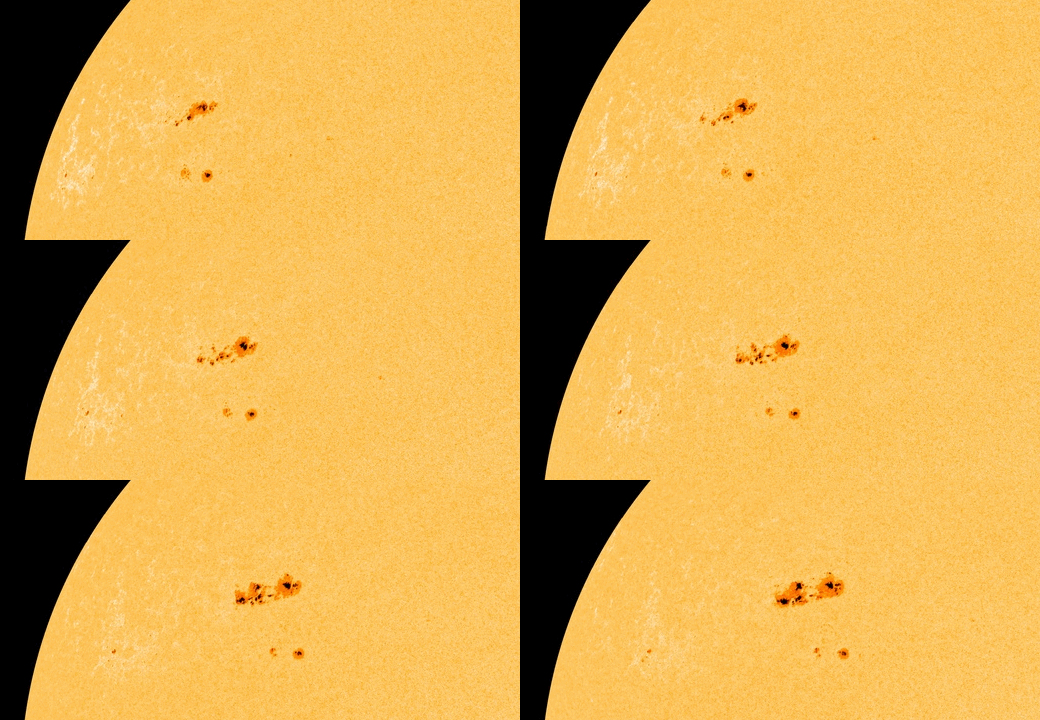
DOUBLE TROUBLE: Since yesterday, big sunspot AR3014 has doubled in size. This 24-hour movie from NASA's Solar Dynamics Observatory shows the sunspot's rapid growth. AR3014 has a 'beta-gamma' magnetic field that harbors energy for strong M-class solar flares. https://www.spaceweather.com/images2022/18may22/double_anim_strip.gif
👍1
TOTAL ECLIPSE OF THE MOON: There's something magic about the darkness that falls during a lunar eclipse. The nightscape should be flooded with moonlight. Instead, the stars pop out. On May 15th, Brad Goldpaint photographed the phenomenon from Farmington, New Mexico.
Source: https://spaceweathergallery.com/indiv_upload.php?upload_id=184898
Source: https://spaceweathergallery.com/indiv_upload.php?upload_id=184898
👍1