☄️THE LYRID METEOR SHOWER: Earth is entering a stream of debris from Comet Thatcher (C/1861 G1), source of the annual Lyrid meteor shower. Peak night is April 22nd.
Now for the bad news: Bright moonlight will interfere with the display, sharply reducing visible meteor rates to no more than 5 to 10 per hour.
2022 is not a good year for the Lyrids.
https://www.meteorshowers.org/view/Lyrids
Now for the bad news: Bright moonlight will interfere with the display, sharply reducing visible meteor rates to no more than 5 to 10 per hour.
2022 is not a good year for the Lyrids.
https://www.meteorshowers.org/view/Lyrids
www.meteorshowers.org
Lyrids meteor shower from space
Watch as Earth flies through clouds of meteors from the Lyrids meteor shower.
MORNING PLANETS: This is a great week to wake up early and look at the planets. They're all lined up. This morning, Jeff Dai photographed the pre-dawn scene from the Yunnan province of China.
"The display shocked me--it was so beautiful!" says Dai. "I watched as Saturn, Mars, Venus and Jupiter rose one by one in the eastern sky. The dawn was so serene. I could see all of these celestial wonders reflected in the peaceful waters of Lake Nian."
The view is about to improve. Venus and Jupiter are converging for a tight conjunction on April 30th and May 1st. They'll be so close together, some onlookers may think the planets have merged. On April 26th and 27th, the crescent Moon will glide by the converging pair. Set your alarm for dawn and enjoy the show.
"The display shocked me--it was so beautiful!" says Dai. "I watched as Saturn, Mars, Venus and Jupiter rose one by one in the eastern sky. The dawn was so serene. I could see all of these celestial wonders reflected in the peaceful waters of Lake Nian."
The view is about to improve. Venus and Jupiter are converging for a tight conjunction on April 30th and May 1st. They'll be so close together, some onlookers may think the planets have merged. On April 26th and 27th, the crescent Moon will glide by the converging pair. Set your alarm for dawn and enjoy the show.
👍2❤1
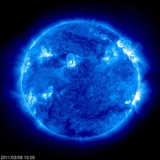
DOUBLE SOLAR FLARE: Sunspot AR2993 erupted twice in quick succession on April 25th, producing an overlapping pair of M1-class solar flares: movie.
The double-blast caused a minor albeit long-lasting radio blackout over southeast Asia and Australia, affecting frequencies below 20 MHz. Stay tuned for updates about a possible CME.
The double-blast caused a minor albeit long-lasting radio blackout over southeast Asia and Australia, affecting frequencies below 20 MHz. Stay tuned for updates about a possible CME.